



Question: The question is which scenario is best? after doing the calculations below You should calculate: $ $ $ $ Assumptions Investment Rate of Return Desired
The question is which scenario is best? after doing the calculations below "You should calculate:"
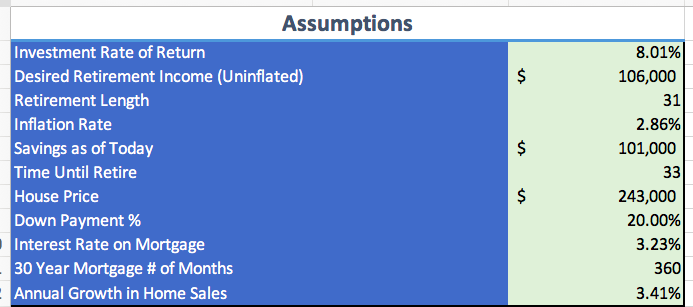
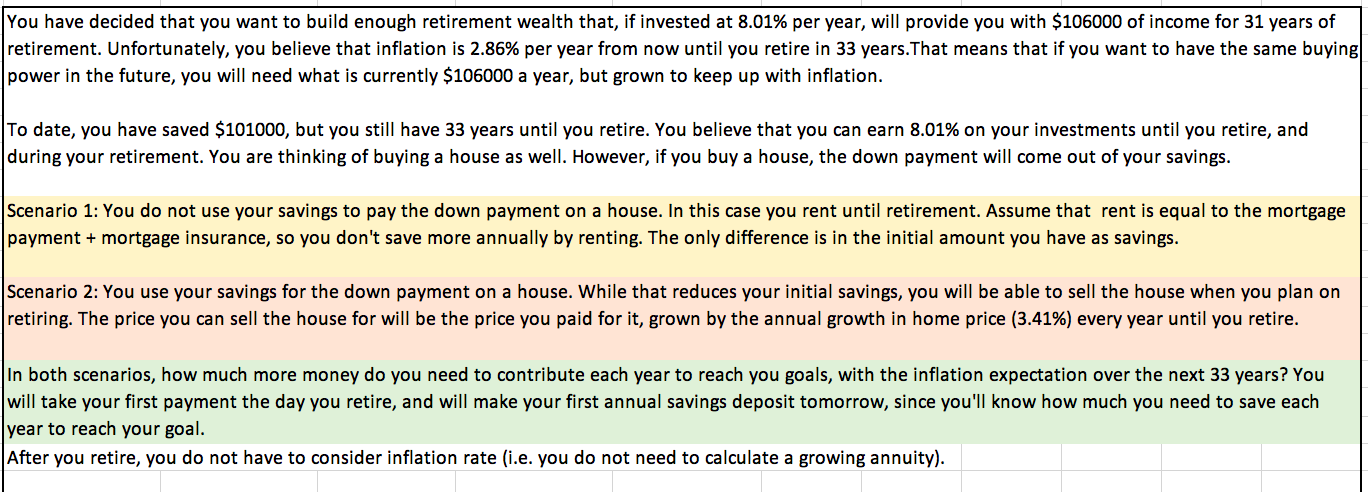
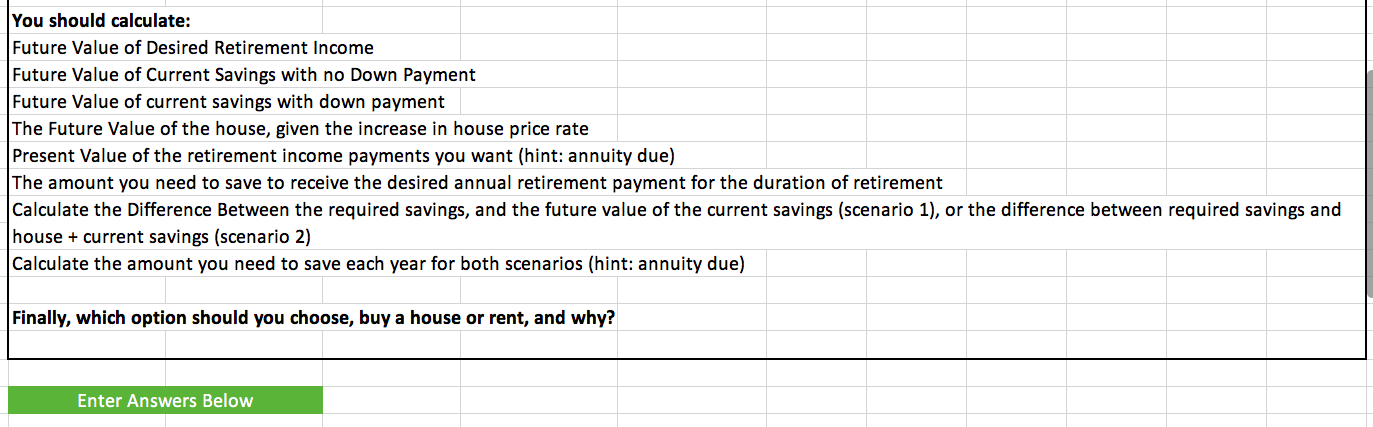
$ $ $ $ Assumptions Investment Rate of Return Desired Retirement Income (Uninflated) Retirement Length Inflation Rate Savings as of Today Time Until Retire House Price Down Payment % Interest Rate on Mortgage 30 Year Mortgage # of Months - Annual Growth in Home Sales 8.01% 106,000 31 2.86% 101,000 33 243,000 20.00% 3.23% 360 3.41% $ $ You have decided that you want to build enough retirement wealth that, if invested at 8.01% per year, will provide you with $106000 of income for 31 years of retirement. Unfortunately, you believe that inflation is 2.86% per year from now until you retire in 33 years. That means that if you want to have the same buying power in the future, you will need what is currently $106000 a year, but grown to keep up with inflation. To date, you have saved $101000, but you still have 33 years until you retire. You believe that you can earn 8.01% on your investments until you retire, and during your retirement. You are thinking of buying a house as well. However, if you buy a house, the down payment will come out of your savings. Scenario 1: You do not use your savings to pay the down payment on a house. In this case you rent until retirement. Assume that rent is equal to the mortgage payment + mortgage insurance, so you don't save more annually by renting. The only difference is in the initial amount you have as savings. Scenario 2: You use your savings for the down payment on a house. While that reduces your initial savings, you will be able to sell the house when you plan on retiring. The price you can sell the house for will be the price you paid for it, grown by the annual growth in home price (3.41%) every year until you retire. In both scenarios, how much more money do you need to contribute each year to reach you goals, with the inflation expectation over the next 33 years? You will take your first payment the day you retire, and will make your first annual savings deposit tomorrow, since you'll know how much you need to save each year to reach your goal. After you retire, you do not have to consider inflation rate (i.e. you do not need to calculate a growing annuity). You should calculate: Future Value of Desired Retirement Income Future Value of Current Savings with no Down Payment Future Value of current savings with down payment The Future Value of the house, given the increase in house price rate Present Value of the retirement income payments you want (hint: annuity due) The amount you need to save to receive the desired annual retirement payment for the duration of retirement Calculate the Difference Between the required savings, and the future value of the current savings (scenario 1), or the difference between required savings and house + current savings (scenario 2) Calculate the amount you need to save each year for both scenarios (hint: annuity due) Finally, which option should you choose, buy a house or rent, and why? Enter Answers Below $ $ $ $ Assumptions Investment Rate of Return Desired Retirement Income (Uninflated) Retirement Length Inflation Rate Savings as of Today Time Until Retire House Price Down Payment % Interest Rate on Mortgage 30 Year Mortgage # of Months - Annual Growth in Home Sales 8.01% 106,000 31 2.86% 101,000 33 243,000 20.00% 3.23% 360 3.41% $ $ You have decided that you want to build enough retirement wealth that, if invested at 8.01% per year, will provide you with $106000 of income for 31 years of retirement. Unfortunately, you believe that inflation is 2.86% per year from now until you retire in 33 years. That means that if you want to have the same buying power in the future, you will need what is currently $106000 a year, but grown to keep up with inflation. To date, you have saved $101000, but you still have 33 years until you retire. You believe that you can earn 8.01% on your investments until you retire, and during your retirement. You are thinking of buying a house as well. However, if you buy a house, the down payment will come out of your savings. Scenario 1: You do not use your savings to pay the down payment on a house. In this case you rent until retirement. Assume that rent is equal to the mortgage payment + mortgage insurance, so you don't save more annually by renting. The only difference is in the initial amount you have as savings. Scenario 2: You use your savings for the down payment on a house. While that reduces your initial savings, you will be able to sell the house when you plan on retiring. The price you can sell the house for will be the price you paid for it, grown by the annual growth in home price (3.41%) every year until you retire. In both scenarios, how much more money do you need to contribute each year to reach you goals, with the inflation expectation over the next 33 years? You will take your first payment the day you retire, and will make your first annual savings deposit tomorrow, since you'll know how much you need to save each year to reach your goal. After you retire, you do not have to consider inflation rate (i.e. you do not need to calculate a growing annuity). You should calculate: Future Value of Desired Retirement Income Future Value of Current Savings with no Down Payment Future Value of current savings with down payment The Future Value of the house, given the increase in house price rate Present Value of the retirement income payments you want (hint: annuity due) The amount you need to save to receive the desired annual retirement payment for the duration of retirement Calculate the Difference Between the required savings, and the future value of the current savings (scenario 1), or the difference between required savings and house + current savings (scenario 2) Calculate the amount you need to save each year for both scenarios (hint: annuity due) Finally, which option should you choose, buy a house or rent, and why? Enter Answers Below
Step by Step Solution
There are 3 Steps involved in it

Get step-by-step solutions from verified subject matter experts