







Question: The quiz answer to the question is given below. How did they get this form? 4. For the system below, generate the state-space representation using
The quiz answer to the question is given below. How did they get this form?
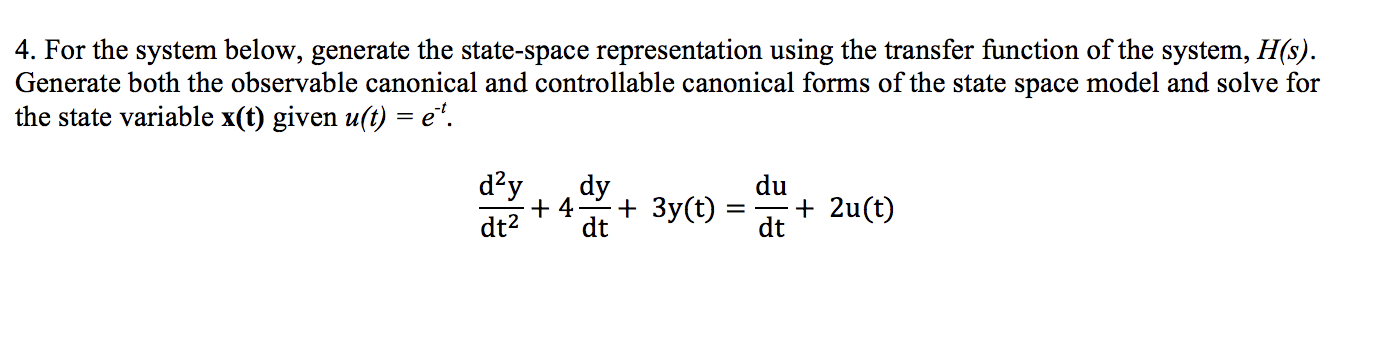
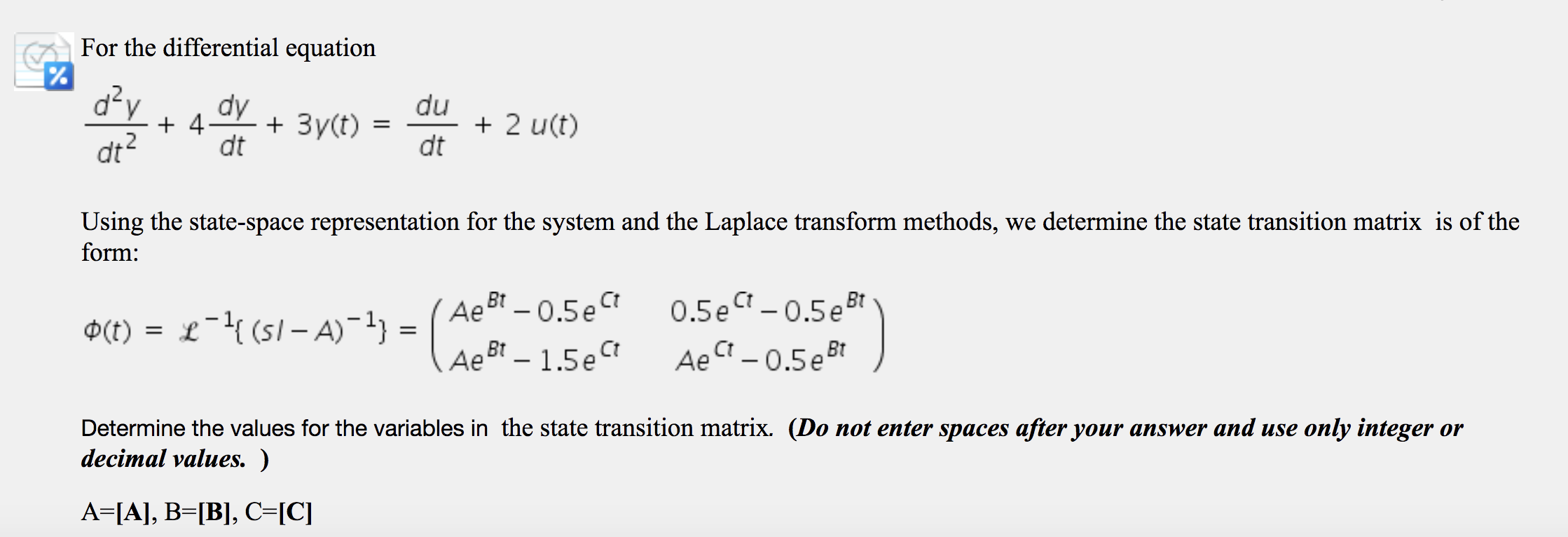
4. For the system below, generate the state-space representation using the transfer function of the system, H(s). Generate both the observable canonical and controllable canonical forms of the state space model and solve for the state variable x(t) given u(t) = e". day dy + 3y(t) = du + 4. dt2 dt dt + 2u(t)For the differential equation %% d'v + 4 4 + 3 v(t) = du + 2 u(t ) dt dt dt Using the state-space representation for the system and the Laplace transform methods, we determine the state transition matrix is of the form: $(t) = 2-1((51- A) -1) = Ae - 0.5ect 0.5e - 0.5e BT Ae BI - 1.5e C Ae - 0.5 e BI Determine the values for the variables in the state transition matrix. (Do not enter spaces after your answer and use only integer or decimal values. ) A=[A], B=[B], C=[C]
Step by Step Solution
There are 3 Steps involved in it

Get step-by-step solutions from verified subject matter experts
 Study Help