







Question: The rectangular object B is travelling in a horizontal path as demonstrated in Fig. 2, as it collides with a hindrance due to elevation
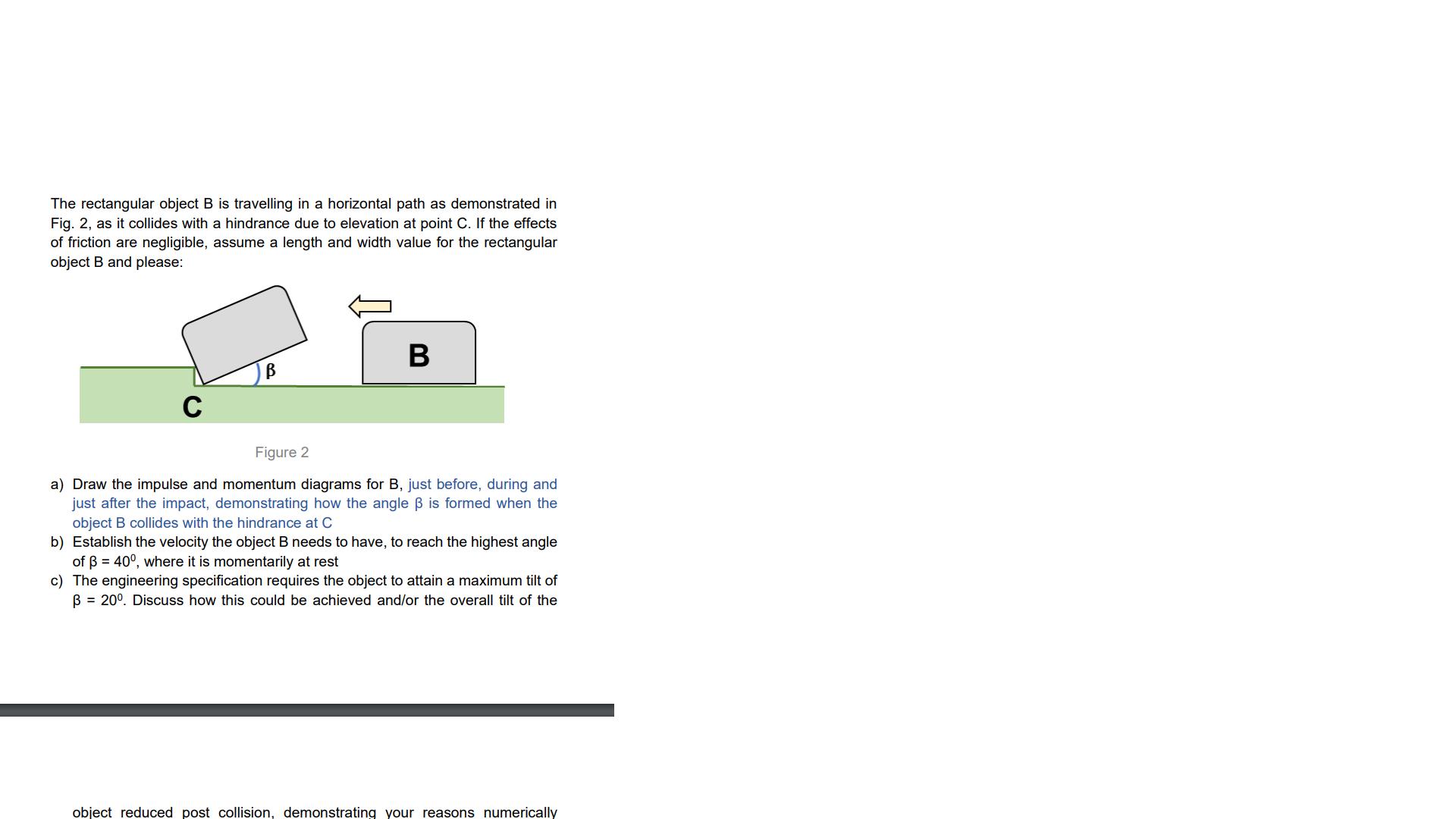
The rectangular object B is travelling in a horizontal path as demonstrated in Fig. 2, as it collides with a hindrance due to elevation at point C. If the effects of friction are negligible, assume a length and width value for the rectangular object B and please: B C Figure 2 a) Draw the impulse and momentum diagrams for B, just before, during and just after the impact, demonstrating how the angle B is formed when the object B collides with the hindrance at C b) Establish the velocity the object B needs to have, to reach the highest angle of B = 40, where it is momentarily at rest c) The engineering specification requires the object to attain a maximum tilt of B = 20. Discuss how this could be achieved and/or the overall tilt of the object reduced post collision, demonstrating your reasons numerically
Step by Step Solution
3.41 Rating (148 Votes )
There are 3 Steps involved in it
To solve this problem lets break it down into steps a Drawing Impulse and Momentum Diagrams 1 Just B... View full answer

Get step-by-step solutions from verified subject matter experts
 Study Help