Question: The right side is the assignment and questions to answer on the left. 2 PM 3.4 Ticket out the Door 8th Period Pre-AP World Geography
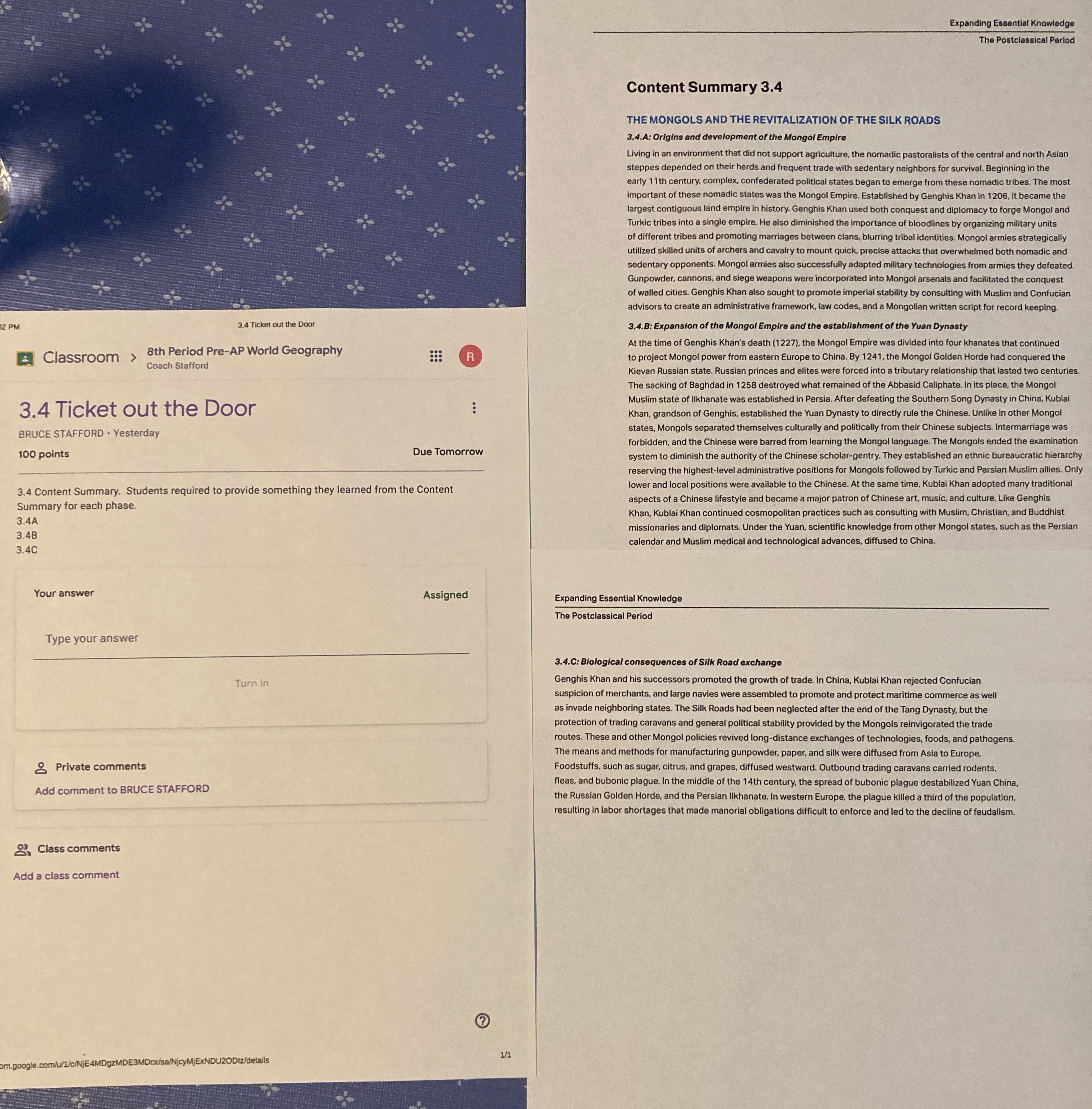
The right side is the assignment and questions to answer on the left.
2 PM 3.4 Ticket out the Door 8th Period Pre-AP World Geography Coach Stafford By Classroom > 3.4 Ticket out the Door : BRUCE STAFFORD - Yesterday 100 points Due Tomorrow 3.4 Content Summary. Students required to provide something they learned from the Content Summary for each phase. 3.4A 3.48 3.4C Your answer Assigned Type your answer 2, Private comments Add comment to BRUCE STAFFORD 23, Class comments Add a class comment om.google. mwu/llclN'-EtMDwMDEBMDa/uMwM'ExNDUZoDIdecm!s n Expanding Essential Knowledge The Postclassical Period Content Summary 3.4 THE MONGOLS AND THE REVITALIZATION OF THE SILK ROADS 3.4.A: Origins and development of the Mangol Empire Living in an environment that did not support agriculture, the nomadic pastoralists of the central and north Asian steppes depended on their herds and frequent trade with sedentary neighbors for survival. Beginning in the early 11th century, complex, confederated political states began to emerge from these nomadic tribes. The most. important of these nomadic states was the Mongol Empire. Established by Genghis Khan in 1208, it became the largest contiguous land empire in history. Genghis Khan used both conquest and diplomacy to forge Mongol and Turkic tribes into a single empire. He also diminished the importance of bloodlines by organizing military units of different tribes and promoting marriages between clans, blurring tribal identities. Mongol armies strategically utilized skilled units of archers and cavalry to mount quick. precise attacks that overwhelmed both nomadic and sedentary opponents. Mongol armies also successfully adapted military technologies from armies they defeated. Gunpowder, cannons, and siege weapons were incorporated into Mongol arsenals and facllitated the conquest of walled cities. Genghis Khan also sought to promote imperial stability by consulting with Muslim and Confucian advisors to create an administrative framework, law codes, and a Mongolian written script for record keeping. 3.4.B: Expansion of the Mongol Empire and the establishment of the Yuan Dynasty At the time of Genghis Khan's death (1227), the Mongol Empire was divided into four khanates that continued to project Mongol power from eastern Europe to China. By 1241, the Mongol Golden Horde had conquered the Kievan Russian state. Russian princes and elites were forced into a tributary relationship that lasted two centuries. The sacking of Baghdad in 1258 destroyed what remained of the Abbasid Caliphate. In its place, the Mongol Muslim state of likhanate was established in Persia. After defeating the Southern Song Dynasty in China, Kublai Khan, grandson of Genghis, established the Yuan Dynasty to directly rule the Chinese. Unlike in other Mongol states, Mongols separated themselves culturally and politically from their Chinese subjects. Intermarriage was forbidden, and the Chinese were barred from learning the Mongol language. The Mongols ended the examination system to diminish the authority of the Chinese scholar-gentry. They established an ethnic bureaucratic hierarchy reserving the highest-level administrative positions for Mongols followed by Turkic and Persian Muslim allies. Only lower and local positions were available to the Chinese. At the same time, Kublai Khan adopted many traditional aspects of a Chinese lifestyle and became a major patron of Chinese art, music, and culture. Like Genghls Khan, Kublai Khan continued cosmopolitan practices such as consulting with Muslim, Christian, and Buddhist missionaries and diplomats. Under the Yuan, scientific knowledge from other Mongol states, such as the Persian calendar and Muslim medical and technological advances, diffused to China. Expanding Essential Knowledge The Postclassical Period 3.4.C: Biological consequences of Silk Road exchange Genghis Khan and his successors promoted the growth of trade. In China, Kublai Khan rejected Confucian suspicion of merchants, and large navies were assembled to promote and protect maritime commerce as well as invade neighboring states. The Silk Roads had been neglected after the end of the Tang Dynasty, but the protection of trading caravans and general political stability provided by the Mongols reinvigorated the trade routes. These and other Mongol policies revived long-distance exchanges of technologies, foods, and pathogens. The means and methods for manufacturing gunpowder, paper, and silk were diffused from Asia to Europe. Foodstuffs, such as sugar, citrus, and grapes, diffused westward. Outbound trading caravans carried rodents, fleas, and bubonic plague. In the middle of the 14th century, the spread of bubonic plague destabilized Yuan China, the Russlan Golden Horde, and the Persian likhanate. In western Europe, the plague Killed a third of the population, resulting in labor shortages that made manorial obligations difficult to enforce and led to the decline of feudalism









 Study Help