







Question: The Ryanair case says, Between 2013 and 2018, it [Ryanair] successfully architected and delivered a strategic turnaround enshrining its position as Europes largest, cheapest, and
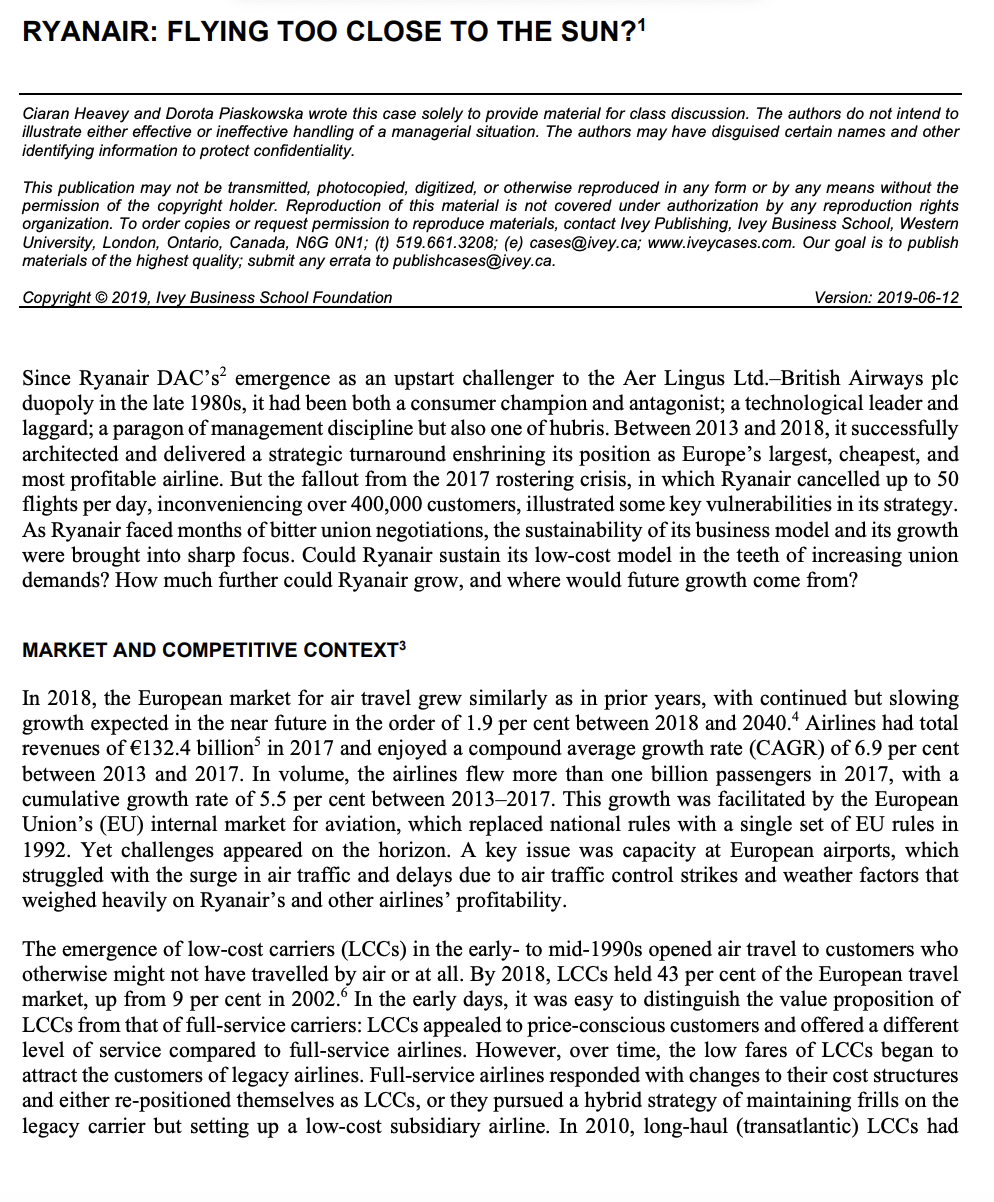
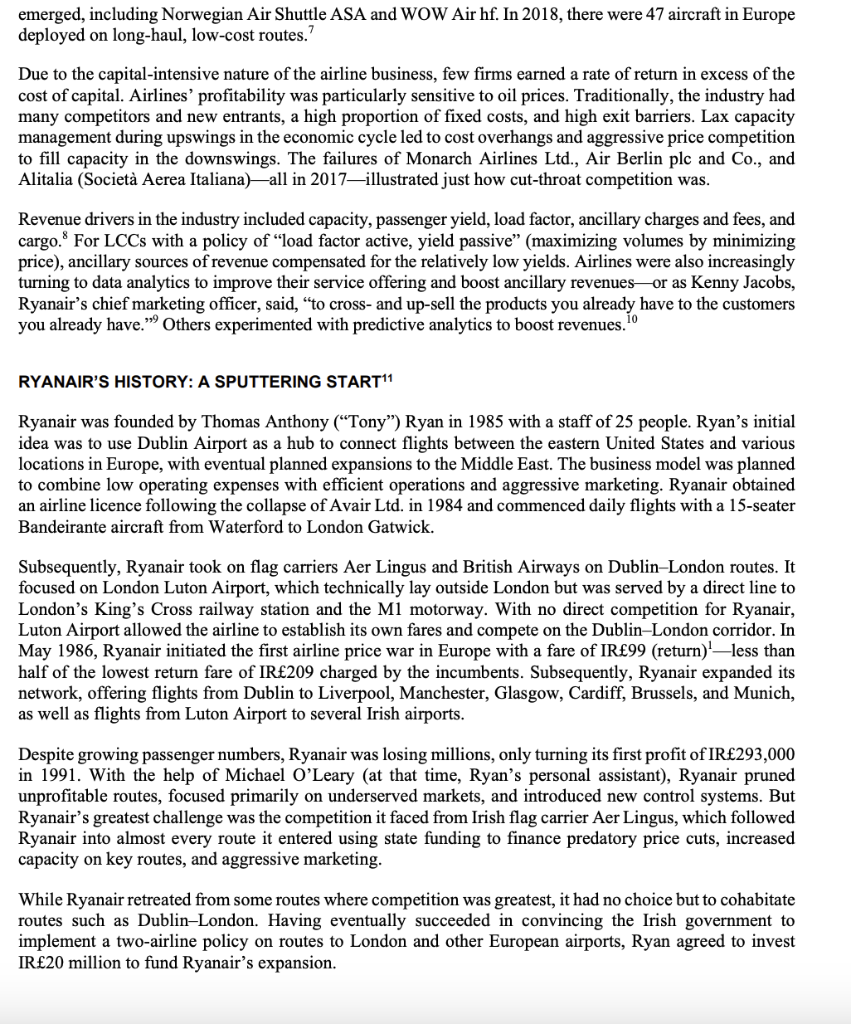
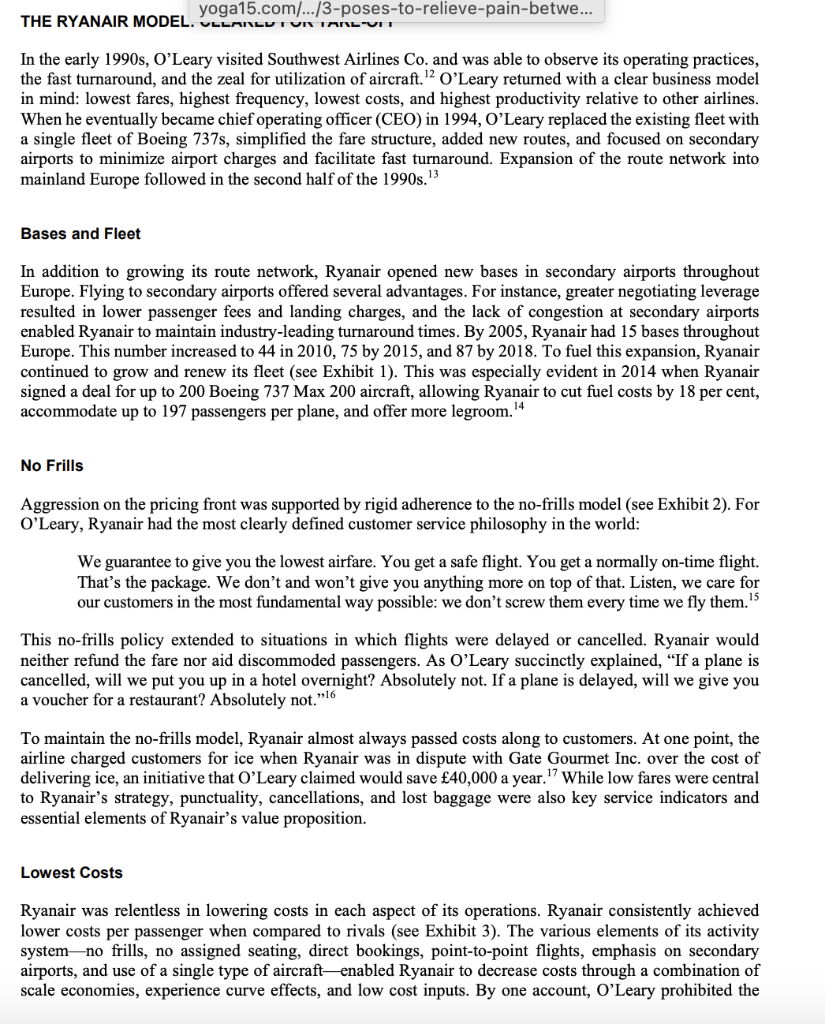
The Ryanair case says, Between 2013 and 2018, it [Ryanair] successfully architected and delivered a strategic turnaround enshrining its position as Europes largest, cheapest, and most profitable airline (p. 1). What accounts for its success?
RYANAIR: FLYING TOO CLOSE TO THE SUN? 1 Ciaran Heavey and Dorota Piaskowska wrote this case solely to provide material for class discussion. The authors do not intend to illustrate either effective or ineffective handling of a managerial situation. The authors may have disguised certain names and other identifying information to protect confidentiality. This publication may not be transmitted, photocopied, digitized, or otherwise reproduced in any form or by any means without the permission of the copyright holder. Reproduction of this material is not covered under authorization by any reproduction rights organization. To order copies or request permission to reproduce materials, contact Ivey Publishing, Ivey Business School, Western University, London, Ontario, Canada, N6G ON1; (t) 519.661.3208; (e) cases@ivey.ca; www.iveycases.com. Our goal is to publish materials of the highest quality; submit any errata to publishcases@ivey.ca. Copyright @ 2019, Ivey Business School Foundation Version: 2019-06-12 Since Ryanair DAC's 2 emergence as an upstart challenger to the Aer Lingus Ltd.-British Airways plc duopoly in the late 1980s, it had been both a consumer champion and antagonist; a technological leader and laggard; a paragon of management discipline but also one of hubris. Between 2013 and 2018, it successfully architected and delivered a strategic turnaround enshrining its position as Europe's largest, cheapest, and most profitable airline. But the fallout from the 2017 rostering crisis, in which Ryanair cancelled up to 50 flights per day, inconveniencing over 400,000 customers, illustrated some key vulnerabilities in its strategy. As Ryanair faced months of bitter union negotiations, the sustainability of its business model and its growth were brought into sharp focus. Could Ryanair sustain its low-cost model in the teeth of increasing union demands? How much further could Ryanair grow, and where would future growth come from? MARKET AND COMPETITIVE CONTEXT 3 In 2018, the European market for air travel grew similarly as in prior years, with continued but slowing growth expected in the near future in the order of 1.9 per cent between 2018 and 2040.4 Airlines had total revenues of 132.4 billion 5 in 2017 and enjoyed a compound average growth rate (CAGR) of 6.9 per cent between 2013 and 2017. In volume, the airlines flew more than one billion passengers in 2017, with a cumulative growth rate of 5.5 per cent between 2013-2017. This growth was facilitated by the European Union's (EU) internal market for aviation, which replaced national rules with a single set of EU rules in 1992. Yet challenges appeared on the horizon. A key issue was capacity at European airports, which struggled with the surge in air traffic and delays due to air traffic control strikes and weather factors that weighed heavily on Ryanair's and other airlines' profitability. The emergence of low-cost carriers (LCCs) in the early- to mid-1990s opened air travel to customers who otherwise might not have travelled by air or at all. By 2018, LCCs held 43 per cent of the European travel market, up from 9 per cent in 2002.6 In the early days, it was easy to distinguish the value proposition of LCCs from that of full-service carriers: LCCs appealed to price-conscious customers and offered a different level of service compared to full-service airlines. However, over time, the low fares of LCCs began to attract the customers of legacy airlines. Full-service airlines responded with changes to their cost structures and either re-positioned themselves as LCCs, or they pursued a hybrid strategy of maintaining frills on the legacy carrier but setting up a low-cost subsidiary airline. In 2010, long-haul (transatlantic) LCCs had emerged, including Norwegian Air Shuttle ASA and WOW Air hf. In 2018, there were 47 aircraft in Europe deployed on long-haul, low-cost routes. 7 Due to the capital-intensive nature of the airline business, few firms earned a rate of return in excess of the cost of capital. Airlines' profitability was particularly sensitive to oil prices. Traditionally, the industry had many competitors and new entrants, a high proportion of fixed costs, and high exit barriers. Lax capacity management during upswings in the economic cycle led to cost overhangs and aggressive price competition to fill capacity in the downswings. The failures of Monarch Airlines Ltd., Air Berlin plc and Co., and Alitalia (Societ Aerea Italiana) - all in 2017illustrated just how cut-throat competition was. Revenue drivers in the industry included capacity, passenger yield, load factor, ancillary charges and fees, and cargo. 8 For LCCs with a policy of "load factor active, yield passive" (maximizing volumes by minimizing price), ancillary sources of revenue compensated for the relatively low yields. Airlines were also increasingly turning to data analytics to improve their service offering and boost ancillary revenues - or as Kenny Jacobs, Ryanair's chief marketing officer, said, "to cross- and up-sell the products you already have to the customers you already have." Others experimented with predictive analytics to boost revenues. 10 RYANAIR'S HISTORY: A SPUTTERING START 11 Ryanair was founded by Thomas Anthony ("Tony") Ryan in 1985 with a staff of 25 people. Ryan's initial idea was to use Dublin Airport as a hub to connect flights between the eastern United States and various locations in Europe, with eventual planned expansions to the Middle East. The business model was planned to combine low operating expenses with efficient operations and aggressive marketing. Ryanair obtained an airline licence following the collapse of Avair Ltd. in 1984 and commenced daily flights with a 15-seater Bandeirante aircraft from Waterford to London Gatwick. Subsequently, Ryanair took on flag carriers Aer Lingus and British Airways on Dublin-London routes. It focused on London Luton Airport, which technically lay outside London but was served by a direct line to London's King's Cross railway station and the M1 motorway. With no direct competition for Ryanair, Luton Airport allowed the airline to establish its own fares and compete on the Dublin-London corridor. In May 1986, Ryanair initiated the first airline price war in Europe with a fare of IR99 (return) 1-less than half of the lowest return fare of IR209 charged by the incumbents. Subsequently, Ryanair expanded its network, offering flights from Dublin to Liverpool, Manchester, Glasgow, Cardiff, Brussels, and Munich, as well as flights from Luton Airport to several Irish airports. Despite growing passenger numbers, Ryanair was losing millions, only turning its first profit of IR293,000 in 1991. With the help of Michael O'Leary (at that time, Ryan's personal assistant), Ryanair pruned unprofitable routes, focused primarily on underserved markets, and introduced new control systems. But Ryanair's greatest challenge was the competition it faced from Irish flag carrier Aer Lingus, which followed Ryanair into almost every route it entered using state funding to finance predatory price cuts, increased capacity on key routes, and aggressive marketing. While Ryanair retreated from some routes where competition was greatest, it had no choice but to cohabitate routes such as Dublin-London. Having eventually succeeded in convincing the Irish government to implement a two-airline policy on routes to London and other European airports, Ryan agreed to invest IR20 million to fund Ryanair's expansion. THE RYANAIR MODEL. yoga15.com/.../3-poses-to-relieve-pain-betwe... In the early 1990 s, O'Leary visited Southwest Airlines Co. and was able to observe its operating practices, the fast turnaround, and the zeal for utilization of aircraft. 12 O'Leary returned with a clear business model in mind: lowest fares, highest frequency, lowest costs, and highest productivity relative to other airlines. When he eventually became chief operating officer (CEO) in 1994, O'Leary replaced the existing fleet with a single fleet of Boeing 737s, simplified the fare structure, added new routes, and focused on secondary airports to minimize airport charges and facilitate fast turnaround. Expansion of the route network into mainland Europe followed in the second half of the 1990s. 13 Bases and Fleet In addition to growing its route network, Ryanair opened new bases in secondary airports throughout Europe. Flying to secondary airports offered several advantages. For instance, greater negotiating leverage resulted in lower passenger fees and landing charges, and the lack of congestion at secondary airports enabled Ryanair to maintain industry-leading turnaround times. By 2005 , Ryanair had 15 bases throughout Europe. This number increased to 44 in 2010,75 by 2015 , and 87 by 2018 . To fuel this expansion, Ryanair continued to grow and renew its fleet (see Exhibit 1). This was especially evident in 2014 when Ryanair signed a deal for up to 200 Boeing 737 Max 200 aircraft, allowing Ryanair to cut fuel costs by 18 per cent, accommodate up to 197 passengers per plane, and offer more legroom. 14 No Frills Aggression on the pricing front was supported by rigid adherence to the no-frills model (see Exhibit 2). For O'Leary, Ryanair had the most clearly defined customer service philosophy in the world: We guarantee to give you the lowest airfare. You get a safe flight. You get a normally on-time flight. That's the package. We don't and won't give you anything more on top of that. Listen, we care for our customers in the most fundamental way possible: we don't screw them every time we fly them. 15 This no-frills policy extended to situations in which flights were delayed or cancelled. Ryanair would neither refund the fare nor aid discommoded passengers. As O'Leary succinctly explained, "If a plane is cancelled, will we put you up in a hotel overnight? Absolutely not. If a plane is delayed, will we give you a voucher for a restaurant? Absolutely not."16 To maintain the no-frills model, Ryanair almost always passed costs along to customers. At one point, the airline charged customers for ice when Ryanair was in dispute with Gate Gourmet Inc. over the cost of delivering ice, an initiative that O'Leary claimed would save 40,000 a year. 17While low fares were central to Ryanair's strategy, punctuality, cancellations, and lost baggage were also key service indicators and essential elements of Ryanair's value proposition. Lowest Costs Ryanair was relentless in lowering costs in each aspect of its operations. Ryanair consistently achieved lower costs per passenger when compared to rivals (see Exhibit 3). The various elements of its activity system - no frills, no assigned seating, direct bookings, point-to-point flights, emphasis on secondary airports, and use of a single type of aircraft - enabled Ryanair to decrease costs through a combination of scale economies, experience curve effects, and low cost inputs. By one account, O'Leary prohibited theStep by Step Solution
There are 3 Steps involved in it
1 Expert Approved Answer
Step: 1 Unlock

Question Has Been Solved by an Expert!
Get step-by-step solutions from verified subject matter experts
Step: 2 Unlock
Step: 3 Unlock
 Study Help