







Question: The score is the dependent variable representing the average final exam scores of the postgraduate students. The estimation of linear probability model is shown below:
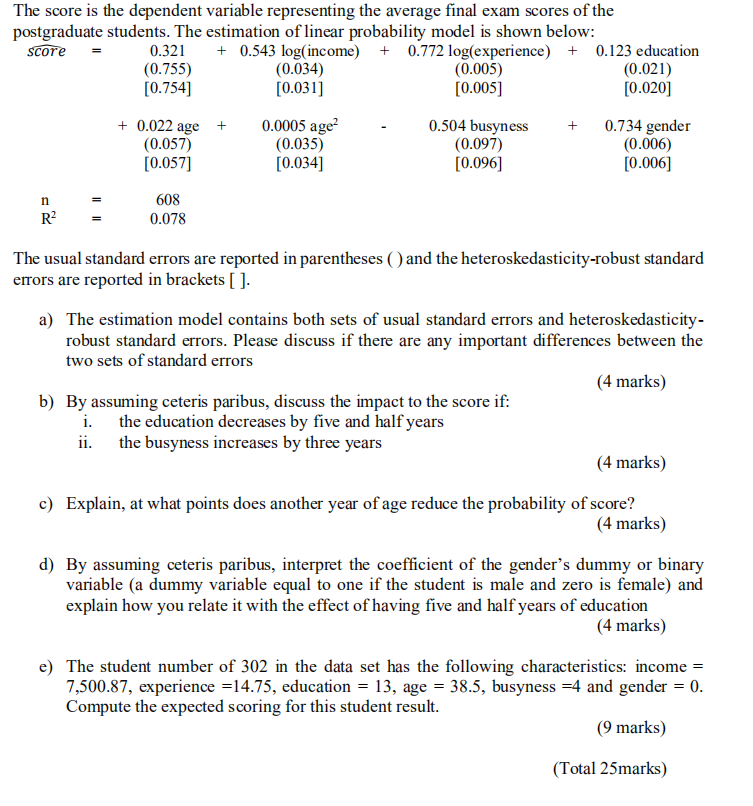
The score is the dependent variable representing the average final exam scores of the postgraduate students. The estimation of linear probability model is shown below: score 0.321 + 0.543 log(income) + 0.772 log(experience) + 0.123 education (0.755) (0.034) (0.005) (0.021) [0.754] [0.031] [0.005) [0.020] + 0.022 age 0.0005 age 0.504 busyness + 0.734 gender (0.057) (0.035) (0.097) (0.006) [0.057] [0.034] [0.096] [0.006] + n R2 608 0.078 The usual standard errors are reported in parentheses () and the heteroskedasticity-robust standard errors are reported in brackets [ ]. a) The estimation model contains both sets of usual standard errors and heteroskedasticity- robust standard errors. Please discuss if there are any important differences between the two sets of standard errors (4 marks) b) By assuming ceteris paribus, discuss the impact to the score if: i. the education decreases by five and half years ii. the busyness increases by three years (4 marks) c) Explain, at what points does another year of age reduce the probability of score? (4 marks) d) By assuming ceteris paribus, interpret the coefficient of the gender's dummy or binary variable (a dummy variable equal to one if the student is male and zero is female) and explain how you relate it with the effect of having five and half years of education (4 marks) e) The student number of 302 in the data set has the following characteristics: income 7,500.87, experience =14.75, education = 13, age = 38.5, busyness =4 and gender = 0. Compute the expected scoring for this student result (9 marks) (Total 25marks)
Step by Step Solution
There are 3 Steps involved in it

Get step-by-step solutions from verified subject matter experts
 Study Help