Question: The second op-ed article assignment for this course is worth 10% of the final grade. It is due by 10:00 am on Monday, November 29.
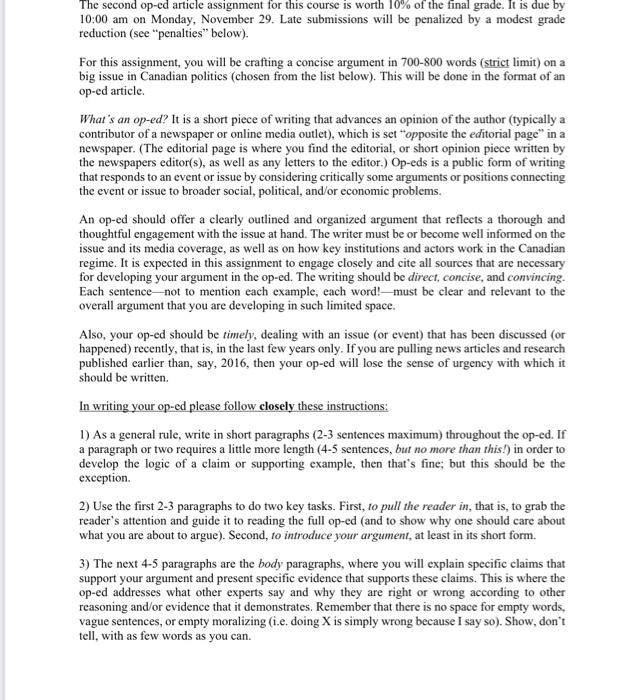
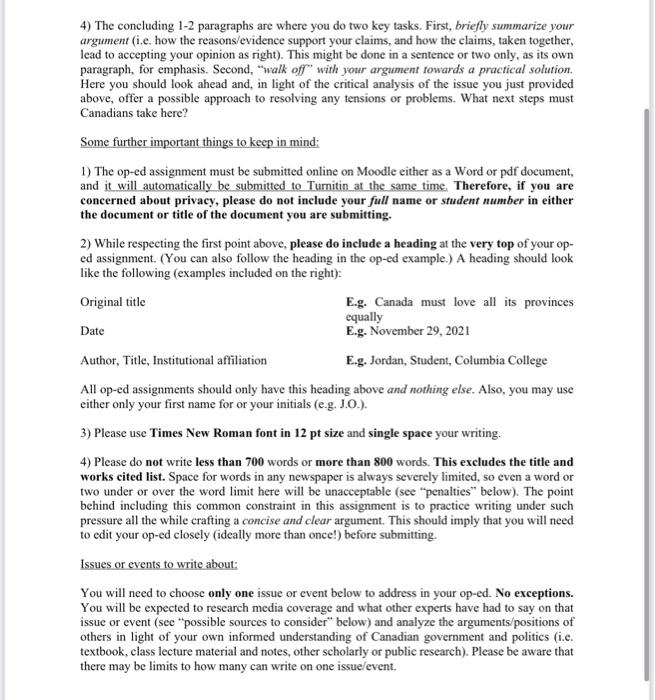
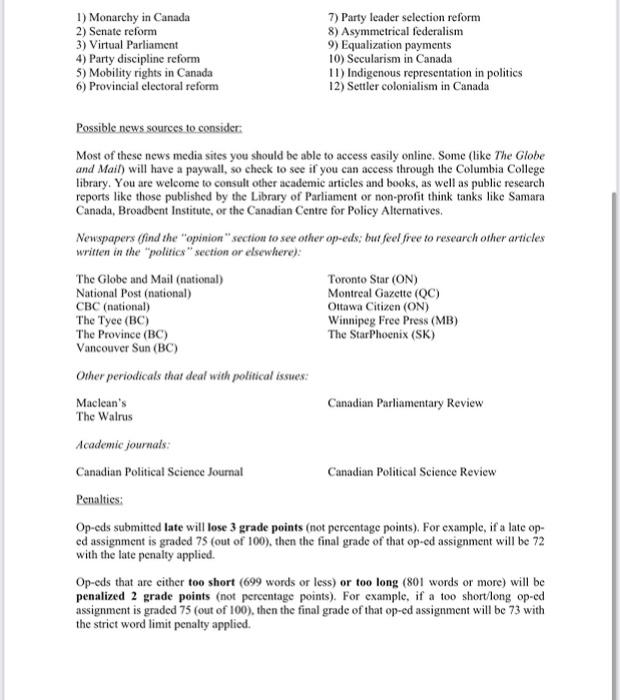
The second op-ed article assignment for this course is worth 10% of the final grade. It is due by 10:00 am on Monday, November 29. Late submissions will be penalized by a modest grade reduction (see "penalties" below). For this assignment, you will be crafting a concise argument in 700-800 words (strict limit) on a big issue in Canadian politics (chosen from the list below). This will be done in the format of an op-ed article What's an op-ed? It is a short piece of writing that advances an opinion of the author (typically a contributor of a newspaper or online media outlet), which is set opposite the editorial page" in a newspaper. (The editorial page is where you find the editorial, or short opinion piece written by the newspapers editor(s), as well as any letters to the editor.) Op-eds is a public form of writing that responds to an event or issue by considering critically some arguments or positions connecting the event or issue to broader social, political, and/or economic problems. An op-ed should offer a clearly outlined and organized argument that reflects a thorough and thoughtful engagement with the issue at hand. The writer must be or become well informed on the issue and its media coverage, as well as on how key institutions and actors work in the Canadian regime. It is expected in this assignment to engage closely and cite all sources that are necessary for developing your argument in the op-ed. The writing should be direct, concise, and convincing. Each sentence-not to mention each example, each word!- must be clear and relevant to the overall argument that you are developing in such limited space. Also, your op-ed should be timely, dealing with an issue (or event) that has been discussed (or happened) recently, that is, in the last few years only. If you are pulling news articles and research published carlier than, say, 2016, then your op-ed will lose the sense of urgency with which it should be written. In writing your op-ed please follow closely these instructions: 1) As a general rule, write in short paragraphs (2-3 sentences maximum) throughout the op-ed. If a paragraph or two requires a little more length (4-5 sentences, but no more than this.') in order to develop the logic of a claim or supporting example, then that's fine; but this should be the exception. 2) Use the first 2-3 paragraphs to do two key tasks. First, to pull the reader in, that is, to grab the reader's attention and guide it to reading the full op-ed (and to show why one should care about what you are about to argue). Second, to introduce your argument, at least in its short form. 3) The next 4-5 paragraphs are the body paragraphs, where you will explain specific claims that support your argument and present specific evidence that supports these claims. This is where the op-ed addresses what other experts say and why they are right or wrong according to other reasoning and/or evidence that it demonstrates. Remember that there is no space for empty words, vague sentences, or empty moralizing (i.e. doing X is simply wrong because I say so). Show, don't tell, with as few words as you can 4) The concluding 1-2 paragraphs are where you do two key tasks. First, briefly summarize your argument (i.e. how the reasons/evidence support your claims, and how the claims, taken together, lead to accepting your opinion as right). This might be done in a sentence or two only, as its own paragraph, for emphasis. Second, "walk off" with your argument towards a practical solution. Here you should look ahead and, in light of the critical analysis of the issue you just provided above, offer a possible approach to resolving any tensions or problems. What next steps must Canadians take here? Some further important things to keep in mind: 1) The op-ed assignment must be submitted online on Moodle either as a Word or pdf document, and it will automatically be submitted to Tumitin at the same time. Therefore, if you are concerned about privacy, please do not include your full name or student number in either the document or title of the document you are submitting. 2) While respecting the first point above, please do include a heading at the very top of your op- ed assignment. (You can also follow the heading in the op-ed example.) A heading should look like the following (examples included on the right): Original title E.g. Canada must love all its provinces equally Date E... November 29, 2021 Author, Title, Institutional affiliation E.g. Jordan, Student, Columbia College All op-ed assignments should only have this heading above and nothing else. Also, you may use either only your first name for or your initials (e.g. J.O.). 3) Please use Times New Roman font in 12 pt size and single space your writing. 4) Please do not write less than 700 words or more than 800 words. This excludes the title and works cited list. Space for words in any newspaper is always severely limited, so even a word or two under or over the word limit here will be unacceptable (see "penalties" below). The point behind including this common constraint in this assignment is to practice writing under such pressure all the while crafting a concise and clear argument. This should imply that you will need to edit your op-ed closely (ideally more than once!) before submitting. Issues or events to write about: You will need to choose only one issue or event below to address in your op-ed. No exceptions. You will be expected to research media coverage and what other experts have had to say on that issue or event (see "possible sources to consider" below) and analyze the arguments/positions of others in light of your own informed understanding of Canadian government and politics (i.c. textbook, class lecture material and notes, other scholarly or public research). Please be aware that there may be limits to how many can write on one issue/event. 1) Monarchy in Canada 2) Senate reform 3) Virtual Parliament 4) Party discipline reform 5) Mobility rights in Canada 6) Provincial electoral reform 7) Party leader selection reform 8) Asymmetrical federalism 9) Equalization payments 10) Secularism in Canada 11) Indigenous representation in politics 12) Settler colonialism in Canada Possible news sources to consider: Most of these news media sites you should be able to access casily online. Some (like The Globe and Mail) will have a paywall, so check to see if you can access through the Columbia College library. You are welcome to consult other academic articles and books, as well as public research reports like those published by the Library of Parliament or non-profit think tanks like Samara Canada, Broadbent Institute, or the Canadian Centre for Policy Alternatives. Newspapers find the opinion" section to see other op-eds, but feel free to research other articles written in the politics" section or elsewhere): The Globe and Mail (national) Toronto Star (ON) National Post (national) Montreal Gazette (QC) CBC (national) Ottawa Citizen (ON) The Tyee (BC) Winnipeg Free Press (MB) The Province (BC) The Star Phoenix (SK) Vancouver Sun (BC) Other periodicals that deal with political issues: Maclean's Canadian Parliamentary Review The Walrus Academic journals: Canadian Political Science Journal Canadian Political Science Review Penalties: Op-eds submitted late will lose 3 grade points (not percentage points). For example, if a late op- ed assignment is graded 75 (out of 100). then the final grade of that op-ed assignment will be 72 with the late penalty applied. Op-eds that are either too short (699 words or less) or too long (801 words or more) will be penalized 2 grade points (not percentage points). For example, if a too shortlong op-ed assignment is graded 75 (out of 100). then the final grade of that op-ed assignment will be 73 with the strict word limit penalty applied









 Study Help