







Question: The (semantics of) language F uses the binary tree data type D we already know from WHILE. Consider the following elements in D: (a) ((nil.nil).
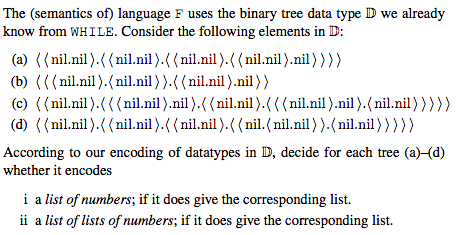
The (semantics of) language F uses the binary tree data type D we already know from WHILE. Consider the following elements in D: (a) ((nil.nil). {(nil.nil). ((nil.nil).((nil.nil).nil) > >> (b) (((nil.nil). (nil.nil).((nil.nil).nil >> (e) (nil.nil).(((nil.nil). nil).((nil.nil).(((nil.nil).nil). (nil.nil>>>>> (d) ((nil.nil).>>>> According to our encoding of datatypes in D, decide for each tree (a)-(d) whether it encodes i a list of numbers; if it does give the corresponding list. ii a list of lists of numbers, if it does give the corresponding list. The (semantics of) language F uses the binary tree data type D we already know from WHILE. Consider the following elements in D: (a) ((nil.nil). {(nil.nil). ((nil.nil).((nil.nil).nil) > >> (b) (((nil.nil). (nil.nil).((nil.nil).nil >> (e) (nil.nil).(((nil.nil). nil).((nil.nil).(((nil.nil).nil). (nil.nil>>>>> (d) ((nil.nil).>>>> According to our encoding of datatypes in D, decide for each tree (a)-(d) whether it encodes i a list of numbers; if it does give the corresponding list. ii a list of lists of numbers, if it does give the corresponding list
Step by Step Solution
There are 3 Steps involved in it

Get step-by-step solutions from verified subject matter experts
 Study Help