







Question: The signal ( y ( t ) ) at the PLL output therefore presents a variation proportional to the variation (
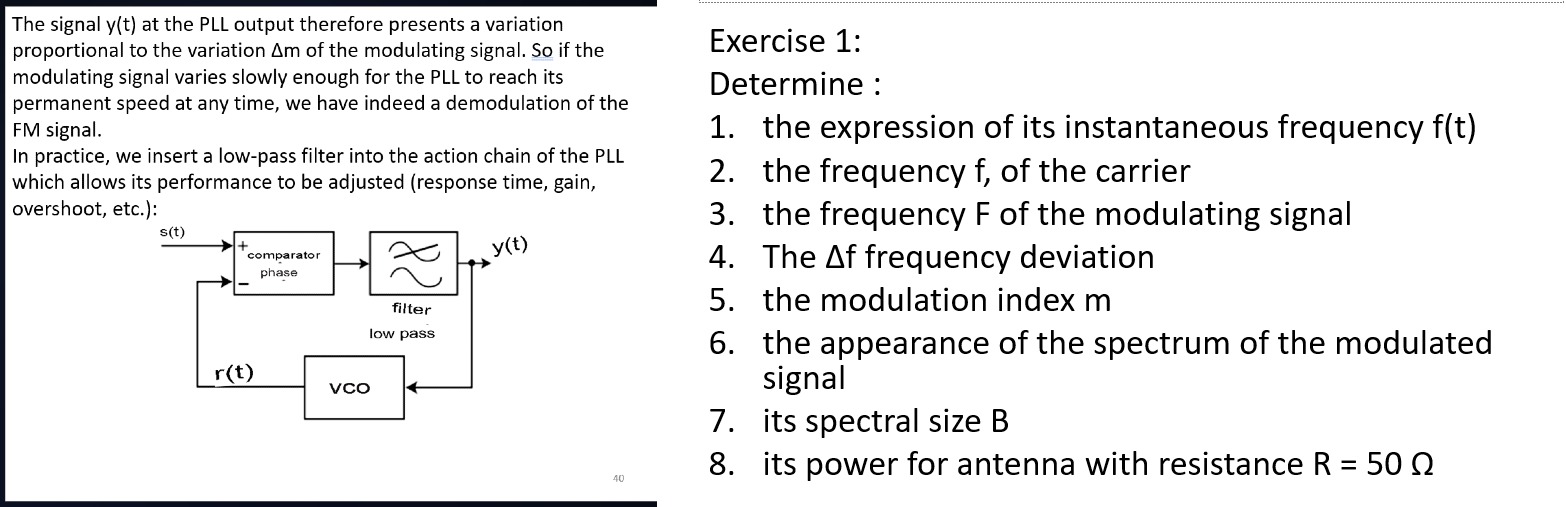
The signal yt at the PLL output therefore presents a variation proportional to the variation Delta mathrmm of the modulating signal. So if the modulating signal varies slowly enough for the PLL to reach its permanent speed at any time, we have indeed a demodulation of the FM signal.
In practice, we insert a lowpass filter into the action chain of the PLL which allows its performance to be adjusted response time, gain, overshoot, etc.
Exercise :
Determine :
the expression of its instantaneous frequency ft
the frequency f of the carrier
the frequency F of the modulating signal
The Delta f frequency deviation
the modulation index m
the appearance of the spectrum of the modulated signal
its spectral size B
its power for antenna with resistance ROmega
Step by Step Solution
There are 3 Steps involved in it
1 Expert Approved Answer
Step: 1 Unlock

Question Has Been Solved by an Expert!
Get step-by-step solutions from verified subject matter experts
Step: 2 Unlock
Step: 3 Unlock
 Study Help