







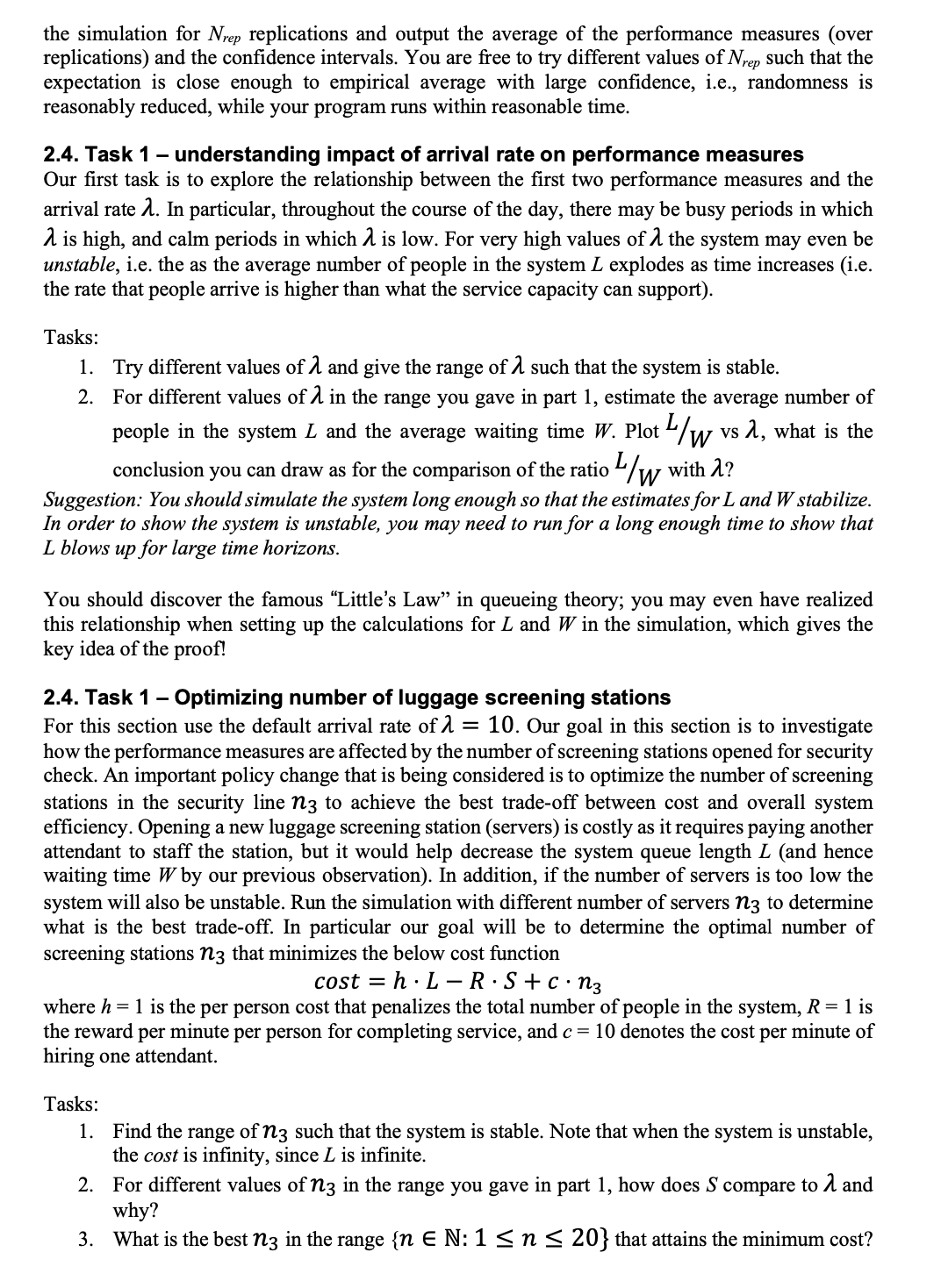
Question: the simulation for N r e p replications and output the average of the performance measures ( over replications ) and the confidence intervals. You
the simulation for replications and output the average of the performance measures over
replications and the confidence intervals. You are free to try different values of such that the
expectation is close enough to empirical average with large confidence, ie randomness is
reasonably reduced, while your program runs within reasonable time.
Task understanding impact of arrival rate on performance measures
Our first task is to explore the relationship between the first two performance measures and the
arrival rate In particular, throughout the course of the day, there may be busy periods in which
is high, and calm periods in which is low. For very high values of the system may even be
unstable, ie the as the average number of people in the system explodes as time increases ie
the rate that people arrive is higher than what the service capacity can support
Tasks:
Try different values of and give the range of such that the system is stable.
For different values of in the range you gave in part estimate the average number of
people in the system and the average waiting time Plot vs what is the
conclusion you can draw as for the comparison of the ratio with
Suggestion: You should simulate the system long enough so that the estimates for and stabilize.
In order to show the system is unstable, you may need to run for a long enough time to show that
blows up for large time horizons.
You should discover the famous "Little's Law" in queueing theory; you may even have realized
this relationship when setting up the calculations for and in the simulation, which gives the
key idea of the proof!
Task Optimizing number of luggage screening stations
For this section use the default arrival rate of Our goal in this section is to investigate
how the performance measures are affected by the number of screening stations opened for security
check. An important policy change that is being considered is to optimize the number of screening
stations in the security line to achieve the best tradeoff between cost and overall system
efficiency. Opening a new luggage screening station servers is costly as it requires paying another
attendant to staff the station, but it would help decrease the system queue length and hence
waiting time by our previous observation In addition, if the number of servers is too low the
system will also be unstable. Run the simulation with different number of servers to determine
what is the best tradeoff. In particular our goal will be to determine the optimal number of
screening stations that minimizes the below cost function
where is the per person cost that penalizes the total number of people in the system, is
the reward per minute per person for completing service, and denotes the cost per minute of
hiring one attendant.
Task:
Find the range of such that the system is stable. Note that when the system is unstable,
the cost is infinity, since is infinite.
For different values of in the range you gave in part how does compare to and
why?
What is the best in the range : that attains the minimum cost?
Step by Step Solution
There are 3 Steps involved in it
1 Expert Approved Answer
Step: 1 Unlock

Question Has Been Solved by an Expert!
Get step-by-step solutions from verified subject matter experts
Step: 2 Unlock
Step: 3 Unlock
 Study Help