







Question: The SinglyLinkedList code package HW4_Skeleton; public class SinglyLinkedList { private SinglyLinkedNode head; private int size; public SinglyLinkedList(){ this.head
The SinglyLinkedList code
package HW4_Skeleton;
public class SinglyLinkedList {
private SinglyLinkedNode head;
private int size;
public SinglyLinkedList(){
this.head = null;
this.size = 0;
}
// add a new node at the beginning of the list
public void addAtBeginning(int value){
SinglyLinkedNode newNode = new SinglyLinkedNode(value);
newNode.setNextNode(this.head);
this.head=newNode;
this.size++;
}
public void reverse() {
}
public SinglyLinkedNode getHead() { return this.head; }
public int getSize() {
return this.size;
}
@Override
public String toString(){
String str = "";
SinglyLinkedNode curr = this.head;
while(curr != null){
str += "->" + curr.getData();
curr = curr.getNextNode();
}
return str;
}
}
The SinglyLinkedListStarter
package HW4_Skeleton;
public class SinglyLinkedListStarter {
public static void main(String args[]) {
SinglyLinkedList myLinkedList = new SinglyLinkedList();
myLinkedList.addAtBeginning(4);
myLinkedList.addAtBeginning(7);
myLinkedList.addAtBeginning(1);
myLinkedList.addAtBeginning(2);
System.out.println(myLinkedList.toString());
System.out.println(myLinkedList.getSize());
System.out.println(myLinkedList.getHead());
myLinkedList.reverse();
System.out.println(myLinkedList.toString());
System.out.println(myLinkedList.getSize());
System.out.println(myLinkedList.getHead());
}
}
The SinglyLinkedNode
package HW4_Skeleton;
public class SinglyLinkedNode {
private int item;
private SinglyLinkedNode next;
public SinglyLinkedNode(int data, SinglyLinkedNode nextNode) {
this.item = data;
this.next = nextNode;
}
public SinglyLinkedNode(int data) {
this(data, null);
}
public int getData() {
return item;
}
public SinglyLinkedNode getNextNode() {
return next;
}
public void setData(int data) {
this.item = data;
}
public void setNextNode(SinglyLinkedNode nextNode) {
this.next = nextNode;
}
@Override
public String toString() {
return ""+this.item;
}
}
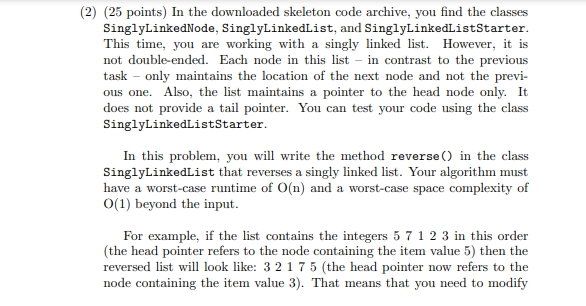
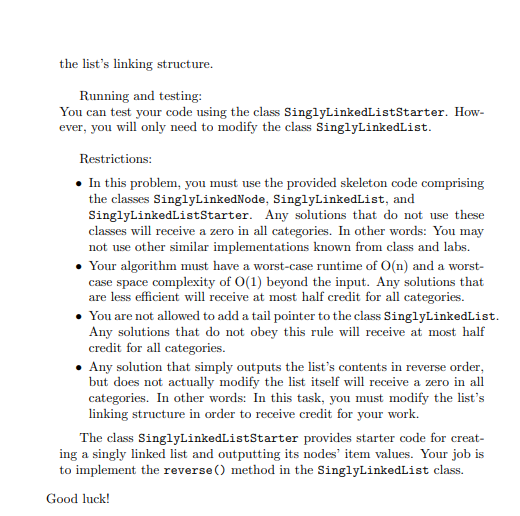
(2) (25 points) In the downloaded skeleton code archive, you find the classes SinglyLinkedNode, SinglyLinkedList, and SinglyLinkedListStarter. This time, you are working with a singly linked list. However, it is not double-ended. Each node in this list in contrast to the previous task only maintains the location of the next node and not the previ- ous one. Also, the list maintains a pointer to the head node only. It does not provide a tail pointer. You can test your code using the class SinglyLinkedListStarter. In this problem, you will write the method reverse () in the class SinglyLinkedList that reverses a singly linked list. Your algorithm must have a worst-case runtime of O(n) and a worst-case space complexity of O(1) beyond the input. For example, if the list contains the integers 5 7 1 2 3 in this order (the head pointer refers to the node containing the item value 5) then the reversed list will look like: 32175 (the head pointer now refers to the node containing the item value 3). That means that you need to modify
Step by Step Solution
There are 3 Steps involved in it

Get step-by-step solutions from verified subject matter experts
 Study Help