



Question: The social planner has the objective to maximize the lifetime discounted utility of the representative consumer: B* u(c) { Where 0 0, and is the
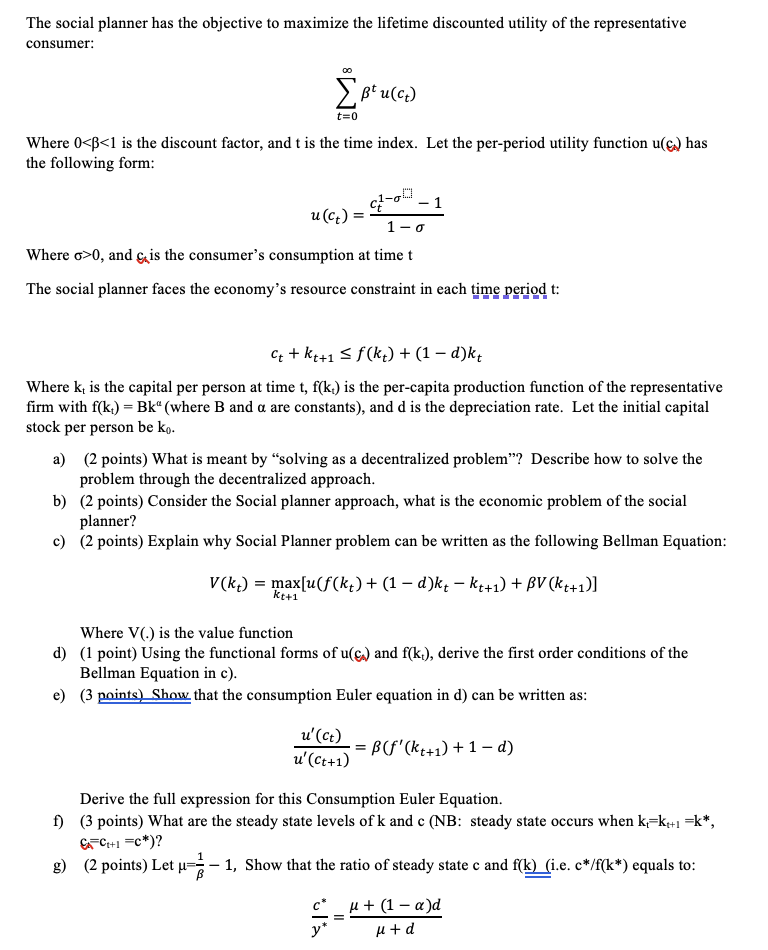
The social planner has the objective to maximize the lifetime discounted utility of the representative consumer: B* u(c) { Where 00, and is the consumer's consumption at time t The social planner faces the economy's resource constraint in each time period t: C+ + kt+1 = f(kt) + (1 - d)kt Where k, is the capital per person at time t, f(ke) is the per-capita production function of the representative firm with f(kt) = Bk (where B and a are constants), and d is the depreciation rate. Let the initial capital stock per person be ko. a) (2 points) What is meant by solving as a decentralized problem? Describe how to solve the problem through the decentralized approach. b) (2 points) Consider the Social planner approach, what is the economic problem of the social planner? c) (2 points) Explain why Social Planner problem can be written as the following Bellman Equation: V(kt) = max[u(f(kt) + (1 - d)kt - kt+1) + BV (kt+1)] ke+1 Where V(.) is the value function d) (1 point) Using the functional forms of u(a) and f(k.), derive the first order conditions of the Bellman Equation in c). e) (3 points) Show that the consumption Euler equation in d) can be written as: u'(Ct) u' (Ct+1) = B(f'(kt+1) +1 -d) Derive the full expression for this Consumption Euler Equation. f) (3 points) What are the steady state levels of k and c (NB: steady state occurs when k=k++1 =k*, EFC2+1 =c*)? g) (2 points) Let u=; 1, Show that the ratio of steady state c and f(k) (i.e. c*/f(k*) equals to: B c* 4+ (1 - ald y* u+d The social planner has the objective to maximize the lifetime discounted utility of the representative consumer: B* u(c) { Where 00, and is the consumer's consumption at time t The social planner faces the economy's resource constraint in each time period t: C+ + kt+1 = f(kt) + (1 - d)kt Where k, is the capital per person at time t, f(ke) is the per-capita production function of the representative firm with f(kt) = Bk (where B and a are constants), and d is the depreciation rate. Let the initial capital stock per person be ko. a) (2 points) What is meant by solving as a decentralized problem? Describe how to solve the problem through the decentralized approach. b) (2 points) Consider the Social planner approach, what is the economic problem of the social planner? c) (2 points) Explain why Social Planner problem can be written as the following Bellman Equation: V(kt) = max[u(f(kt) + (1 - d)kt - kt+1) + BV (kt+1)] ke+1 Where V(.) is the value function d) (1 point) Using the functional forms of u(a) and f(k.), derive the first order conditions of the Bellman Equation in c). e) (3 points) Show that the consumption Euler equation in d) can be written as: u'(Ct) u' (Ct+1) = B(f'(kt+1) +1 -d) Derive the full expression for this Consumption Euler Equation. f) (3 points) What are the steady state levels of k and c (NB: steady state occurs when k=k++1 =k*, EFC2+1 =c*)? g) (2 points) Let u=; 1, Show that the ratio of steady state c and f(k) (i.e. c*/f(k*) equals to: B c* 4+ (1 - ald y* u+d
Step by Step Solution
There are 3 Steps involved in it

Get step-by-step solutions from verified subject matter experts