







Question: the solution to the problem but with different values, could you plug my values in correctly to check my answers. thanks!! 1) Cakculate the concentration
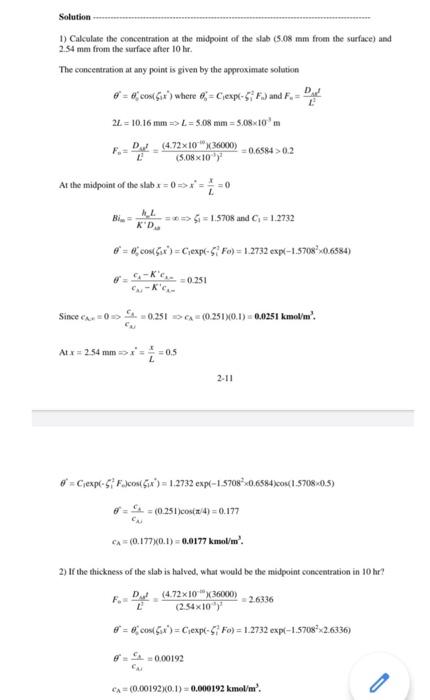
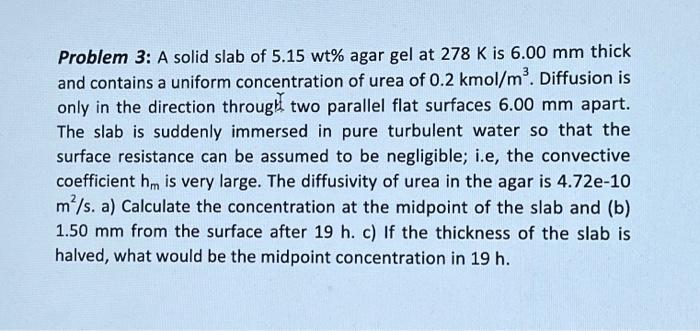
1) Cakculate the concentration at the midpoint of the slab ( 5.08mm from the surface) and 2.54mm from the surface after 10hr. The canceatration at any point is given by the approximate solution =4cos(1x)where0=C1exp(12Fn)andFn=L2Dsxt22L=10.16mmL=5.08mm=5.08103mFs=L2Dst=(5.08103)2(4.721010)(36000)=0.6584>0.2 At the midpoint of the slab x=0x=Lx=0 Bim=KD2hL=1=1.5708andC1=1.2732=6cos(1x)=C1exp(11Fo)=1.2732exp(1.570820.6584)=cA,KcA=cAKcA==0.251 Since cA=0cAcA=0.25t=cA=(0.251)(0.1)=0.0251kmol/m3. Atx=2.54mmx=Lx=0.5 2=C1exp(12Fe)cos(1x)=1.2732exp(1.570820.6584)cos(1.57080.5)=cAcA=(0.251)cos(/4)=0.177cA=(0.177)(0.1)=0.0177kmol/m3. 2) If the thickness of the slab is halved, what would be the midpoint concentration in 10 hr? Fe=L2Dtt=(2.54101)2(4.721010)(36000)=2.6336=0cos(x2)=C1exp(12F0)=1.2732exp(1.570822.6336)=CAcA=0.00192cA=(0.00192)(0.1)=0.000192kmol/m3. Problem 3: A solid slab of 5.15wt% agar gel at 278K is 6.00mm thick and contains a uniform concentration of urea of 0.2kmol/m3. Diffusion is only in the direction through two parallel flat surfaces 6.00mm apart. The slab is suddenly immersed in pure turbulent water so that the surface resistance can be assumed to be negligible; i.e, the convective coefficient hm is very large. The diffusivity of urea in the agar is 4.72e10 m2/s. a) Calculate the concentration at the midpoint of the slab and (b) 1.50mm from the surface after 19h. c) If the thickness of the slab is halved, what would be the midpoint concentration in 19h
Step by Step Solution
There are 3 Steps involved in it

Get step-by-step solutions from verified subject matter experts
 Study Help