



Question: The sounding from a Cone Penetration Test performed at a bridge site in British Columbia, Canada is shown below ( Niazi et al . ,
The sounding from a Cone Penetration Test performed at a bridge site in British
Columbia, Canada is shown below Niazi et al The sounding shows cone tip
resistance sleeve friction and pore water pressure whereas indicates
the projected hydrostatic pressure from the groundwater table which is located
meters below the ground surface. Unit weight of the soils are estimated as
between between and
below depth points
You are tasked with utilizing this CPT sounding for site characterization and evaluation of
relevant geotechnical properties for foundation design.
Figure CPT sounding from the Golden Ears Bridge site in British Columbia, CanadaIn practice, you would need to analyze the entire soil profile. For the sake of this homework
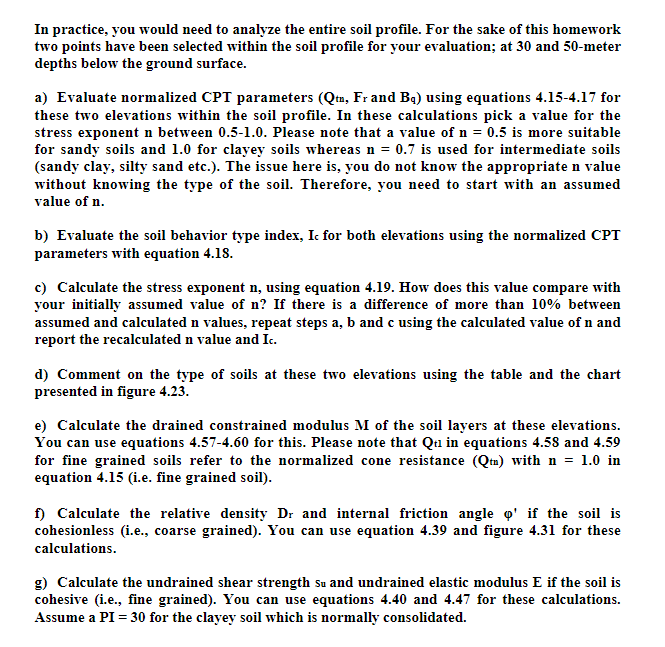
two points have been selected within the soil profile for your evaluation; at and meter
depths below the ground surface.
a Evaluate normalized CPT parameters and using equations for
these two elevations within the soil profile. In these calculations pick a value for the
stress exponent between Please note that a value of is more suitable
for sandy soils and for clayey soils whereas is used for intermediate soils
sandy clay, silty sand etc. The issue here is you do not know the appropriate value
without knowing the type of the soil. Therefore, you need to start with an assumed
value of
b Evaluate the soil behavior type index, Ic for both elevations using the normalized CPT
parameters with equation
c Calculate the stress exponent using equation How does this value compare with
your initially assumed value of If there is a difference of more than between
assumed and calculated values, repeat steps and using the calculated value of and
report the recalculated value and
d Comment on the type of soils at these two elevations using the table and the chart
presented in figure
e Calculate the drained constrained modulus of the soil layers at these elevations.
You can use equations for this. Please note that in equations and
for fine grained soils refer to the normalized cone resistance with in
equation ie fine grained soil
f Calculate the relative density and internal friction angle if the soil is
cohesionless ie coarse grained You can use equation and figure for these
calculations.
g Calculate the undrained shear strength su and undrained elastic modulus if the soil is
cohesive ie fine grained You can use equations and for these calculations.
Assume a PI for the clayey soil which is normally consolidated.
Step by Step Solution
There are 3 Steps involved in it
1 Expert Approved Answer
Step: 1 Unlock

Question Has Been Solved by an Expert!
Get step-by-step solutions from verified subject matter experts
Step: 2 Unlock
Step: 3 Unlock