







Question: the spread sheets are from the previous questions , please use those previous question is Q 10 The manager hopes to reduce the average time
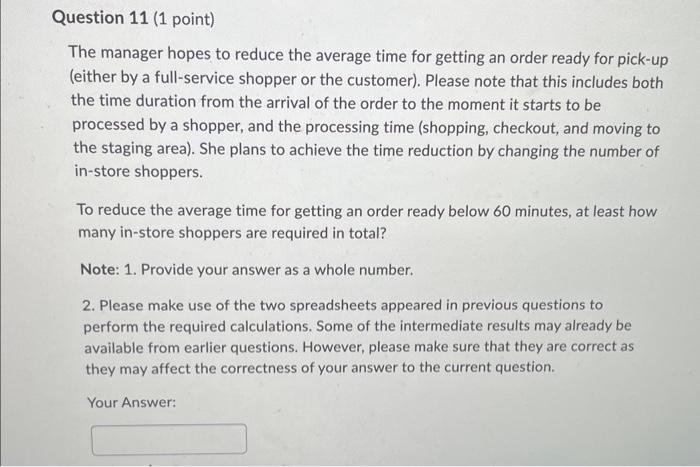
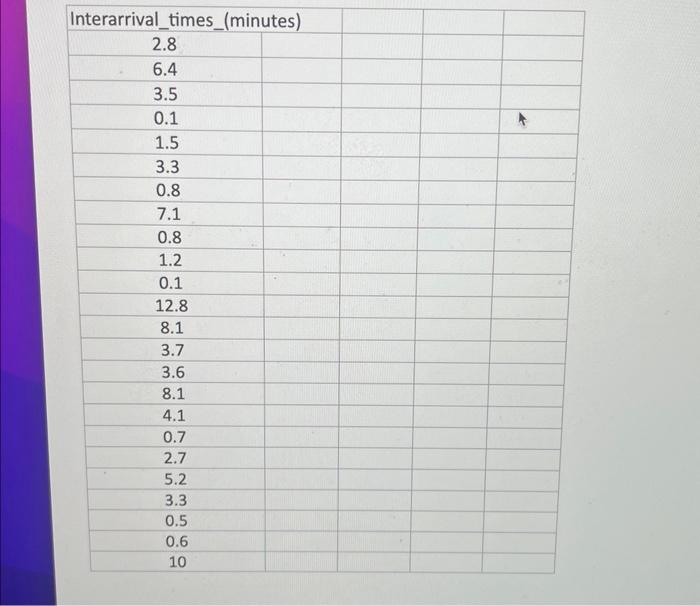
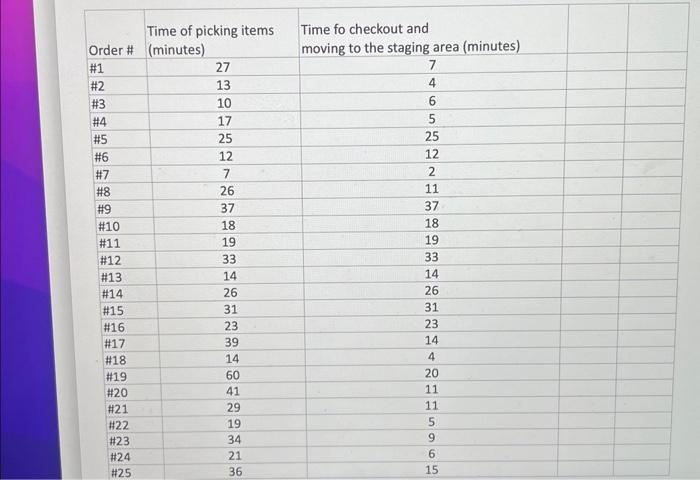
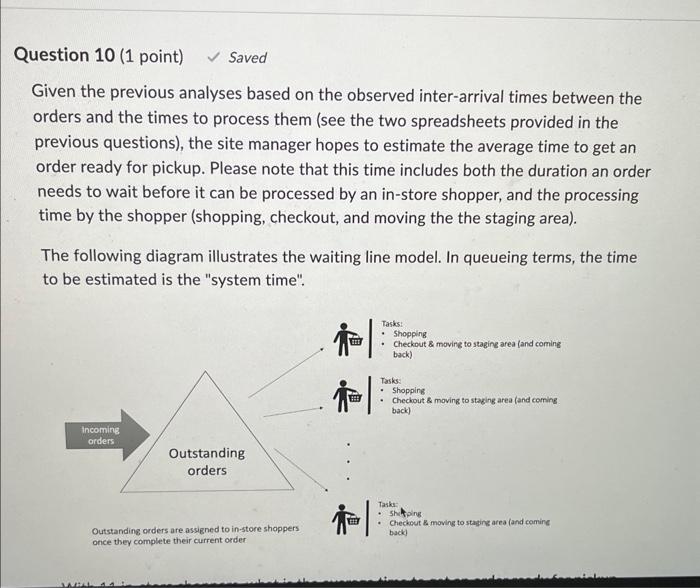
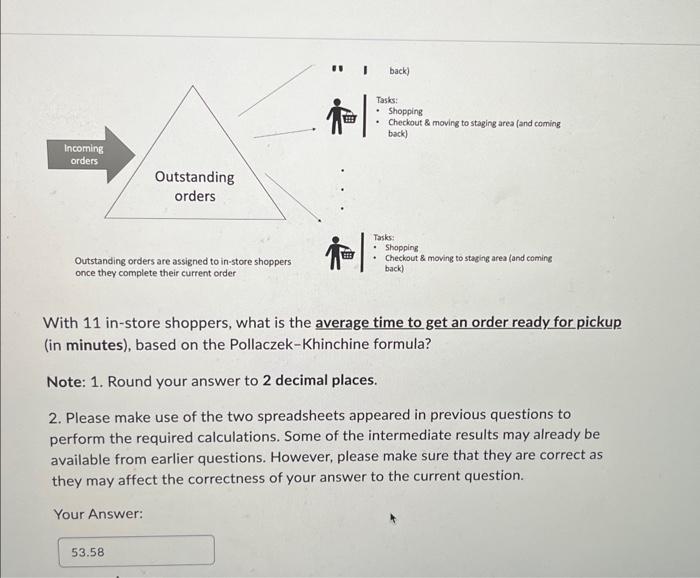
The manager hopes to reduce the average time for getting an order ready for pick-up (either by a full-service shopper or the customer). Please note that this includes both the time duration from the arrival of the order to the moment it starts to be processed by a shopper, and the processing time (shopping, checkout, and moving to the staging area). She plans to achieve the time reduction by changing the number of in-store shoppers. To reduce the average time for getting an order ready below 60 minutes, at least how many in-store shoppers are required in total? Note: 1 . Provide your answer as a whole number. 2. Please make use of the two spreadsheets appeared in previous questions to perform the required calculations. Some of the intermediate results may already be available from earlier questions. However, please make sure that they are correct as they may affect the correctness of your answer to the current question. Your Answer: Interarrival_times_(minutes) \begin{tabular}{c} \hline 2.8 \\ 6.4 \\ 3.5 \\ 0.1 \\ 1.5 \\ 3.3 \\ 0.8 \\ 7.1 \\ 0.8 \\ 1.2 \\ 0.1 \\ 12.8 \\ 8.1 \\ 3.7 \\ 3.6 \\ 8.1 \\ 4.1 \\ 0.7 \\ 2.7 \\ \hline .2 \\ \hline 3.3 \\ \hline 0.5 \\ \hline 0.6 \\ 10 \end{tabular} \begin{tabular}{|l|c|c|} \hline & TimeofpickingitemsOrder#inutes) & Timefocheckoutandmovingtothestagingarea(minutes) \\ \hline#1 & 27 & 7 \\ \hline#2 & 13 & 4 \\ \hline#3 & 10 & 6 \\ \hline#4 & 17 & 5 \\ \hline#5 & 25 & 25 \\ \hline#6 & 12 & 12 \\ \hline#7 & 7 & 2 \\ \hline#8 & 26 & 11 \\ \hline#9 & 37 & 37 \\ \hline#10 & 18 & 18 \\ \hline#11 & 19 & 19 \\ \hline#12 & 33 & 33 \\ \hline#13 & 14 & 14 \\ \hline#14 & 26 & 26 \\ \hline#15 & 31 & 31 \\ \hline#16 & 23 & 23 \\ \hline#17 & 39 & 14 \\ \hline#18 & 14 & 4 \\ \hline#19 & 60 & 20 \\ \hline#20 & 41 & 11 \\ \hline#21 & 29 & 11 \\ \hline#22 & 19 & 5 \\ \hline#23 & 34 & 9 \\ \hline#24 & 31 & 6 \\ \hline#25 & 15 \\ \hline \end{tabular} Given the previous analyses based on the observed inter-arrival times between the orders and the times to process them (see the two spreadsheets provided in the previous questions), the site manager hopes to estimate the average time to get an order ready for pickup. Please note that this time includes both the duration an order needs to wait before it can be processed by an in-store shopper, and the processing time by the shopper (shopping, checkout, and moving the the staging area). The following diagram illustrates the waiting line model. In queueing terms, the time to be estimated is the "system time". With 11 in-store shoppers, what is the average time to get an order ready for pickup (in minutes), based on the Pollaczek-Khinchine formula? Note: 1 . Round your answer to 2 decimal places. 2. Please make use of the two spreadsheets appeared in previous questions to perform the required calculations. Some of the intermediate results may already be available from earlier questions. However, please make sure that they are correct as they may affect the correctness of your answer to the current question. Your Answer: The manager hopes to reduce the average time for getting an order ready for pick-up (either by a full-service shopper or the customer). Please note that this includes both the time duration from the arrival of the order to the moment it starts to be processed by a shopper, and the processing time (shopping, checkout, and moving to the staging area). She plans to achieve the time reduction by changing the number of in-store shoppers. To reduce the average time for getting an order ready below 60 minutes, at least how many in-store shoppers are required in total? Note: 1 . Provide your answer as a whole number. 2. Please make use of the two spreadsheets appeared in previous questions to perform the required calculations. Some of the intermediate results may already be available from earlier questions. However, please make sure that they are correct as they may affect the correctness of your answer to the current question. Your Answer: Interarrival_times_(minutes) \begin{tabular}{c} \hline 2.8 \\ 6.4 \\ 3.5 \\ 0.1 \\ 1.5 \\ 3.3 \\ 0.8 \\ 7.1 \\ 0.8 \\ 1.2 \\ 0.1 \\ 12.8 \\ 8.1 \\ 3.7 \\ 3.6 \\ 8.1 \\ 4.1 \\ 0.7 \\ 2.7 \\ \hline .2 \\ \hline 3.3 \\ \hline 0.5 \\ \hline 0.6 \\ 10 \end{tabular} \begin{tabular}{|l|c|c|} \hline & TimeofpickingitemsOrder#inutes) & Timefocheckoutandmovingtothestagingarea(minutes) \\ \hline#1 & 27 & 7 \\ \hline#2 & 13 & 4 \\ \hline#3 & 10 & 6 \\ \hline#4 & 17 & 5 \\ \hline#5 & 25 & 25 \\ \hline#6 & 12 & 12 \\ \hline#7 & 7 & 2 \\ \hline#8 & 26 & 11 \\ \hline#9 & 37 & 37 \\ \hline#10 & 18 & 18 \\ \hline#11 & 19 & 19 \\ \hline#12 & 33 & 33 \\ \hline#13 & 14 & 14 \\ \hline#14 & 26 & 26 \\ \hline#15 & 31 & 31 \\ \hline#16 & 23 & 23 \\ \hline#17 & 39 & 14 \\ \hline#18 & 14 & 4 \\ \hline#19 & 60 & 20 \\ \hline#20 & 41 & 11 \\ \hline#21 & 29 & 11 \\ \hline#22 & 19 & 5 \\ \hline#23 & 34 & 9 \\ \hline#24 & 31 & 6 \\ \hline#25 & 15 \\ \hline \end{tabular} Given the previous analyses based on the observed inter-arrival times between the orders and the times to process them (see the two spreadsheets provided in the previous questions), the site manager hopes to estimate the average time to get an order ready for pickup. Please note that this time includes both the duration an order needs to wait before it can be processed by an in-store shopper, and the processing time by the shopper (shopping, checkout, and moving the the staging area). The following diagram illustrates the waiting line model. In queueing terms, the time to be estimated is the "system time". With 11 in-store shoppers, what is the average time to get an order ready for pickup (in minutes), based on the Pollaczek-Khinchine formula? Note: 1 . Round your answer to 2 decimal places. 2. Please make use of the two spreadsheets appeared in previous questions to perform the required calculations. Some of the intermediate results may already be available from earlier questions. However, please make sure that they are correct as they may affect the correctness of your answer to the current question. Your
Step by Step Solution
There are 3 Steps involved in it

Get step-by-step solutions from verified subject matter experts
 Study Help