



Question: The spring-like effect in a golf club could be determined by measuring the coefficient of restitution (the ratio of the outbound velocity to the inbound
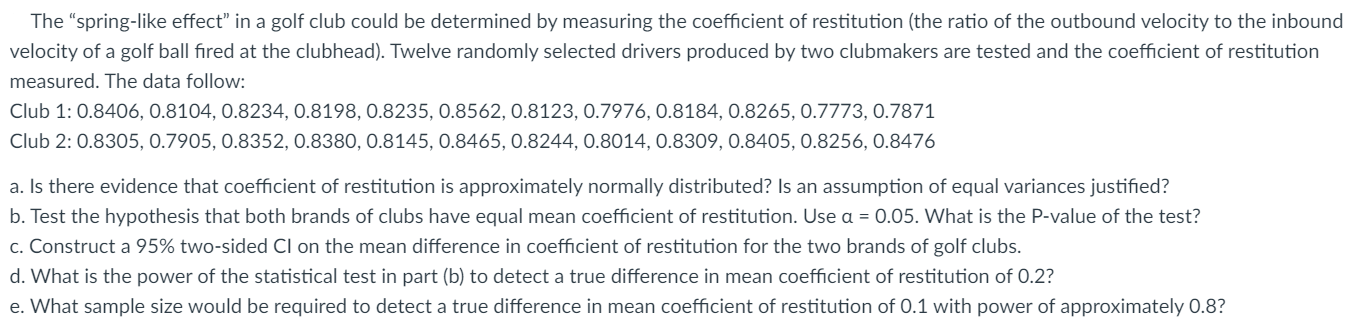
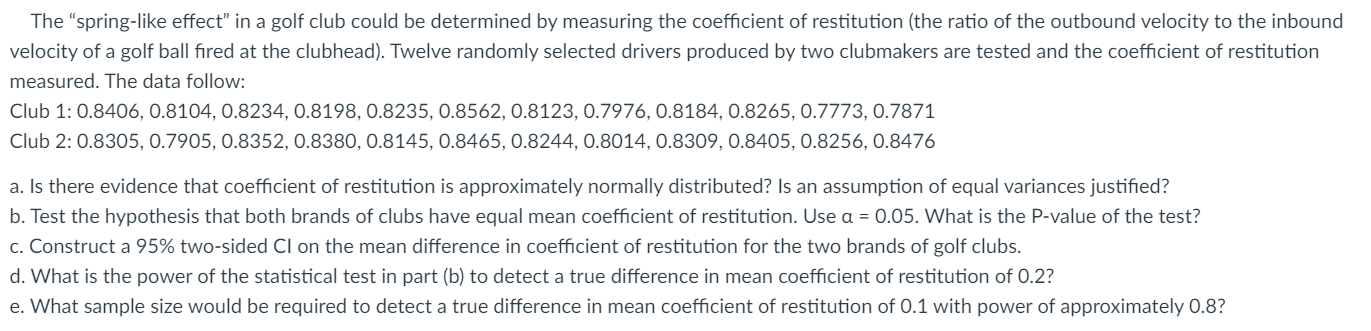
The "spring-like effect" in a golf club could be determined by measuring the coefficient of restitution (the ratio of the outbound velocity to the inbound velocity of a golf ball fired at the clubhead). Twelve randomly selected drivers produced by two clubmakers are tested and the coefficient of restitution measured. The data follow: Club 1: 0.8406, 0.8104, 0.8234, 0.8198, 0.8235, 0.8562, 0.8123, 0.7976, 0.8184, 0.8265, 0.7773, 0.7871 Club 2: 0.8305, 0.7905, 0.8352, 0.8380, 0.8145, 0.8465, 0.8244, 0.8014, 0.8309, 0.8405, 0.8256, 0.8476 a. Is there evidence that coefficient of restitution is approximately normally distributed? Is an assumption of equal variances justified? b. Test the hypothesis that both brands of clubs have equal mean coefficient of restitution. Use a = 0.05. What is the P-value of the test? c. Construct a 95% two-sided CI on the mean difference in coefficient of restitution for the two brands of golf clubs. d. What is the power of the statistical test in part (b) to detect a true difference in mean coefficient of restitution of 0.2? e. What sample size would be required to detect a true difference in mean coefficient of restitution of 0.1 with power of approximately 0.8
Step by Step Solution
There are 3 Steps involved in it

Get step-by-step solutions from verified subject matter experts