







Question: The statement coupled by its huge availability of resources which allows it rope for R&D, diversification and expansion .. Honda manages to pursue its strategies
- The statement coupled by its huge availability of resources which allows it rope for R&D, diversification and expansion.. Honda manages to pursue its strategies successfully. We can understand through the resource based approach that for a resource to be valuable, it must have THREE (3) things.
Discuss critically the THREE (3) important criterias that makes a resource valuable.
- Aside from the importance of internal resources, external forces are also a major determinant of an organisations success.
Discuss the FIVE (5) categories of external forces that may have also helped Honda in its success.
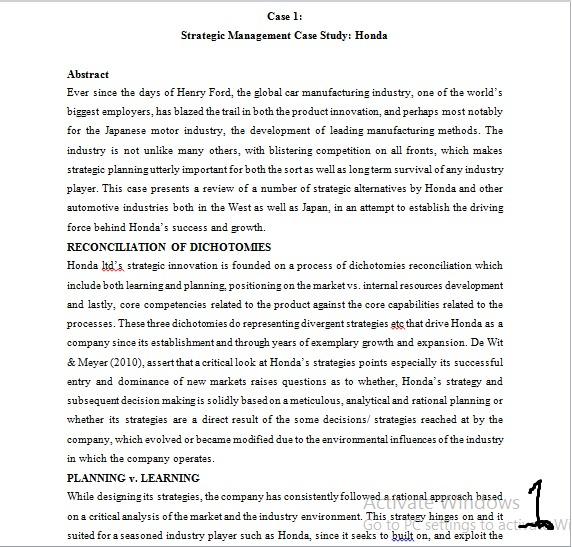
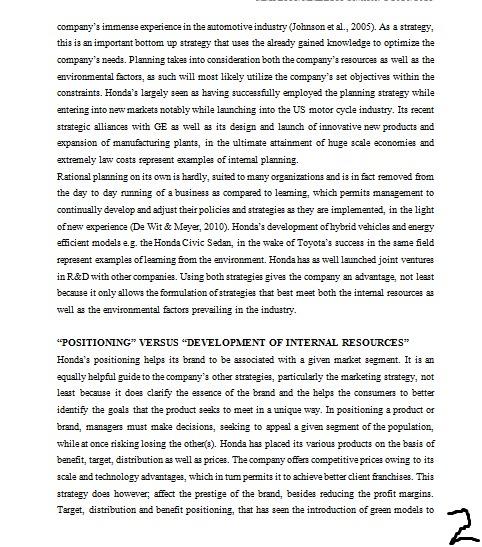
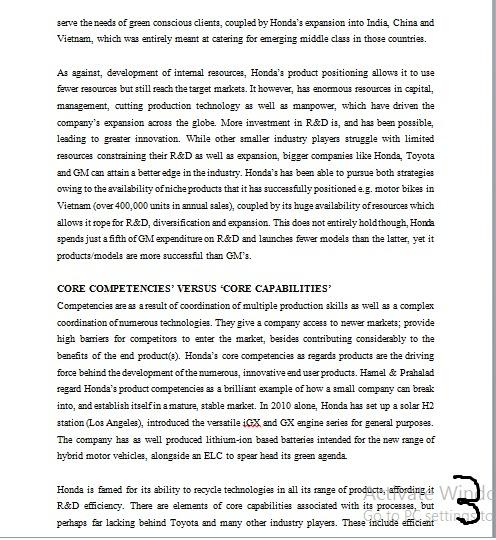
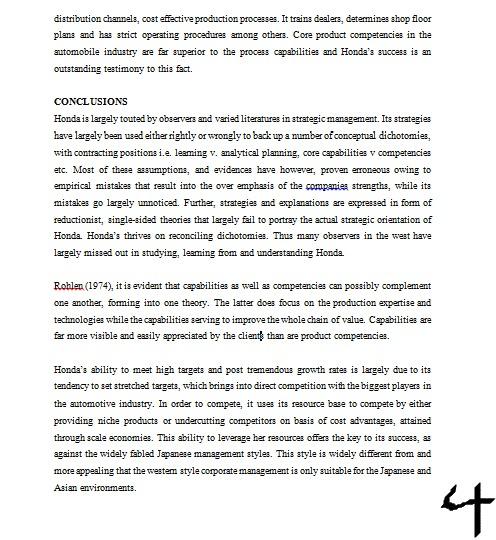
Case 1: Strategic Management Case Study: Honda Abstract Ever since the days of Henry Ford the global car manufacturing industry, one of the world's biggest employers, has blazed the trail in both the product innovation, and perhaps most notably for the Japanese motor industry, the development of leading manufacturing methods. The industry is not unlike many others, with blistering competition on all fronts, which makes strategic planning utterly important for both the sort as well as long term survival of any industry player. This case presents a review of a number of strategic alternatives by Honda and other automotive industries both in the West as well as Japan, in an attempt to establish the driving force behind Honda's success and growth. RECONCILIATION OF DICHOTOMES Honda ltd's strategic innovation is founded on a process of dichotomies reconciliation which include both learning and planning. positioning on the market vs. internal resources development and lastly, core competencies related to the product against the core capabilities related to the processes. These three dichotomies do representing divergent strategies sts that drive Honda as a company since its establishment and through years of exemplary growth and expansion. De Wit & Mayer (2010), assert that a critical look at Honda's strategies points especially its successful entry and dominance of new markets raises questions as to whether. Honda's strategy and subsequent decision making is solidly based on a meticulous, analytical and rational planning or whether its strategies are a direct result of the some decisions/strategies reached at by the company, which evolved or became modified due to the environmental influences of the industry in which the company operates. PLANNING . LEARNING While designing its strategies, the company has consistently followed a rational approach basedus on a critical analysis of the market and the industry environment. This strategy This strategy hingas on and it cartoon suited for a seasoned industry player such as Honda, since it seeks to built on, and exploit the 1 1 company's immense experience in the automotive industry (Johnson et al., 2005). As a strategy. this is an important bottom up strategy that uses the already gained knowledge to optimize the company's needs. Planning takes into consideration both the company's resources as well as the environmental factors, as such will most likely utilize the company's set objectives within the constraints. Honda's largely saan as having successfully employed the planning strategy while entering into new markets notably while launching into the US motor cycle industry. Its recent strategic alliances with GE as well as its design and launch of innovative new products and expansion of manufacturing plants, in the ultimate attainment of huge scale economies and extremely law costs represent examples of intemal planning. Rational planning on its own is hardly, suited to many organizations and is in fact removed from the day to day running of a business as compared to leaming, which permits management to continually develop and adjust their policies and strategies as they are implemented in the light of new experience (De Wit & Meyer, 2010). Honda's development of hybrid vehicles and energy efficient models e.g. the Honda Civic Sedan, in the wake of Toyota's success in the same field represent examples of leaming from the environment. Honda has a well launched joint ventures in R&D with other companies. Using both strategies gives the company an advantage, not least because it only allows the formulation of strategies that best meet both the internal resources 23 well as the environmental factors prevailing in the industry. "POSITIONING VERSUS DEVELOPMENT OF INTERNAL RESOURCES" Honda's positioning helps its brand to be associated with a given market segment. It is an equally helpful guide to the company's other strategies, particularly the marketing strategy, not least because it does clarify the essence of the brand and the helps the consumers to better identify the goals that the product seeks to meet in a unique way. In positioning a product or brand, managers must make decisions, seeking to appeal a given segment of the population, while at once risking losing the other(s). Honda has placed its various products on the basis of benefit, target, distribution as well as prices. The company offers competitive prices owing to its scale and technology advantages, which in tum permits it to achieve better client franchises. This strategy does however, affect the prestige of the brand, besides reducing the profit margins. Target, distribution and benefit positioning, that has seen the introduction of green models to 2 serve the needs of green conscious clients, coupled by Honda's expansion into India China and Vietnam, which was entirely meant at catering for emerging middle class in those countries. As against, development of intemal resources, Honda's product positioning allows it to use fewer resources but still reach the target markets. It however, has enormous resources in capital, management, cutting production technology as well as manpower, which have driven the company's expansion across the globe. More investment in R&D is, and has been possible, leading to greater innovation. While other smaller industry players struggle with limited resources constraining their R&D as well as expansion, bigger companies like Honda Toyota and GM can attain a better edge in the industry. Honda's has been able to pursue both strategies owing to the availability of niche products that it has successfully positioned eg. motor bikes in Vietnam (over 400,000 units in annual sales), coupled by its huge availability of resources which allows it rope for R&D, diversification and expansion. This does not entirely hold though, Honda spends just a fifth of GM expenditure on R&D and launches fewer models than the latter, yet it products/models are more successful than GM's. CORE COMPETENCIES' VERSUS CORE CAPABILITIES Competencies are as a result of coordination of multiple production skills as well as a complex coordination of numerous technologies. They give a company access to newer markets; provide high baniers for competitors to enter the market, besides contributing considerably to the benefits of the end product(s). Honda's core competencies as regards products are the driving force behind the development of the numerous, innovative and user products. Hamel & Prahalad regard Honda's product competencies as a brilliant example of how a small company can break into, and establish itself in a mature, stable market. In 2010 alone. Honda has set up a solar H2 station (Los Angeles), introduced the versatile iCX and GX engine series for general purposes. The company has a well produced lithium-ion based batteries intended for the new range of hybrid motor vehicles, alongside an ELC to spear bead its grean agenda Honda is famed for its ability to recycle technologies in all its range of products, affording it fording at WID R&D efficiency. There are elements of core capabilities associated with its processes, but setti perhaps far lacking behind Toyota and many other industry players. These include efficient distribution channels, cost effective production processes. It trains dealers, determines shop floor plans and has strict operating procedures among others. Core product competencies in the automobile industry are far superior to the process capabilities and Honda's success is an outstanding testimony to this fact. CONCLUSIONS Honda is largely touted by observers and varied literatures in strategic management. Its strategies have largely been used either rightly or wrongly to back up a member of conceptual dichotomies, with contracting positions i.e. leaming v. analytical planning, core capabilities v competencies etc. Most of these assumptions, and evidences have however, proven erroneous owing to empirical mistakes that result into the over emphasis of the companies strengths, while its mistakes go largely unnoticed. Further, strategies and explanations are expressed in form of reductionist, single-sided theories that largely fail to portray the actual strategic orientation of Honda Honda's thrives on reconciling dichotomies. Thus many observers in the west have largely missed out in studying, leaming from and understanding Honda Rohlen (1974), it is evident that capabilities as well as competencies can possibly complement one another, forming into one theory. The latter does focus on the production expertise and technologies while the capabilities serving to improve the whole chain of value. Capabilities are far more visible and easily appreciated by the client than are product competencies. Honda's ability to meet high targets and post tremendous growth rates is largely due to its tendency to set stretched targets, which brings into direct competition with the biggest players in the automotive industry. In order to compete, it uses its resource base to compete by either providing niche products or undercutting competitors on basis of cost advantages, attained through scale economies. This ability to leverage her resources the key to success, as against the widely fabled Japanese management styles. This style is widely different from and more appealing that the westem style corporate management is only suitable for the Japanese and Asian environments. 4
Step by Step Solution
There are 3 Steps involved in it
1 Expert Approved Answer
Step: 1 Unlock

Question Has Been Solved by an Expert!
Get step-by-step solutions from verified subject matter experts
Step: 2 Unlock
Step: 3 Unlock
 Study Help