







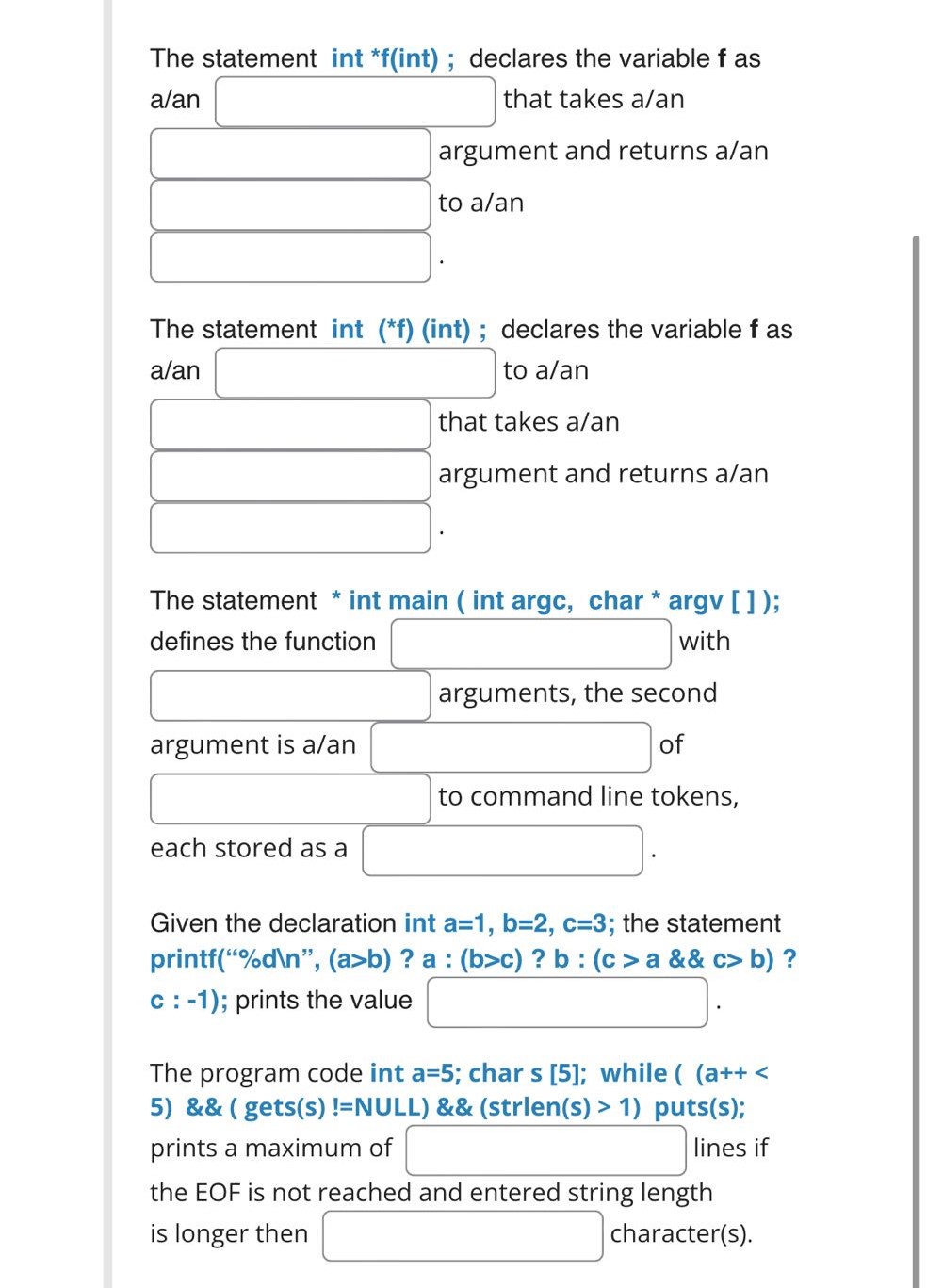
Question: The statement int * f ( int ) ; declares the variable f as a / an that takes a / an argument and returns
The statement int fint ; declares the variable as
aan
that takes aan
argument and returns aan
to aan
The statement int fint ; declares the variable f as
aan
to aan
that takes aan
argument and returns aan
The statement int main int argc, char argv ;
defines the function
with
arguments, the second
argument is aan
of
to command line tokens,
each stored as a
Given the declaration int ; the statement
printfdlnab a : bc b : c a && c b
:; prints the value
The program code int a; char s ; while a
&& getssNULL && strlens putss;
prints a maximum of
lines if
the EOF is not reached and entered string length
is longer then
characters
Step by Step Solution
There are 3 Steps involved in it
1 Expert Approved Answer
Step: 1 Unlock

Question Has Been Solved by an Expert!
Get step-by-step solutions from verified subject matter experts
Step: 2 Unlock
Step: 3 Unlock
 Study Help