







Question: The statistical thinking underlying Six Sigma is based on the following three principles: All work is subject to varying performance outcomes; the amount of variability
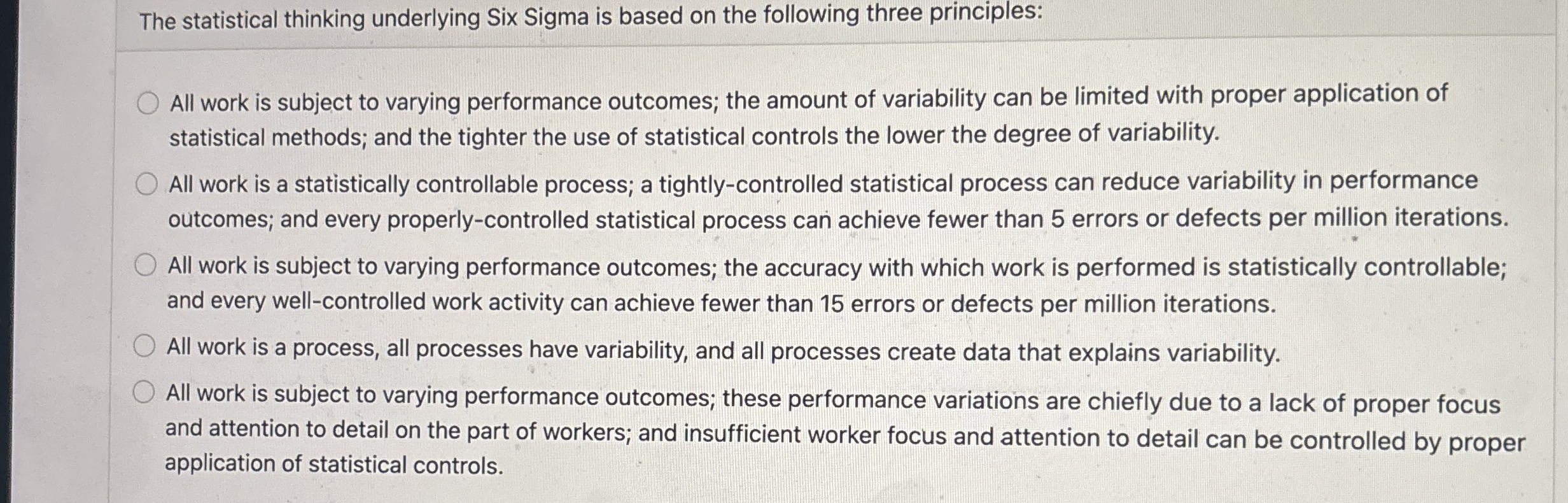
The statistical thinking underlying Six Sigma is based on the following three principles:
All work is subject to varying performance outcomes; the amount of variability can be limited with proper application of statistical methods; and the tighter the use of statistical controls the lower the degree of variability.
All work is a statistically controllable process; a tightlycontrolled statistical process can reduce variability in performance outcomes; and every properlycontrolled statistical process can achieve fewer than errors or defects per million iterations.
All work is subject to varying performance outcomes; the accuracy with which work is performed is statistically controllable; and every wellcontrolled work activity can achieve fewer than errors or defects per million iterations.
All work is a process, all processes have variability, and all processes create data that explains variability.
All work is subject to varying performance outcomes; these performance variations are chiefly due to a lack of proper focus and attention to detail on the part of workers; and insufficient worker focus and attention to detail can be controlled by proper application of statistical controls.
Step by Step Solution
There are 3 Steps involved in it
1 Expert Approved Answer
Step: 1 Unlock

Question Has Been Solved by an Expert!
Get step-by-step solutions from verified subject matter experts
Step: 2 Unlock
Step: 3 Unlock
 Study Help