







Question: The .step-down allocation method: typically begins with the support department that provides the highest percentage of its total services to other support departments recognizes the
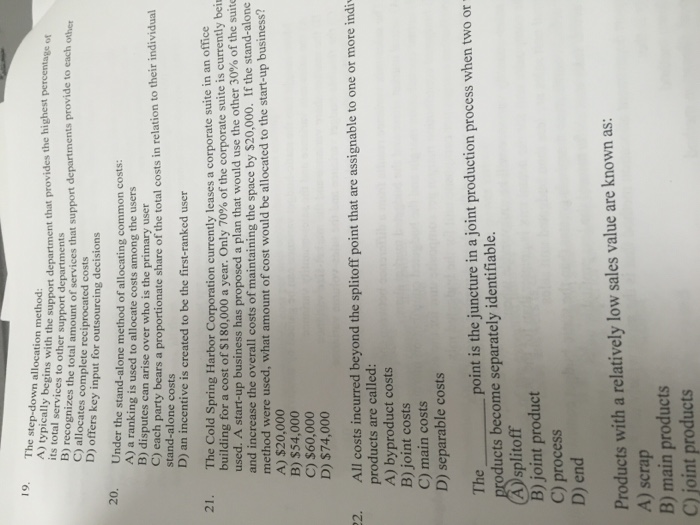
The .step-down allocation method: typically begins with the support department that provides the highest percentage of its total services to other support departments recognizes the total amount of services that support deportments provide to each other allocates complete reciprocated costs oilers key input for outsourcing decisions Under the stand-alone method of allocating common costs: a ranking is used to allocate costs among the users disputes can arise over who is the primary user each party bears a proportionate share of the total costs in relation to their individual stand-alone costs an incentive is created to be the first-ranked user The Cold Spring Harbor Corporation currently leases a corporate suite in an office building for a cost of $180,000 a year. Only 70% of the corporate suite is currently used. A start-up business has proposed a plan that would use the other 30% of the and increase the overall costs of maintaining the space by $20,000. If the stand-alone method were used, what amount of cost would be allocated to the start-up business? $20,000 $54,000 $60,000 $74.000 All costs incurred beyond the splitoff point that are assignable to one or more products are called: byproduct costs joint costs main costs separable costs The point is the juncture in a joint production process when tow or products become separately identifiable. splitoff joint product process end Products with a relatively low sales value are known as: scrap main products joint products
Step by Step Solution
There are 3 Steps involved in it

Get step-by-step solutions from verified subject matter experts
 Study Help