







Question: The table at the bottom is for d, e, and f 2. Roz and Celia are making milk shakes and smoothies. They can make products
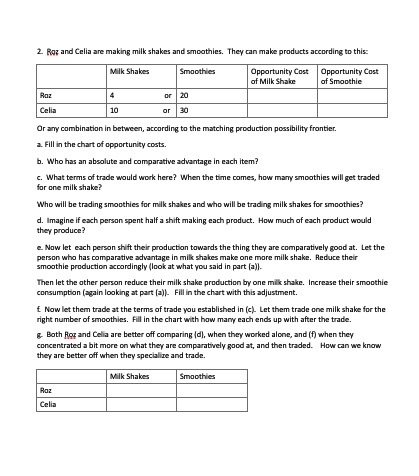
The table at the bottom is for d, e, and f
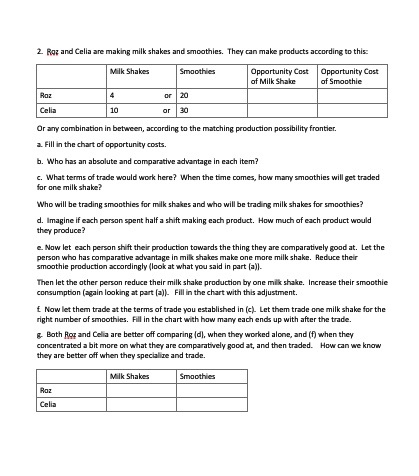
2. Roz and Celia are making milk shakes and smoothies. They can make products according to this: Milk Shakes Smoothies Opportunity Cost Opportunity Cost of Milk Shake of Smoothie Roz 4 Celia 10 or Or any combination in between, according to the matching production possibility frontier. a. Fill in the chart of opportunity costs. b. Who has an absolute and comparative advantage in each item? c. What terms of trade would work here?' When the time comes, how many smoothies will get traded for one milk shake? Who will be trading smoothies for milk shakes and who will be trading milk shakes for smoothies? d. Imagine if each person spent half a shift making each product. How much of each product would they produce? e. Now let each person shift their production towards the thing they are comparatively good at. Let the person who has comparative advantage in milk shakes make one more milk shake. Reduce their smoothie production accordingly (look at what you said in part (ajl. Then let the other person reduce their milk shake production by one milk shake. Increase their smoothie consumption (again looking at part [a)). Fill in the chart with this adjustment. f Now let them trade at the terms of trade you established in (c). Let them trade one milk shake for the right number of smoothies. Fill in the chart with how many each ends up with after the trade. - Both For and Celia are better off comparing (d), when they worked alone, and (f) when they concentrated a bit more on what they are comparatively good at, and then traded. How can we know they are better off when they specialize and trade. Milk Shakes Smoothies Roz Celia
Step by Step Solution
There are 3 Steps involved in it

Get step-by-step solutions from verified subject matter experts
 Study Help