







Question: The table gives observed values for the function y=f(x). We will use four methods to approximate the instantaneous rate of change of f(x) when x=10.
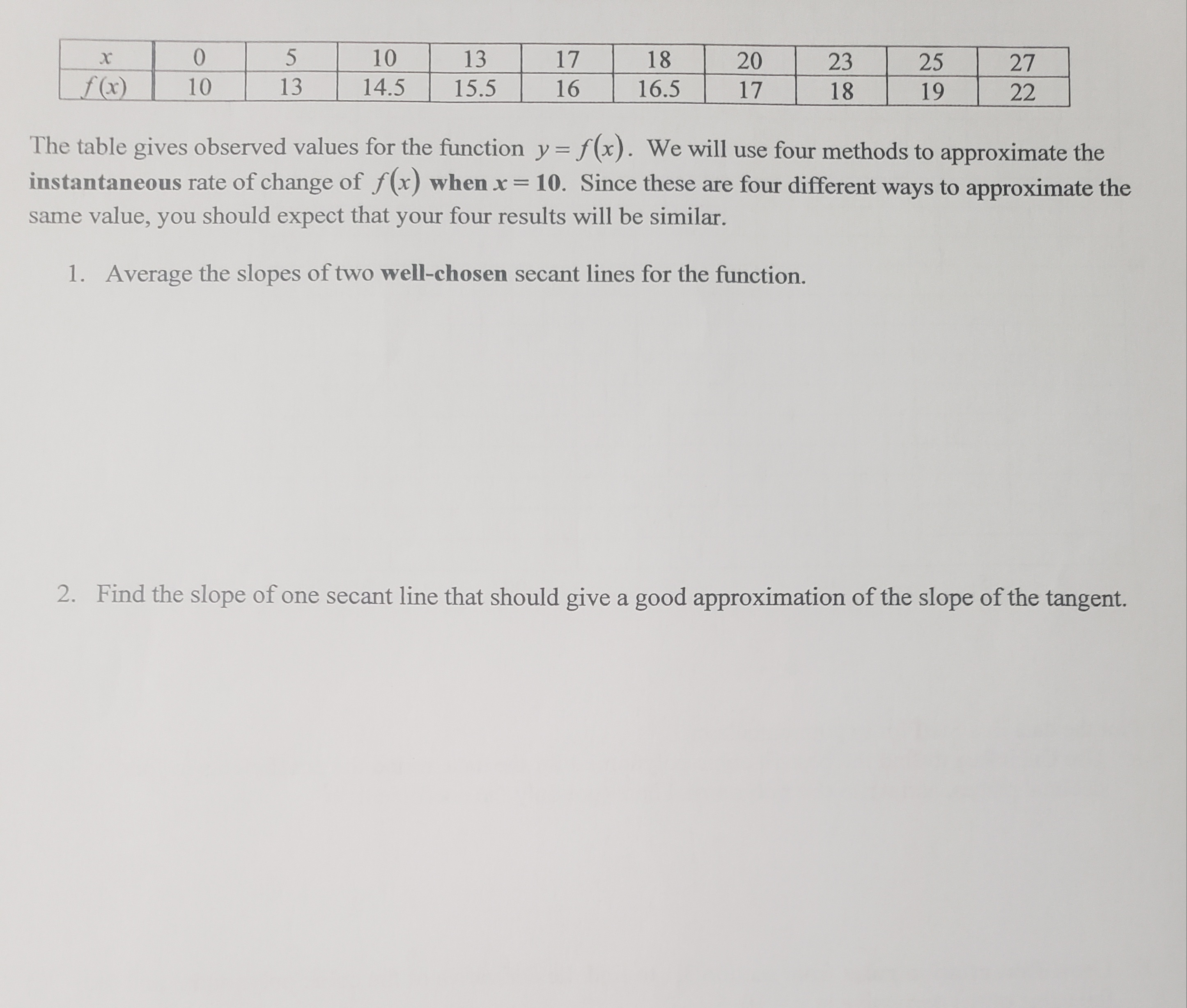
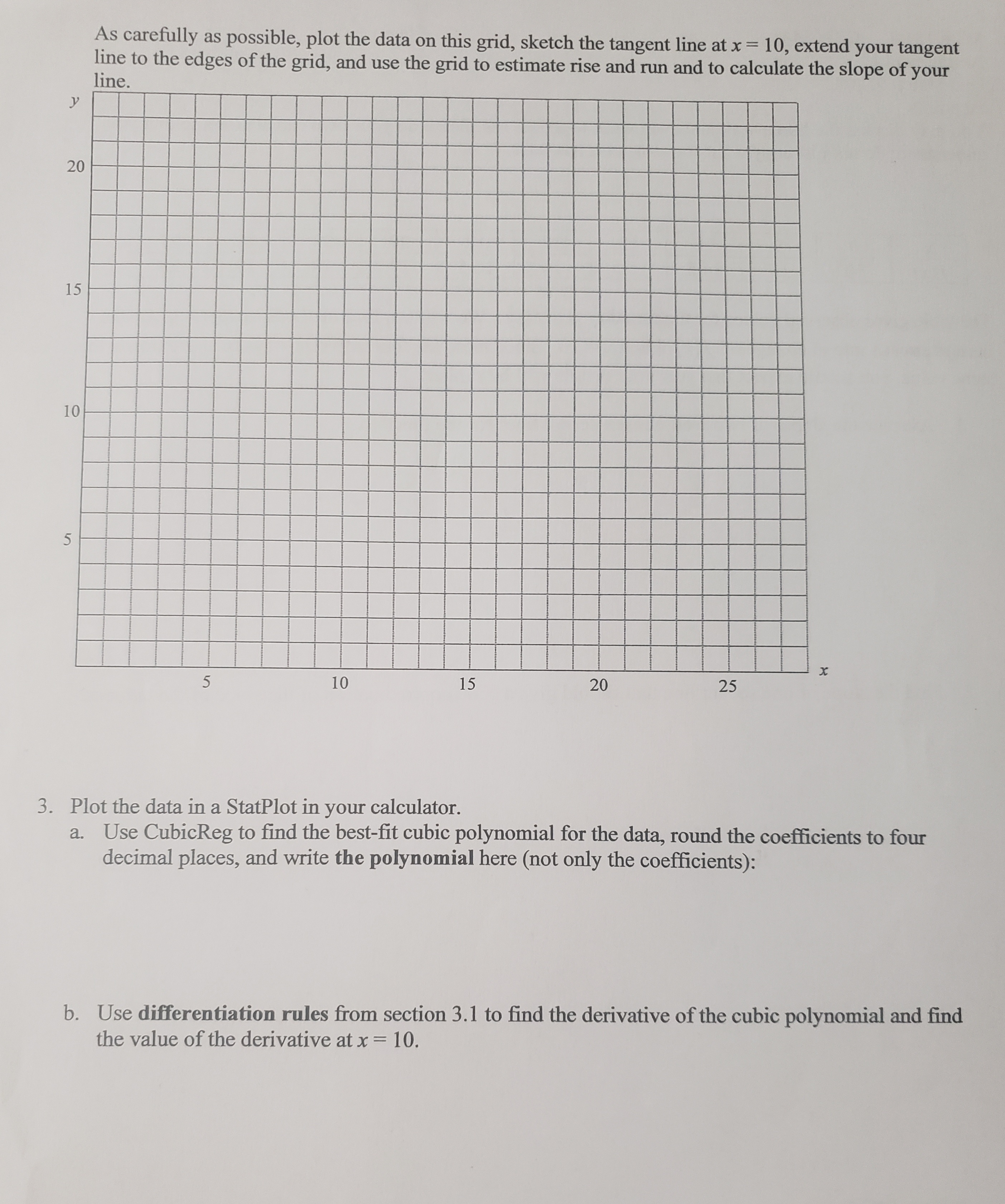
The table gives observed values for the function y=f(x). We will use four methods to approximate the instantaneous rate of change of f(x) when x=10. Since these are four different ways to approximate the same value, you should expect that your four results will be similar. 1. Average the slopes of two well-chosen secant lines for the function. 2. Find the slope of one secant line that should give a good approximation of the slope of the tangent. As carefully as possible, plot the data on this grid, sketch the tangent line at x=10, extend your tangent line to the edges of the grid, and use the grid to estimate rise and run and to calculate the slope of your lino 3. Plot the data in a StatPlot in your calculator. a. Use CubicReg to find the best-fit cubic polynomial for the data, round the coefficients to four decimal places, and write the polynomial here (not only the coefficients): b. Use differentiation rules from section 3.1 to find the derivative of the cubic polynomial and find the value of the derivative at x=10
Step by Step Solution
There are 3 Steps involved in it

Get step-by-step solutions from verified subject matter experts
 Study Help