







Question: The task forces first meeting was described as a total waste of time. Which of the following practices of effective team meetings was not adhered
-
The task forces first meeting was described as a total waste of time. Which of the following practices of effective team meetings was not adhered to?
A. Create and follow a meeting agenda
B. Keep meeting notes or minutes
C. Summarize meeting with action items
D. All of the above
- Which of the following is most likely to be the reason that the team failed to attribute the problem to interdepartmental factors?
| A. | Lack of trust | |
| B. | Lack of commitment | |
| C. | Interdepartmental factors were not within the scope of the teams assignment | |
| D. | Avoidance of accountability |
-
During Meeting #2, which of the following elements of successful team structure emerged as lacking?
A. Goals with intended outcomes
B. Sufficient resources to achieve goals
C. Authority to act
D. Team Stability
-
Which of the following is most likely to be the reason that Meeting #3 didnt happen until top management inquired about the teams progress?
A. Lack of trust
B. Lack of commitment
C. Insufficient technical and process knowledge to solve problems
D. Avoidance of accountability
-
Which of the following is most likely to be the reason that the team excluded any recommendations relating to the Sales & Marketing department?
A. Inattention to results
B. Fear of conflict
C. Lack of trust
D. Lack of commitment
-
Keiths reaction to lagging sales data over the prior two years is best attributed to which of the following?
A. Inattention to results
B. Lack of trust
C. Ineffective/inappropriate reward system
D. Fear of conflict
-
The main reason that Keith gave George the mandate to conceal the weakness or mistakes in the Sales & Marketing Plan with anyone on the task force is:
A. Inattention to results
B. Lack of trust
C. Lack of commitment
D. The team did not represent the right set of stakeholders
-
Which of the following is most likely to be the reason that Carla, Sienna, and Nisha agreed to conclude the economy was to blame for the sales decline in the report to top management?
A. They lack sufficient technical and/or process knowledge to analyze internal problems.
B. Lack of trust
C. Lack of commitment
D. Fear of conflict
-
Which of the following is most likely to be the reason that the last meeting was very short and no attention was given to the quality of the recommendations or report?
A. The team had been working together long enough to act quickly
B. Lack of commitment
C. Fear of conflict
D. Avoidance of accountability
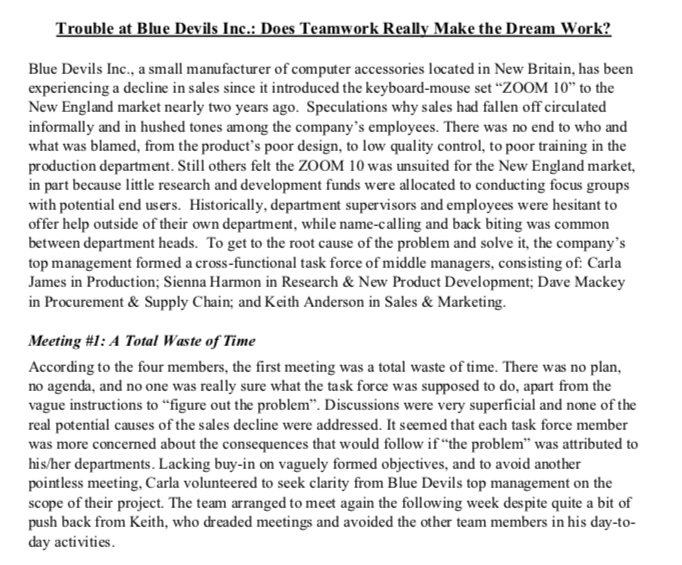
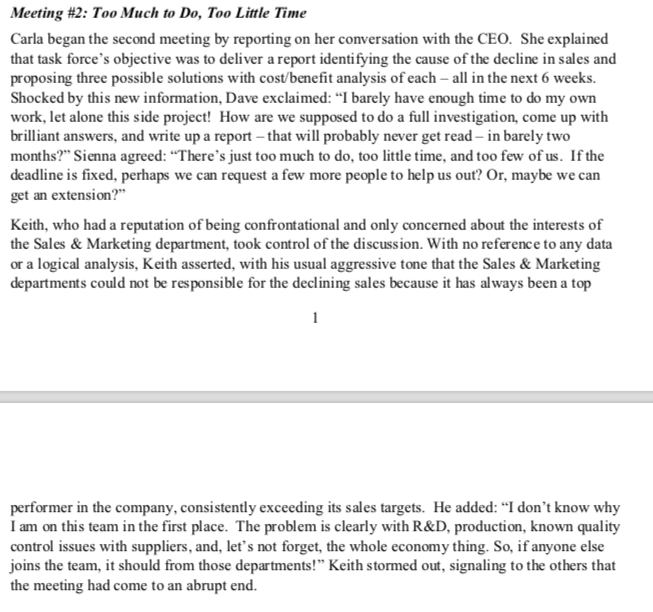
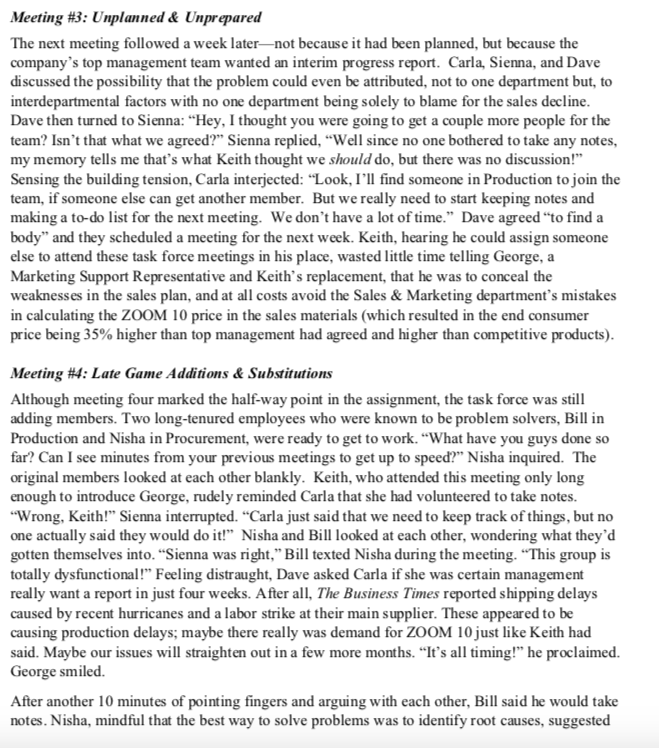
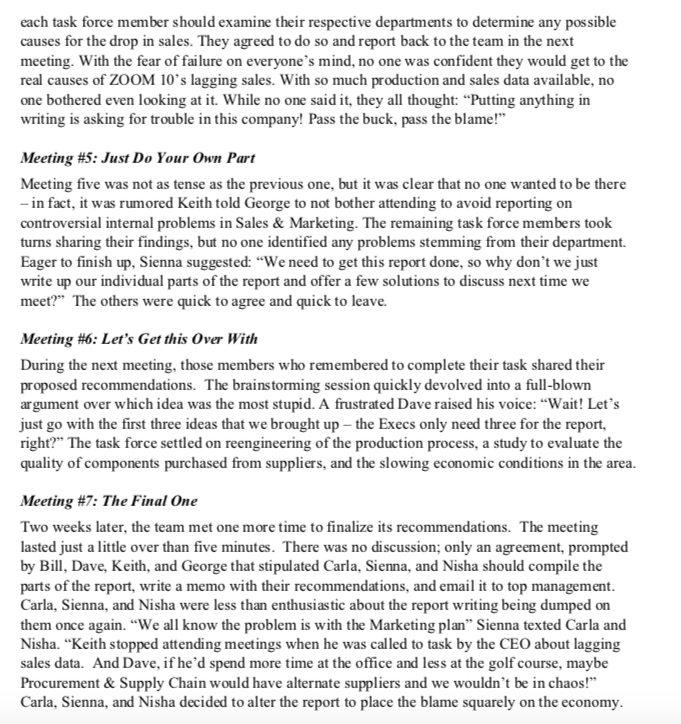
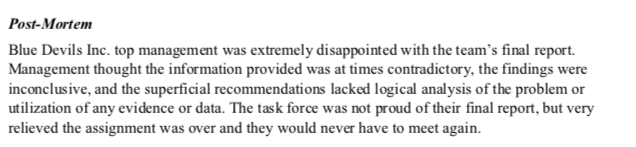
Trouble at Blue Devils Inc.: Does Teamwork Really Make the Dream Work? Blue Devils Inc., a small manufacturer of computer accessories located in New Britain, has been experiencing a decline in sales since it introduced the keyboard-mouse set ZOOM 10 to the New England market nearly two years ago. Speculations why sales had fallen off circulated informally and in hushed tones among the company's employees. There was no end to who and what was blamed, from the product's poor design, to low quality control, to poor training in the production department. Still others felt the ZOOM 10 was unsuited for the New England market, in part because little research and development funds were allocated to conducting focus groups with potential end users. Historically, department supervisors and employees were hesitant to offer help outside of their own department, while name-calling and back biting was common between department heads. To get to the root cause of the problem and solve it, the company's top management formed a cross-functional task force of middle managers, consisting of: Carla James in Production; Sienna Harmon in Research & New Product Development; Dave Mackey in Procurement & Supply Chain; and Keith Anderson in Sales & Marketing. Meeting #1: A Total Waste of Time According to the four members, the first meeting was a total waste of time. There was no plan, no agenda, and no one was really sure what the task force was supposed to do, apart from the vague instructions to figure out the problem. Discussions were very superficial and none of the real potential causes of the sales decline were addressed. It seemed that each task force member was more concerned about the consequences that would follow if the problem was attributed to his/her departments. Lacking buy-in on vaguely formed objectives, and to avoid another pointless meeting, Carla volunteered to seek clarity from Blue Devils top management on the scope of their project. The team arranged to meet again the following week despite quite a bit of push back from Keith, who dreaded meetings and avoided the other team members in his day-to- day activities. Meeting #2: Too Much to Do, Too Little Time Carla began the second meeting by reporting on her conversation with the CEO. She explained that task force's objective was to deliver a report identifying the cause of the decline in sales and proposing three possible solutions with cost/benefit analysis of each - all in the next 6 weeks. Shocked by this new information, Dave exclaimed: I barely have enough time to do my own work, let alone this side project! How are we supposed to do a full investigation, come up with brilliant answers, and write up a report - that will probably never get read - in barely two months?" Sienna agreed: There's just too much to do, too little time, and too few of us. If the deadline is fixed, perhaps we can request a few more people to help us out? Or, maybe we can get an extension?" Keith, who had a reputation of being confrontational and only concerned about the interests of the Sales & Marketing department, took control of the discussion. With no reference to any data or a logical analysis, Keith asserted, with his usual aggressive tone that the Sales & Marketing departments could not be responsible for the declining sales because it has always been a top 1 performer in the company, consistently exceeding its sales targets. He added: I don't know why I am on this team in the first place. The problem is clearly with R&D, production, known quality control issues with suppliers, and, let's not forget, the whole economy thing. So, if anyone else joins the team, it should from those departments!" Keith stormed out, signaling to the others that the meeting had come to an abrupt end. Meeting #3: Unplanned & Unprepared The next meeting followed a week laternot because it had been planned, but because the company's top management team wanted an interim progress report. Carla, Sienna, and Dave discussed the possibility that the problem could even be attributed, not to one department but, to interdepartmental factors with no one department being solely to blame for the sales decline. Dave then turned to Sienna: "Hey, I thought you were going to get a couple more people for the team? Isn't that what we agreed?" Sienna replied, Well since no one bothered to take any notes, my memory tells me that's what Keith thought we should do, but there was no discussion!" Sensing the building tension, Carla interjected: Look, I'll find someone in Production to join the team, if someone else can get another member. But we really need to start keeping notes and making a to-do list for the next meeting. We don't have a lot of time. Dave agreed to find a body and they scheduled a meeting for the next week. Keith, hearing he could assign someone else to attend these task force meetings in his place, wasted little time telling George, a Marketing Support Representative and Keith's replacement, that he was to conceal the weaknesses in the sales plan, and at all costs avoid the Sales & Marketing department's mistakes in calculating the ZOOM 10 price in the sales materials (which resulted in the end consumer price being 35% higher than top management had agreed and higher than competitive products). Meeting #4: Late Game Additions & Substitutions Although meeting four marked the half-way point in the assignment, the task force was still adding members. Two long-tenured employees who were known to be problem solvers, Bill in Production and Nisha in Procurement, were ready to get to work. What have you guys done so far? Can I see minutes from your previous meetings to get up to speed? Nisha inquired. The original members looked at each other blankly. Keith, who attended this meeting only long enough to introduce George, rudely reminded Carla that she had volunteered to take notes. "Wrong, Keith!" Sienna interrupted. "Carla just said that we need to keep track of things, but no one actually said they would do it!" Nisha and Bill looked at each other, wondering what they'd gotten themselves into. "Sienna was right," Bill texted Nisha during the meeting. "This group is totally dysfunctional! Feeling distraught, Dave asked Carla if she was certain management really want a report in just four weeks. After all, The Business Times reported shipping delays caused by recent hurricanes and a labor strike at their main supplier. These appeared to be causing production delays, maybe there really was demand for ZOOM 10 just like Keith had said. Maybe our issues will straighten out in a few more months. It's all timing! he proclaimed. George smiled. After another 10 minutes of pointing fingers and arguing with each other, Bill said he would take notes. Nisha, mindful that the best way to solve problems was to identify root causes, suggested each task force member should examine their respective departments to determine any possible causes for the drop in sales. They agreed to do so and report back to the team in the next meeting. With the fear of failure on everyone's mind, no one was confident they would get to the real causes of ZOOM 10's lagging sales. With so much production and sales data available, no one bothered even looking at it. While no one said it, they all thought: Putting anything in writing is asking for trouble in this company! Pass the buck, pass the blame!" Meeting #5: Just Do Your Own Part Meeting five was not as tense as the previous one, but it was clear that no one wanted to be there - in fact, it was rumored Keith told George to not bother attending to avoid reporting on controversial internal problems in Sales & Marketing. The remaining task force members took turns sharing their findings, but no one identified any problems stemming from their department. Eager to finish up, Sienna suggested: We need to get this report done, so why don't we just write up our individual parts of the report and offer a few solutions to discuss next time we meet?" The others were quick to agree and quick to leave. Meeting #6: Let's Get this Over With During the next meeting, those members who remembered to complete their task shared their proposed recommendations. The brainstorming session quickly devolved into a full-blown argument over which idea was the most stupid. A frustrated Dave raised his voice: Wait! Let's just go with the first three ideas that we brought up the Execs only need three for the report, right? The task force settled on reengineering of the production process, a study to evaluate the quality of components purchased from suppliers, and the slowing economic conditions in the area. Meeting #7: The Final One Two weeks later, the team met one more time to finalize its recommendations. The meeting lasted just a little over than five minutes. There was no discussion; only an agreement, prompted by Bill, Dave, Keith, and George that stipulated Carla, Sienna, and Nisha should compile the parts of the report, write a memo with their recommendations, and email it to top management. Carla, Sienna, and Nisha were less than enthusiastic about the report writing being dumped on them once again. We all know the problem is with the Marketing plan Sienna texted Carla and Nisha. Keith stopped attending meetings when he was called to task by the CEO about lagging sales data. And Dave, if he'd spend more time at the office and less at the golf course, maybe Procurement & Supply Chain would have alternate suppliers and we wouldn't be in chaos!" Carla, Sienna, and Nisha decided to alter the report to place the blame squarely on the economy. Post-Mortem Blue Devils Inc. top management was extremely disappointed with the team's final report. Management thought the information provided was at times contradictory, the findings were inconclusive, and the superficial recommendations lacked logical analysis of the problem or utilization of any evidence or data. The task force was not proud of their final report, but very relieved the assignment was over and they would never have to meet again
Step by Step Solution
There are 3 Steps involved in it

Get step-by-step solutions from verified subject matter experts
 Study Help