







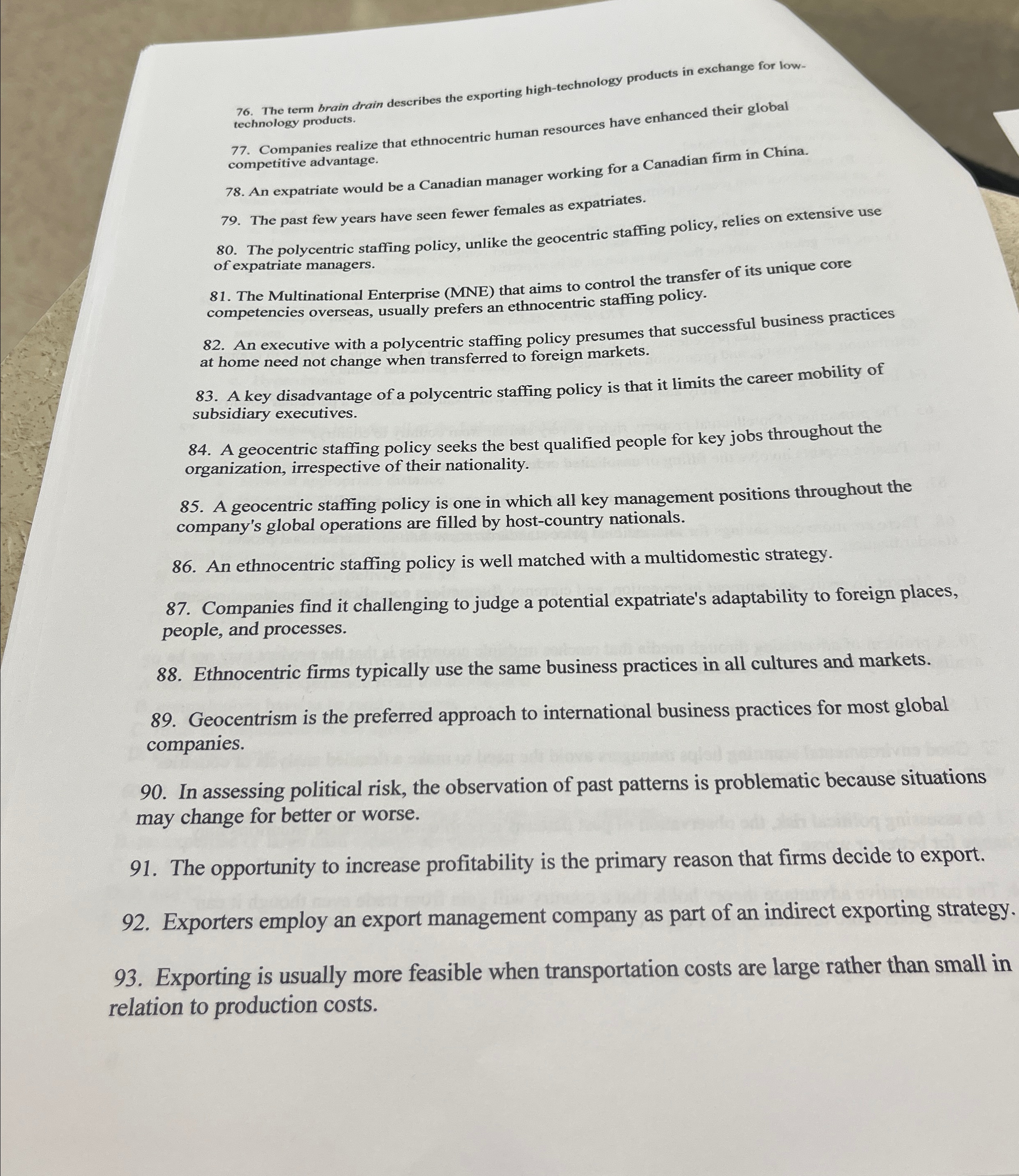
Question: The term brain drain describes the exporting high - technology products in exchange for lowtechnology products. Companies realize that ethnocentric human resources have enhanced their
The term brain drain describes the exporting hightechnology products in exchange for lowtechnology products.
Companies realize that ethnocentric human resources have enhanced their global competitive advantage.
An expatriate would be a Canadian manager working for a Canadian firm in China.
The past few years have seen fewer females as expatriates.
The polycentric staffing policy, unlike the geocentric staffing policy, relies on extensive use of expatriate managers.
The Multinational Enterprise MNE that aims to control the transfer of its unique core competencies overseas, usually prefers an ethnocentric staffing policy.
An executive with a polycentric staffing policy presumes that successful business practices at home need not change when transferred to foreign markets.
A key disadvantage of a polycentric staffing policy is that it limits the career mobility of subsidiary executives.
A geocentric staffing policy seeks the best qualified people for key jobs throughout the organization, irrespective of their nationality.
A geocentric staffing policy is one in which all key management positions throughout the company's global operations are filled by hostcountry nationals.
An ethnocentric staffing policy is well matched with a multidomestic strategy.
Companies find it challenging to judge a potential expatriate's adaptability to foreign places, people, and processes.
Ethnocentric firms typically use the same business practices in all cultures and markets.
Geocentrism is the preferred approach to international business practices for most global companies.
In assessing political risk, the observation of past patterns is problematic because situations may change for better or worse.
The opportunity to increase profitability is the primary reason that firms decide to export.
Exporters employ an export management company as part of an indirect exporting strategy.
Exporting is usually more feasible when transportation costs are large rather than small in relation to production costs.
Step by Step Solution
There are 3 Steps involved in it
1 Expert Approved Answer
Step: 1 Unlock

Question Has Been Solved by an Expert!
Get step-by-step solutions from verified subject matter experts
Step: 2 Unlock
Step: 3 Unlock
 Study Help