







Question: The thermal energy density e ( x , t ) is proportional to the temperature u ( x , t ) : e ( x
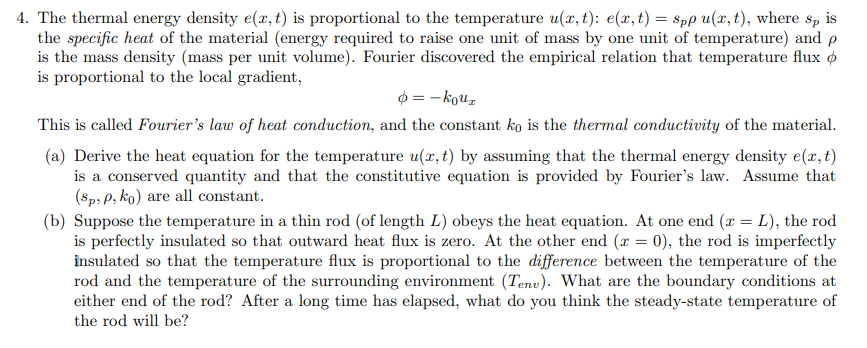
The thermal energy density ex t is proportional to the temperature ux t: ex t sprho ux t where sp is
the specific heat of the material energy required to raise one unit of mass by one unit of temperature and rho
is the mass density mass per unit volume Fourier discovered the empirical relation that temperature flux
is proportional to the local gradient,
kux
This is called Fouriers law of heat conduction, and the constant k is the thermal conductivity of the material.
a Derive the heat equation for the temperature ux t by assuming that the thermal energy density ex t
is a conserved quantity and that the constitutive equation is provided by Fouriers law. Assume that
sprho k are all constant.
b Suppose the temperature in a thin rod of length L obeys the heat equation. At one end x L the rod
is perfectly insulated so that outward heat flux is zero. At the other end x the rod is imperfectly
insulated so that the temperature flux is proportional to the difference between the temperature of the
rod and the temperature of the surrounding environment Tenv What are the boundary conditions at
either end of the rod? After a long time has elapsed, what do you think the steadystate temperature of
the rod will beThe thermal energy density is proportional to the temperature : where is
the specific heat of the material energy required to raise one unit of mass by one unit of temperature and
is the mass density mass per unit volume Fourier discovered the empirical relation that temperature flux
is proportional to the local gradient,
This is called Fourier's law of heat conduction, and the constant is the thermal conductivity of the material.
a Derive the heat equation for the temperature by assuming that the thermal energy density
is a conserved quantity and that the constitutive equation is provided by Fourier's law. Assume that
are all constant.
b Suppose the temperature in a thin rod of length obeys the heat equation. At one end the rod
is perfectly insulated so that outward heat flux is zero. At the other end the rod is imperfectly
insulated so that the temperature flux is proportional to the difference between the temperature of the
rod and the temperature of the surrounding environment What are the boundary conditions at
either end of the rod? After a long time has elapsed, what do you think the steadystate temperature of
the rod will be
Step by Step Solution
There are 3 Steps involved in it
1 Expert Approved Answer
Step: 1 Unlock

Question Has Been Solved by an Expert!
Get step-by-step solutions from verified subject matter experts
Step: 2 Unlock
Step: 3 Unlock
 Study Help