







Question: The time-to-live, TTL, field in a datagram is incremented by 1 each time the datagram is processed by a router. When TTL reaches the maximum
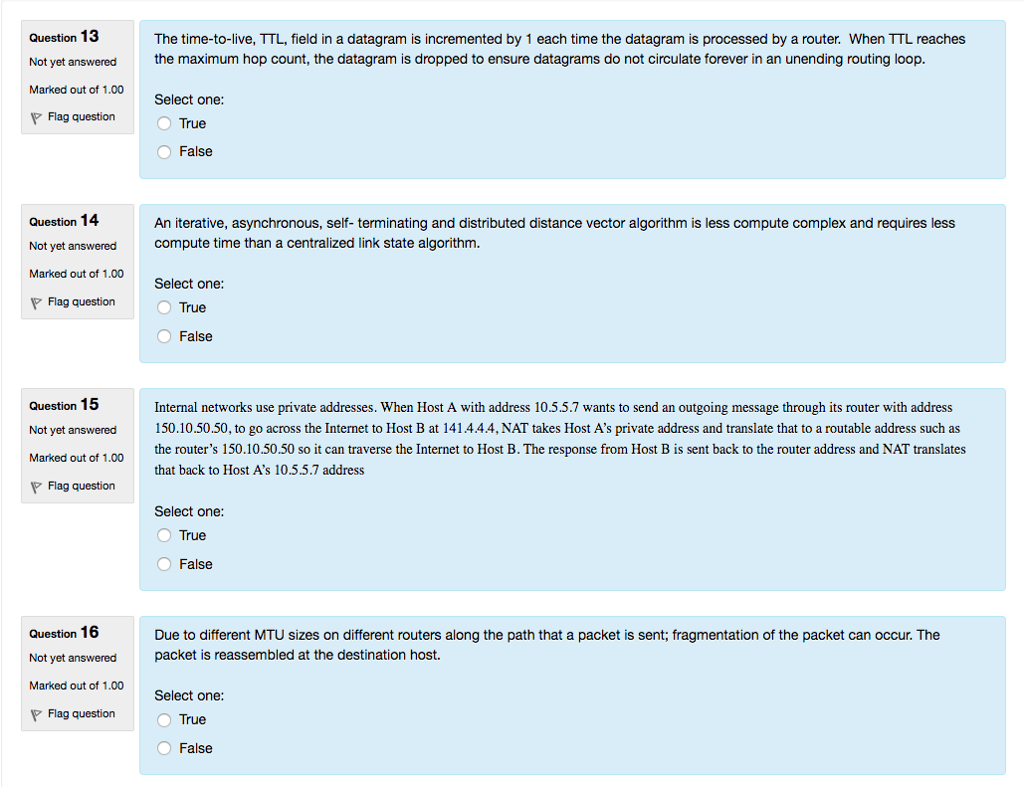 The time-to-live, TTL, field in a datagram is incremented by 1 each time the datagram is processed by a router. When TTL reaches the maximum hop count, the datagram is dropped to ensure datagrams do not circulate forever in an unending routing loop.
Question 13 Not yet answered Marked out of 1.00 The time-to-live, TTL, field in a datagram is incremented by 1 each time the datagram is processed by a router. When TTL reaches the maximum hop count, the datagram is dropped to ensure datagrams do not circulate forever in an unending routing loop. Select one: O True O False Flag question Question 14 Not yet answered Marked out of 1.00 An iterative, asynchronous, self- terminating and distributed distance vector algorithm is less compute complex and requires less compute time than a centralized link state algorithm Select one Flag question True O False Question 15 Not yet answered Marked out of 1.00 Internal networks use private addresses. When Host A with address 10.5.5.7 wants to send an outgoing message through its router with address 150.10.50.50, to go across the Internet to Host B at 141.4.44, NAT takes Host A's private address and translate that to a routable address such as the router's 150.10.50.50 so it can traverse the Internet to Host B. The response from Host B is sent back to the router address and NAT translates that back to Host A's 10.5.5.7 address Flag question Select one: O True False Question 16 Not yet answered Marked out of 1.00 Due to different MTU sizes on different routers along the path that a packet is sent; fragmentation of the packet can occur. The packet is reassembled at the destination host. Select one: Flag question O True False
Step by Step Solution
There are 3 Steps involved in it

Get step-by-step solutions from verified subject matter experts
 Study Help