







Question: The topic was all about Current In the A part , what are the particular terms described in each statement? In the B part ,
The topic was all about Current
In the A part, what are the particular terms described in each statement? In the B part, which statements are true and false? If it is inaccurate, explain why it is wrong or what should be the correct answer.
In the C part, explain how to solve those given problems in detail.
A.
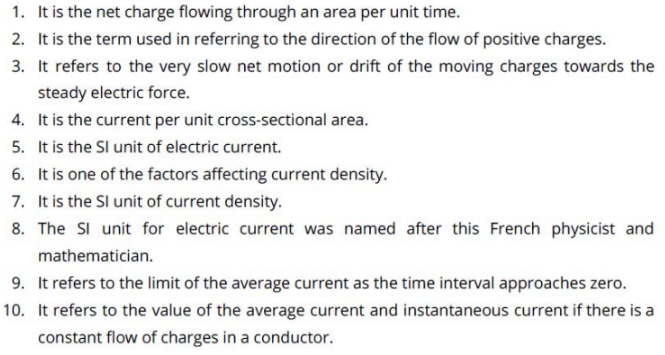
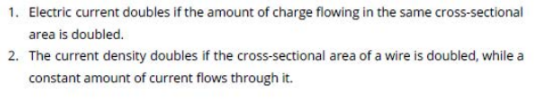
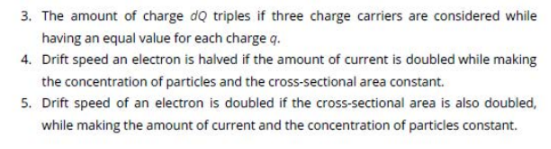
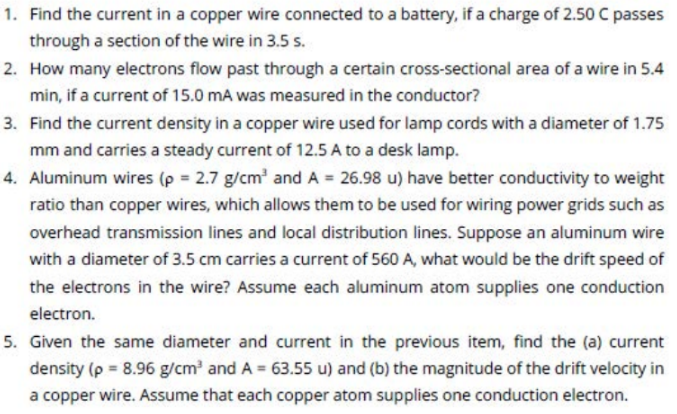
1. It is the net charge flowing through an area per unit time. 2. it is the term used in referring to the direction of the ow of positive charges. 3. It refers to the veryr slow net motion or drift of the moving charges towards the steady electric force. 4. It is the current per unit cross-sectional area. 5. It is the SI unit of electric current. 6. It is one of the factors affecting current density. 3'. It is the SI unit of current density. 3. The Si unit for electric current was named after this French physiclst and mathematician. 9. It refers to the limit of the average current as the time interval approaches zero. 10. It refers to the value of the average currEnt and instantanEOUS current if there is a constant flow of charges In a conductor. 1. Electric current doubles if the amount of charge flowing in the same cross-sectional area is doubled. 2. The current density doubles if the cross-sectional area of a wire is doubled, while a constant amount of current flows through it.3. The amount of charge dQ triples if three charge carriers are considered while having an equal value for each charge q. 4. Drift speed an electron is halved if the amount of current is doubled while making the concentration of particles and the cross-sectional area constant. 5. Drift speed of an electron is doubled if the cross-sectional area is also doubled, while making the amount of current and the concentration of particles constant.1. Find the current in a copper wire connected to a battery, if a charge of 2.50 C passes through a section of the wire in 3.5 s. 2. How many electrons flow past through a certain cross-sectional area of a wire in 5.4 min, if a current of 15.0 mA was measured in the conductor? 3. Find the current density in a copper wire used for lamp cords with a diameter of 1.75 mm and carries a steady current of 12.5 A to a desk lamp. 4. Aluminum wires (p = 2.7 g/cm* and A = 26.98 u) have better conductivity to weight ratio than copper wires, which allows them to be used for wiring power grids such as overhead transmission lines and local distribution lines. Suppose an aluminum wire with a diameter of 3.5 cm carries a current of 560 A, what would be the drift speed of the electrons in the wire? Assume each aluminum atom supplies one conduction electron. 5. Given the same diameter and current in the previous item, find the (a) current density (p = 8.96 g/cm' and A = 63.55 u) and (b) the magnitude of the drift velocity in a copper wire. Assume that each copper atom supplies one conduction electron
Step by Step Solution
There are 3 Steps involved in it

Get step-by-step solutions from verified subject matter experts
 Study Help