







Question: The trapezoid rule is a numerical method for finding the integral of a function that would be difficult to solve analytically. The trapezoid rule algorithm
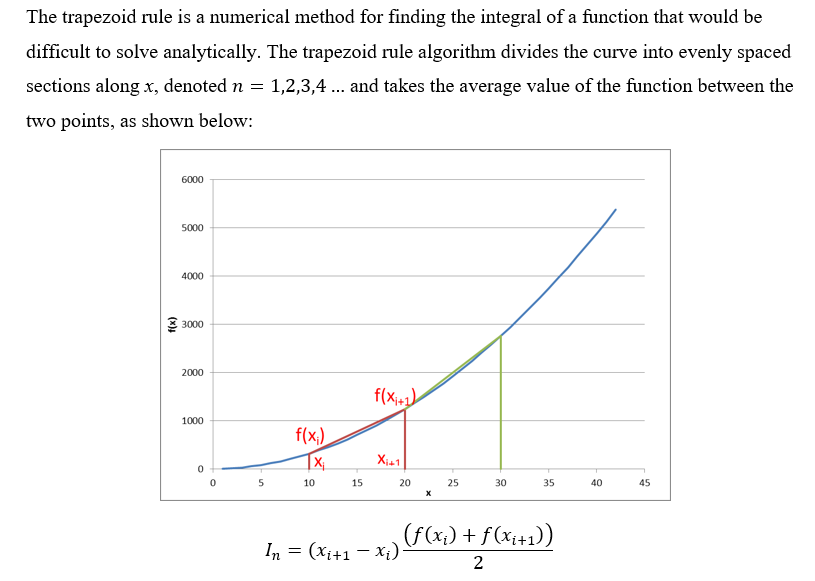
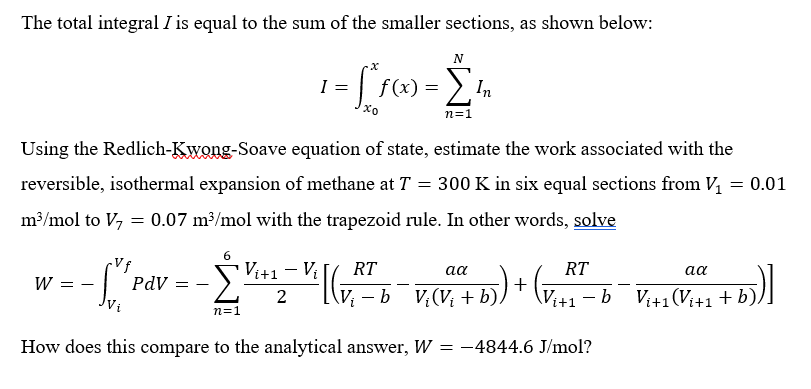
The trapezoid rule is a numerical method for finding the integral of a function that would be difficult to solve analytically. The trapezoid rule algorithm divides the curve into evenly spaced sections along x, denoted n=1,2,3,4 and takes the average value of the function between the two points, as shown below: In=(xi+1xi)2(f(xi)+f(xi+1)) The total integral I is equal to the sum of the smaller sections, as shown below: I=x0xf(x)=n=1NIn Using the Redlich-Kwong-Soave equation of state, estimate the work associated with the reversible, isothermal expansion of methane at T=300K in six equal sections from V1=0.01 m3/mol to V7=0.07m3/mol with the trapezoid rule. In other words, solve W=ViVfPdV=n=162Vi+1Vi[(VibRTVi(Vi+b)a)+(Vi+1bRTVi+1(Vi+1+b)a)] How does this compare to the analytical answer, W=4844.6J/mol
Step by Step Solution
There are 3 Steps involved in it

Get step-by-step solutions from verified subject matter experts
 Study Help