



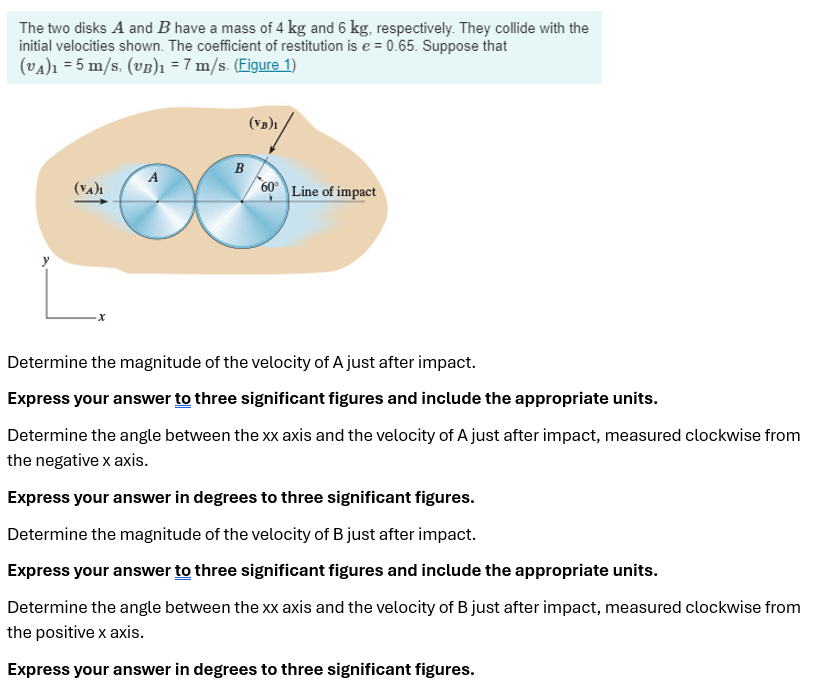
Question: The two disks ( A ) and ( B ) have a mass of 4 kg and 6 kg , respectively.
The two disks A and B have a mass of kg and kg respectively. They collide with the initial velocities shown. The coefficient of restitution is e Suppose that leftvArightmathrm~mmathrmsleftvBrightmathrm~mmathrmsFigure
Determine the magnitude of the velocity of A just after impact.
Express your answer to three significant figures and include the appropriate units.
Determine the angle between the x x axis and the velocity of A just after impact, measured clockwise from the negative x axis.
Express your answer in degrees to three significant figures.
Determine the magnitude of the velocity of B just after impact.
Express your answer to three significant figures and include the appropriate units.
Determine the angle between the xx axis and the velocity of B just after impact, measured clockwise from the positive x axis.
Express your answer in degrees to three significant figures.
Step by Step Solution
There are 3 Steps involved in it
1 Expert Approved Answer
Step: 1 Unlock

Question Has Been Solved by an Expert!
Get step-by-step solutions from verified subject matter experts
Step: 2 Unlock
Step: 3 Unlock