



Question: The two (identical) 10-m diameter Keck telescopes on the summit of Mauna Kea, Hawaii, are two of the largest optical telescopes in the world.
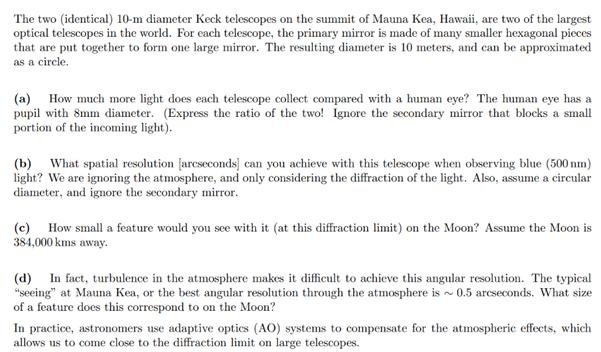
The two (identical) 10-m diameter Keck telescopes on the summit of Mauna Kea, Hawaii, are two of the largest optical telescopes in the world. For each telescope, the primary mirror is made of many smaller hexagonal pieces that are put together to form one large mirror. The resulting diameter is 10 meters, and can be approximated as a circle How much more light does each telescope collect compared with a human eye? The human eye has a pupil with 8mm diameter. (Express the ratio of the two! Ignore the secondary mirror that blocks a small portion of the incoming light). (a) (b) What spatial resolution arcsecondsj can you achieve with this telescope when observing blue (500 nm) light? We are ignoring the atmosphere, and only considering the diffraction of the light. Also, assume a cireular diameter, and ignore the secondary mirror. (c) How small a feature would you see with it (at this diffraction limit) on the Moon? Assume the Moon is 384,000 kms away (d) In fact, turbulence in the atmosphere makes it difficult to achieve this angular resolution. The typical "seeing" at Mauna Kea, or the best angular resolution through the atmosphere is~0.5 arcseconds. What size of a feature docs this correspond to on the Moon? In practice, astronomers use adaptive optics (AO) systems to compensate for the atmospheric effects, which allows us to come close to the diffraction limit on large telescopes.
Step by Step Solution
3.43 Rating (153 Votes )
There are 3 Steps involved in it
Sure Lets solve each part step by step a How much more light does each telescope collect compared wi... View full answer

Get step-by-step solutions from verified subject matter experts