







Question: The two options for both dropdowns is borrower or lender Sovereign Debt Negotiations. A sovereign borrower is considering a $100 million loan for a 4-year
The two options for both dropdowns is borrower or lender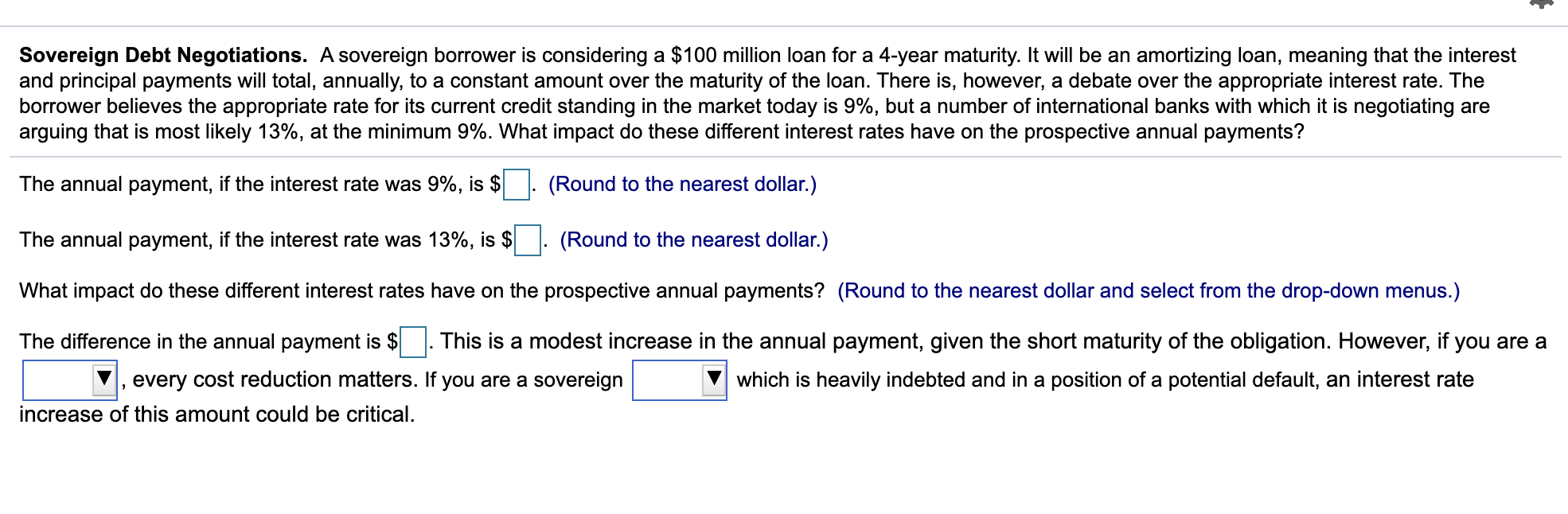
Sovereign Debt Negotiations. A sovereign borrower is considering a $100 million loan for a 4-year maturity. It will be an amortizing loan, meaning that the interest and principal payments will total, annually, to a constant amount over the maturity of the loan. There is, however, a debate over the appropriate interest rate. The borrower believes the appropriate rate for its current credit standing in the market today is 9%, but a number of international banks with which it is negotiating are arguing that is most likely 13%, at the minimum 9%. What impact do these different interest rates have on the prospective annual payments? The annual payment, if the interest rate was 9%, is $ (Round to the nearest dollar.) The annual payment, if the interest rate was 13%, is $ (Round to the nearest dollar.) What impact do these different interest rates have on the prospective annual payments? (Round to the nearest dollar and select from the drop-down menus.) The difference in the annual payment is $. This is a modest increase in the annual payment, given the short maturity of the obligation. However, if you are a every cost reduction matters. If you are a sovereign which is heavily indebted and in a position of a potential default, an interest rate increase of this amount could be critical. 3
Step by Step Solution
There are 3 Steps involved in it

Get step-by-step solutions from verified subject matter experts
 Study Help