







Question: The Two-Phase Simplex Method The onephase simplex method described above may not work if we have a constraint of the form it-Tl 'l' - --+:'n-'1-'n
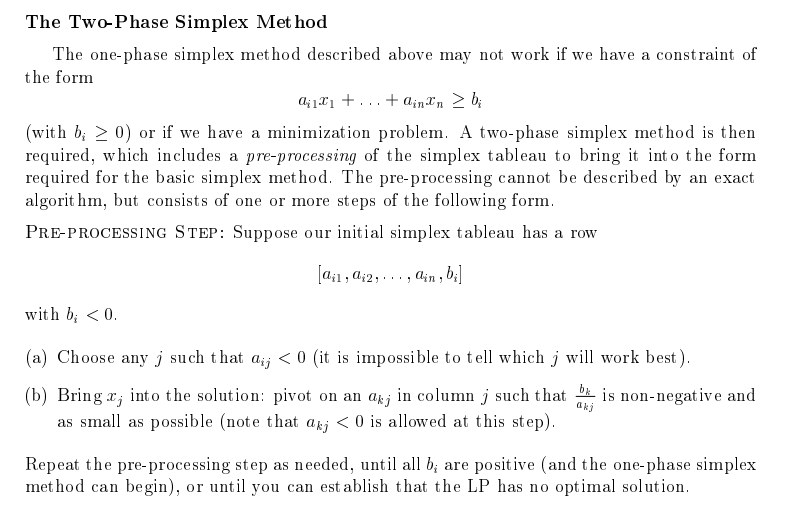
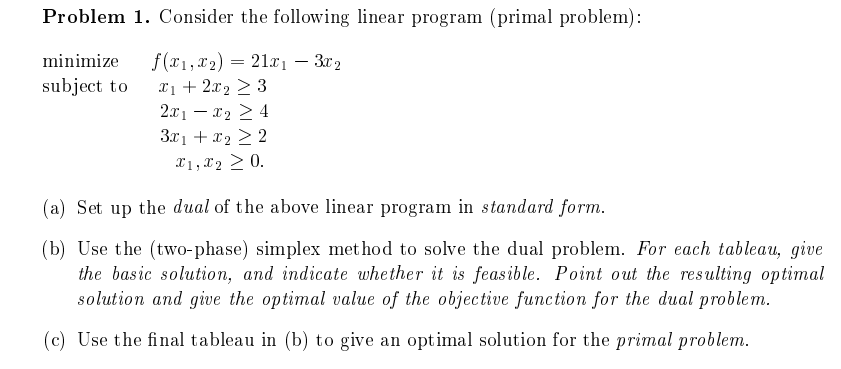
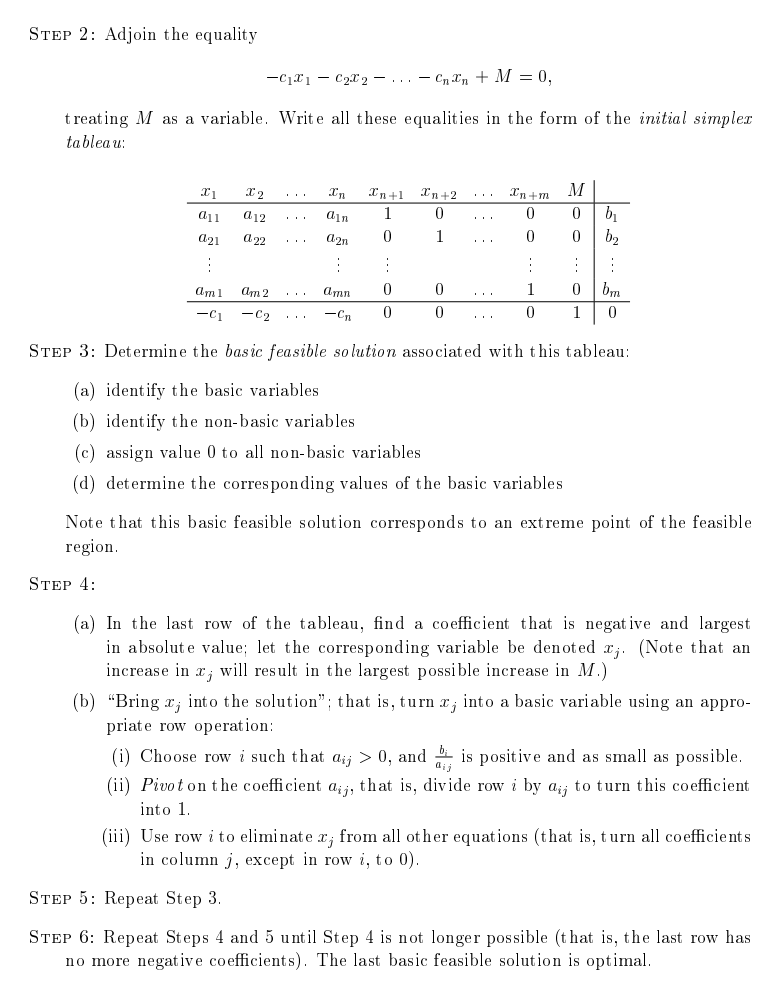
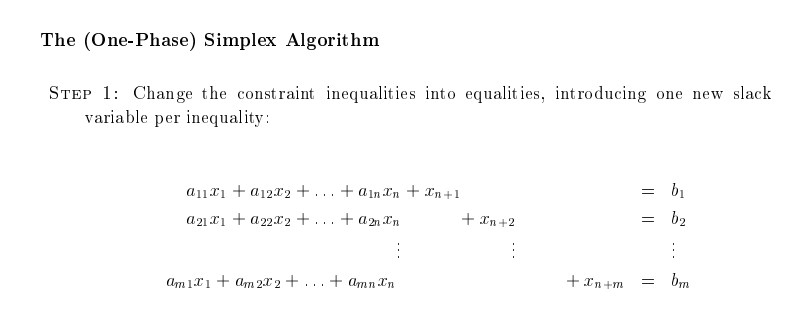
The Two-Phase Simplex Method The onephase simplex method described above may not work if we have a constraint of the form it-Tl 'l' - --+:'n-'1-'n :3" it [with l},- 3 III} or if we have a minimization problem. A two-phase simplex method is then required, which includes a proprocessing of the simplex tableau to bring it into the form required for the basic simplex method. The preprocessing cannot be described by an exact algorithm, but consists of one or more steps of the following form. FEEPROCESSING STEP: Suppose our initial simplex tableau has a row [ilaa'z'Za-Haa'inabi] with l},- s': I]. {a} lChoose any 3' such that so,- 0, and mi is positive and as small as possible. (ii) Pivot on the coefficient a;;, that is, divide row i by a;; to turn this coefficient into 1. (iii) Use row i to eliminate x; from all other equations (that is, turn all coefficients in column j, except in row i, to 0). STEP 5: Repeat Step 3. STEP 6: Repeat Steps 4 and 5 until Step 4 is not longer possible (that is, the last row has no more negative coefficients). The last basic feasible solution is optimal.The (One-Phase) Simplex Algorithm STEP 1: Change the constraint inequalities into equalities, introducing one new slack variable per inequality : andI + a1232 +... + ainEn + In+l = b1 a21 + a2232 + . . . + am In + In +2 = b2 - - - amid1 + amar2 + . .. + amn In + In+m =
Step by Step Solution
There are 3 Steps involved in it

Get step-by-step solutions from verified subject matter experts
 Study Help