



Question: The very first question I just need part B already did part A. Assume that the computation does not result in an arithmetic overflow and
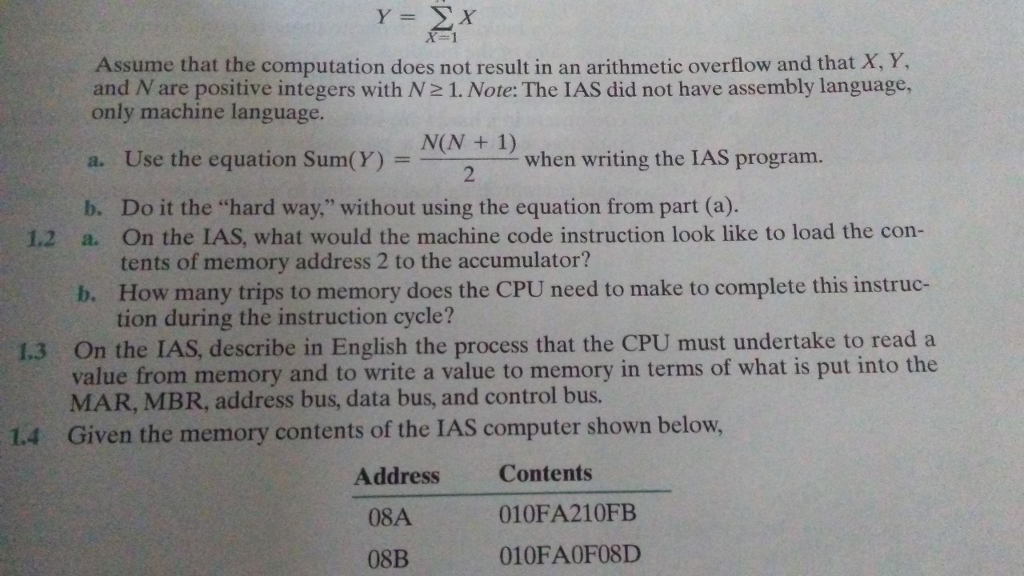 The very first question I just need part B already did part A.
Assume that the computation does not result in an arithmetic overflow and that X, Y, and N are positive integers with N2 1. Note: The IAS did not have assembly language, only machine language. a. Use the equation Sum(Y)- when writing the IAS program. 2 Do it the "hard way," without using the equation from part (a). On the IAS, what would the machine code instruction look like to load the con- tents of memory address 2 to the accumulator? b. 1.2 a. b. How many trips to memory does the CPU need to make to complete this instruc- tion during the instruction cycle? On the IAS, describe in English the process that the CPU must undertake to read a value from memory and to write a value to memory in terms of what is put into the MAR, MBR, address bus, data bus, and control bus. 1.3 1.4 Given the memory contents of the IAS computer shown below Contents 010FA210FB 010FAOFO8D Address 08A 08B
Step by Step Solution
There are 3 Steps involved in it

Get step-by-step solutions from verified subject matter experts