







Question: The whole tree. The result will be expression = 11. Is the the last sentence. This is a c++ project. In this project, you will
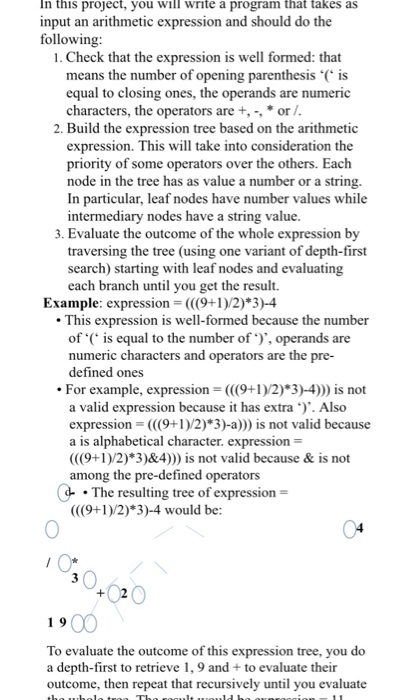 The whole tree. The result will be expression = 11. Is the the last sentence. This is a c++ project.
 In this project, you will write a program that takes as input an arithmetic expression and should do the following: 1. Check that the expression is well formed: that means the number of opening parenthesis is equal to closing ones, the operands are numeric characters, the operators are or 2. Build the expression tree based on the arithmetic expression. This will take into consideration the priority of some operators over the others. Each node in the tree has as value a number or a string. In particular, leaf nodes have number values while intermediary nodes have a string value. 3. Evaluate the outcome of the whole expression by traversing the tree (using one variant of depth-first search) starting with leaf nodes and evaluating each branch until you get the result. Example: expression (((9+1)/2) 3-4 This expression is well-formed because the number of is equal to the number of operands are numeric characters and operators are the pre- defined ones. For example, expression (((9+1)/2) 3-4)) is not a valid expression because it has extra Also a is alphabetical character. expression among the pre-defined operators The resulting tree of expression (((9+1)/2)*3)-4. would be 2 1900 To evaluate the outcome of this expression tree, you do a depth-first to retrieve l, 9 and to evaluate their outcome, then repeat that recursively until you evaluate
Step by Step Solution
There are 3 Steps involved in it

Get step-by-step solutions from verified subject matter experts
 Study Help