







Question: The world dataset variable enpp3_democ measures, for each democracy, the number of effective parliamentary parties: 1-3 parties. 4-5 parties, or 6-11 parties. Use enpp3_democ as
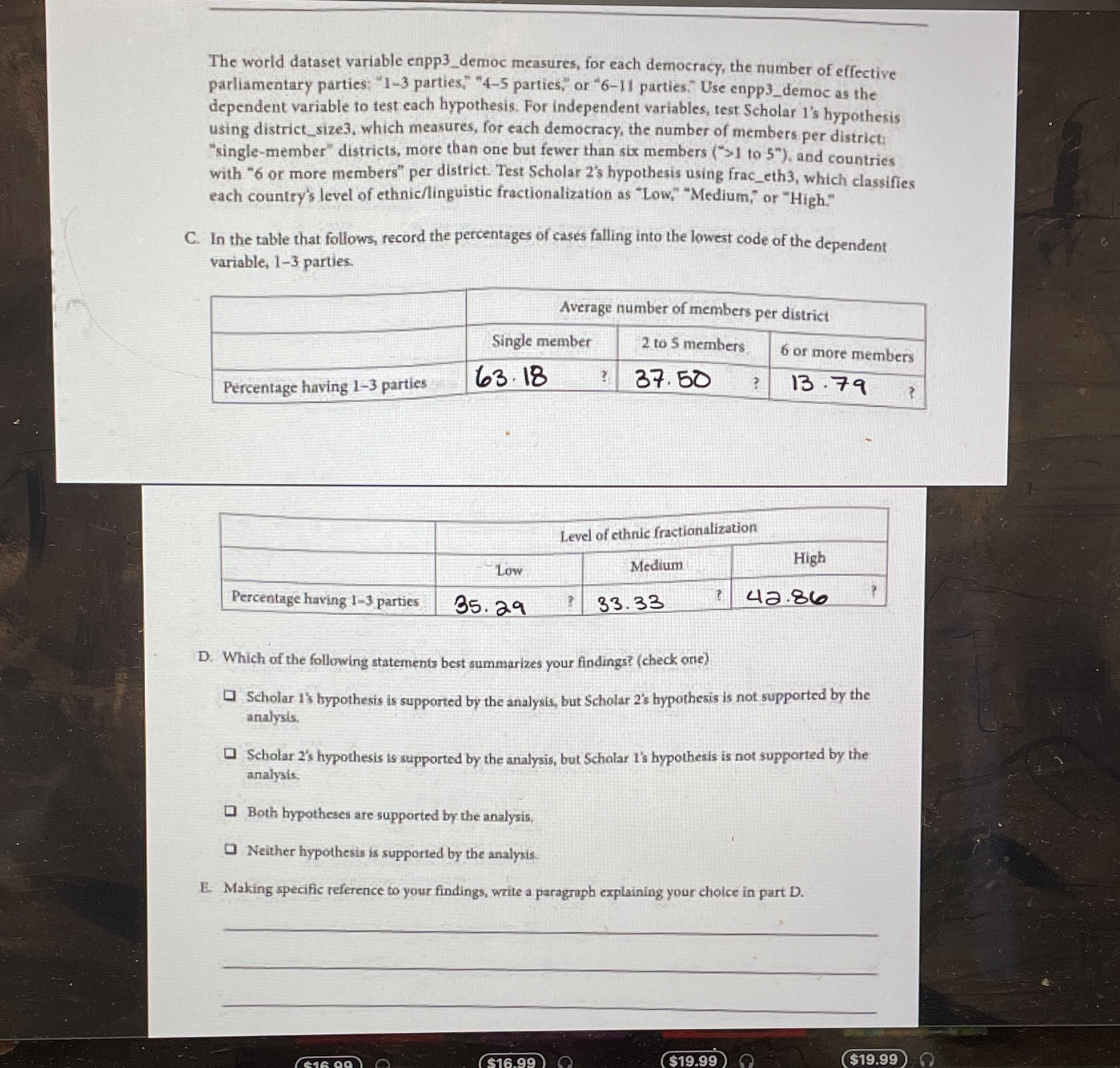
The world dataset variable enpp3_democ measures, for each democracy, the number of effective parliamentary parties: "1-3 parties." "4-5 parties," or "6-11 parties." Use enpp3_democ as the dependent variable to test each hypothesis. For independent variables, test Scholar I's hypothesis using district_size3, which measures, for each democracy, the number of members per district "single-member" districts, more than one but fewer than six members (">1 to 5"), and countries with "6 or more members" per district. Test Scholar 2's hypothesis using frac_eth3, which classifies each country's level of ethnic/linguistic fractionalization as "Low," "Medium," or "High." C. In the table that follows, record the percentages of cases falling into the lowest code of the dependent variable, 1-3 parties. Average number of members per district Single member 2 to 5 members 6 or more members Percentage having 1-3 parties 63. 18 37. 50 13.79 Level of ethnic fractionalization Low Medium High Percentage having 1-3 parties 35. 29 1 33.33 1 42.86 D. Which of the following statements best summarizes your findings? (check one) " Scholar 1's hypothesis is supported by the analysis, but Scholar 2's hypothesis is not supported by the analysis. Scholar 2's hypothesis is supported by the analysis, but Scholar I's hypothesis is not supported by the analysis, Both hypotheses are supported by the analysis, Neither hypothesis is supported by the analysis. E. Making specific reference to your findings, write a paragraph explaining your choice in part D. $19.99 $19.99
Step by Step Solution
There are 3 Steps involved in it

Get step-by-step solutions from verified subject matter experts
 Study Help