







Question: The Zero flag contains a binary I when the result of an arithmetic operation is zero. A) True 1. B) False 2. Is the expression
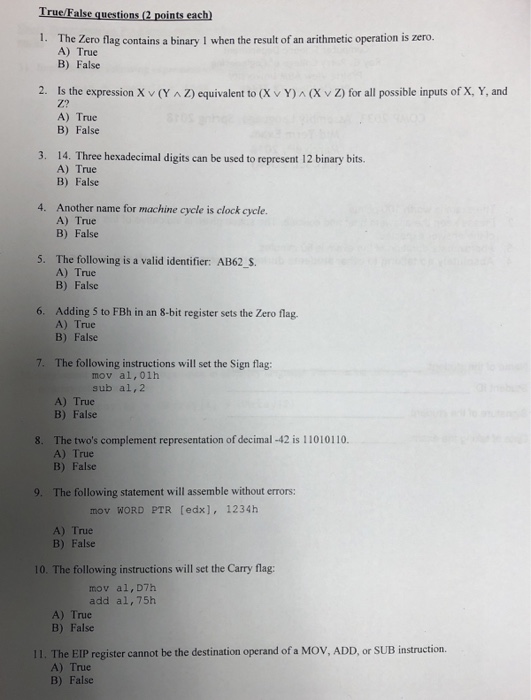
The Zero flag contains a binary I when the result of an arithmetic operation is zero. A) True 1. B) False 2. Is the expression X v (Y ) equivalent to (X v Y)A(X v 2 for all possible inputs of X, Y, and Z? A) True B) False 3. 14. Three hexadecimal digits can be used to represent 12 binary bits. A) True B) False Another name for machine cycle is clock cycle. A) True B) False 4. 5. The following is a valid identifier: AB62 S. A) True B) False Adding 5 to FBh in an 8-bit register sets the Zero flag. A) True B) False 6. 7. The following instructions will set the Sign flag: mov al,01h sub al,2 A) True B) False The two's complement representation of decimal -42 is 11010110. A) True B) False 8. 9. The following statement will assemble without errors: mov WORD PTR [edx), 1234h A) True B) False 10. The following instructions will set the Carry flag: mov al,D7h add al, 75h A) True B) False I1. The EIP register cannot be the destination operand of a MOV, ADD, or SUB instruction A) True B) False
Step by Step Solution
There are 3 Steps involved in it

Get step-by-step solutions from verified subject matter experts
 Study Help