







Question: The zeros of a polynomial function P(x) are the values of KWhICh satisfy the equation P(x) : D (in other words. where y : 0.
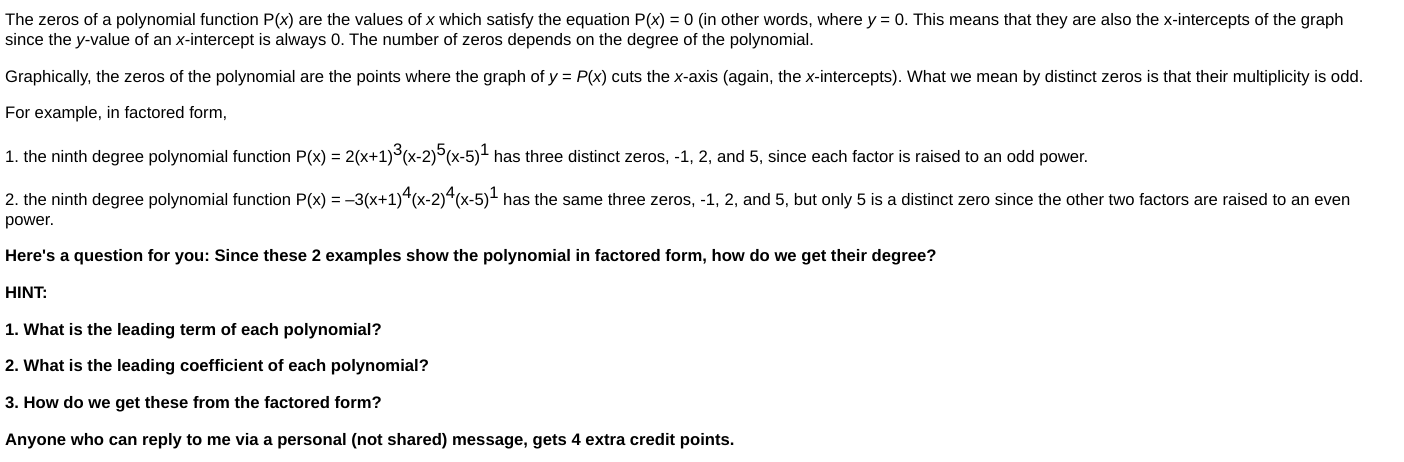
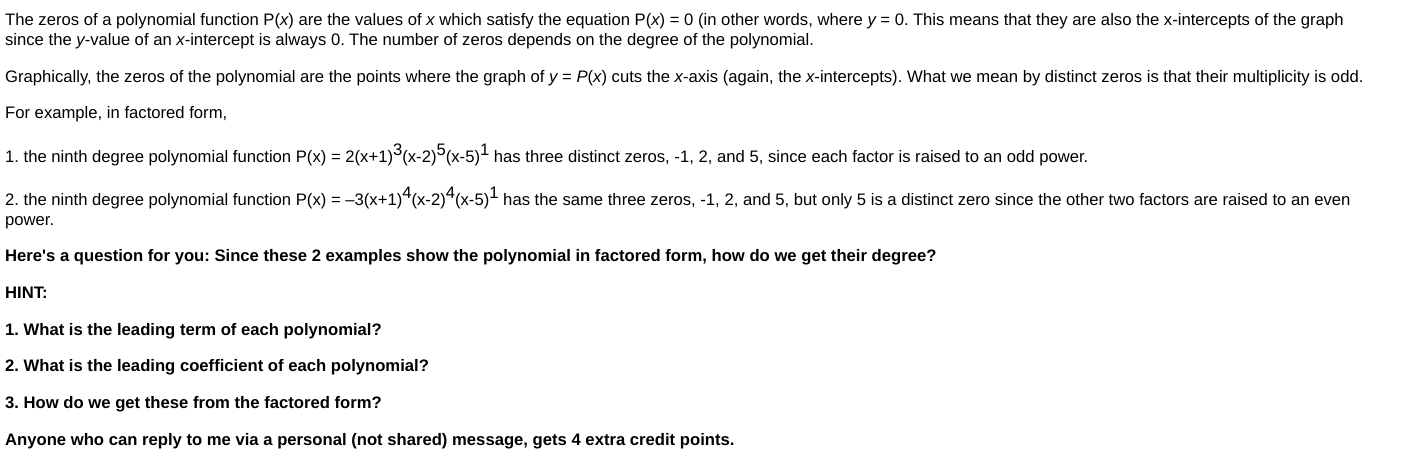
The zeros of a polynomial function P(x) are the values of KWhICh satisfy the equation P(x) : D (in other words. where y : 0. This means that they are also the x-inlercepts of the graph since the yValue of an Xintercept is always 0. The number of zeros depends on the degree of the polynomial. Graphically. the zeros ol the polynomial are the points where the graph 0! y = P(x) cuts the x-axis (again' the x-intercepts). What we mean by distinct zeros is that their multiplicity is odd. For example, in lactored form, 1. the ninth degree polynomial lunction P(x) = 2(x+1)3(x-2)5(x-5)1 has three distinct zeros. -1. 2, and 5, since each factor is raised to an odd power. 2. the ninth degree polynomial lunction For) : 73(x+1)4{x72)4(x75)1 has the same three zeros. 71. 2, and 5, but only 5 is a distinct zero since the other two factors are raised to an even power. Here's a question for you: Since these 2 examples show the polynomial in factored form, how do we get their degree? HINT: 1. What is the leading term of each polynomial? 2. What is the leading coefficient of each polynomial? 3. How do we get these from the factored form? Anyone who can reply to me via a personal (not shared) message, gets 4 extra credit points
Step by Step Solution
There are 3 Steps involved in it

Get step-by-step solutions from verified subject matter experts
 Study Help