- Theme
- What was the focus of the case study? (1 sentence or less)
- Summary of the case study
- Provide the class with a brief description of the case study.
- Discussion questions
- As this story illustrated, sometimes teams have to move quickly. How do you get a team up and running quickly?
- In a crisis situation such as this, what role does a team leader need to play? Explain.
- Using Exhibit 13-10, what characteristics of effective teams would this team need? Explain
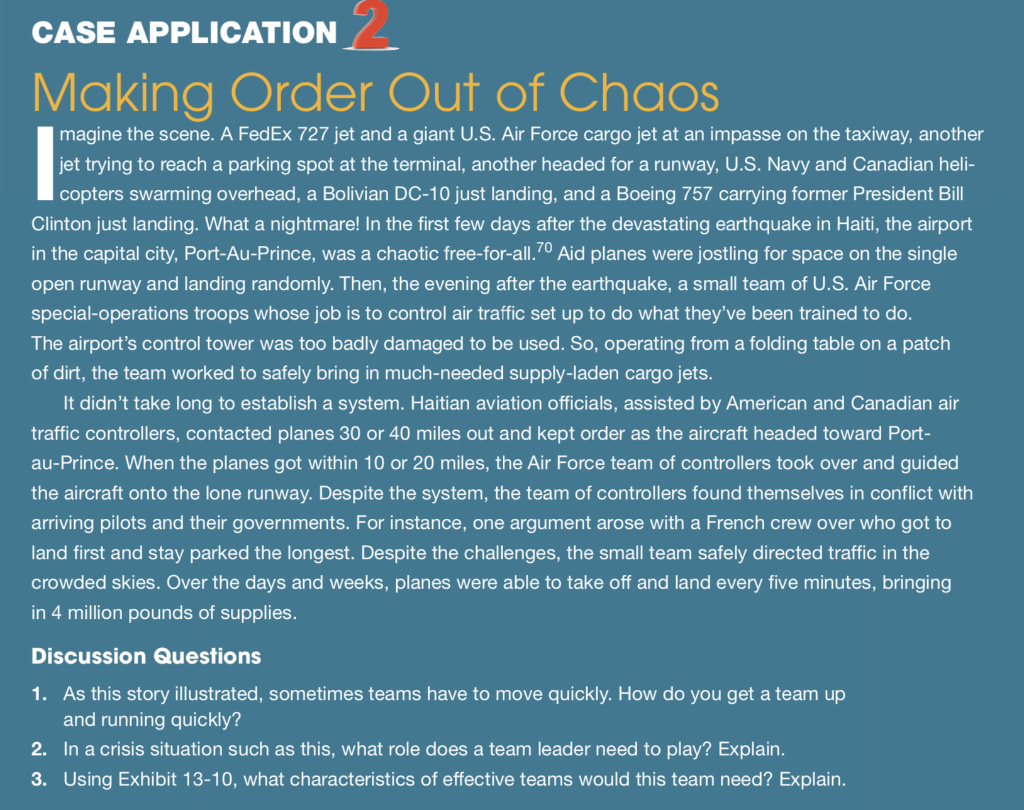
CASE APPLICATION 2 Making Order Out of Chaos magine the scene. A FedEx 727 jet and a giant U.S. Air Force cargo jet at an impasse on the taxiway, another jet trying to reach a parking spot at the terminal, another headed for a runway, U.S. Navy and Canadian heli- copters swarming overhead, a Bolivian DC-10 just landing, and a Boeing 757 carrying former President Bill Clinton just landing. What a nightmare! In the first few days after the devastating earthquake in Haiti, the airport in the capital city, Port-Au-Prince, was a chaotic free-for-all. Aid planes were jostling for space on the single open runway and landing randomly. Then, the evening after the earthquake, a small team of U.S. Air Force special-operations troops whose job is to control air traffic set up to do what they've been trained to do. The airport's control tower was too badly damaged to be used. So, operating from a folding table on a patch of dirt, the team worked to safely bring in much-needed supply-laden cargo jets. It didn't take long to establish a system. Haitian aviation officials, assisted by American and Canadian air traffic controllers, contacted planes 30 or 40 miles out and kept order as the aircraft headed toward Port- au-Prince. When the planes got within 10 or 20 miles, the Air Force team of controllers took over and guided the aircraft onto the lone runway. Despite the system, the team of controllers found themselves in conflict with arriving pilots and their governments. For instance, one argument arose with a French crew over who got to land first and stay parked the longest. Despite the challenges, the small team safely directed traffic in the crowded skies. Over the days and weeks, planes were able to take off and land every five minutes, bringing in 4 million pounds of supplies. Discussion Questions 1. As this story illustrated, sometimes teams have to move quickly. How do you get a team up and running quickly? 2. In a crisis situation such as this, what role does a team leader need to play? Explain. 3. Using Exhibit 13-10, what characteristics of effective teams would this team need? Explain. CASE APPLICATION 2 Making Order Out of Chaos magine the scene. A FedEx 727 jet and a giant U.S. Air Force cargo jet at an impasse on the taxiway, another jet trying to reach a parking spot at the terminal, another headed for a runway, U.S. Navy and Canadian heli- copters swarming overhead, a Bolivian DC-10 just landing, and a Boeing 757 carrying former President Bill Clinton just landing. What a nightmare! In the first few days after the devastating earthquake in Haiti, the airport in the capital city, Port-Au-Prince, was a chaotic free-for-all. Aid planes were jostling for space on the single open runway and landing randomly. Then, the evening after the earthquake, a small team of U.S. Air Force special-operations troops whose job is to control air traffic set up to do what they've been trained to do. The airport's control tower was too badly damaged to be used. So, operating from a folding table on a patch of dirt, the team worked to safely bring in much-needed supply-laden cargo jets. It didn't take long to establish a system. Haitian aviation officials, assisted by American and Canadian air traffic controllers, contacted planes 30 or 40 miles out and kept order as the aircraft headed toward Port- au-Prince. When the planes got within 10 or 20 miles, the Air Force team of controllers took over and guided the aircraft onto the lone runway. Despite the system, the team of controllers found themselves in conflict with arriving pilots and their governments. For instance, one argument arose with a French crew over who got to land first and stay parked the longest. Despite the challenges, the small team safely directed traffic in the crowded skies. Over the days and weeks, planes were able to take off and land every five minutes, bringing in 4 million pounds of supplies. Discussion Questions 1. As this story illustrated, sometimes teams have to move quickly. How do you get a team up and running quickly? 2. In a crisis situation such as this, what role does a team leader need to play? Explain. 3. Using Exhibit 13-10, what characteristics of effective teams would this team need? Explain




