Question: Then, answer the following questions below from the case: A. Explain Lending Club's lending mechanism? B. How defensible is Lending Club's business model? How would
Then, answer the following questions below from the case:
A. Explain Lending Club's lending mechanism?
B. How defensible is Lending Club's business model? How would a potential rise in customer acquisition costs influence profitability and the sustainability of the business model?
C. Should investors value Lending Club as a marketplace technology company, or a specialty finance company? Why?
D. Suppose that you want to invest with the club as a lender. What type of data do you need to make an informed decision as a lender? How would you use the data to develop a borrowers' credit model to evaluate the riskiness of the borrowers? What factors would you consider in you evaluation?
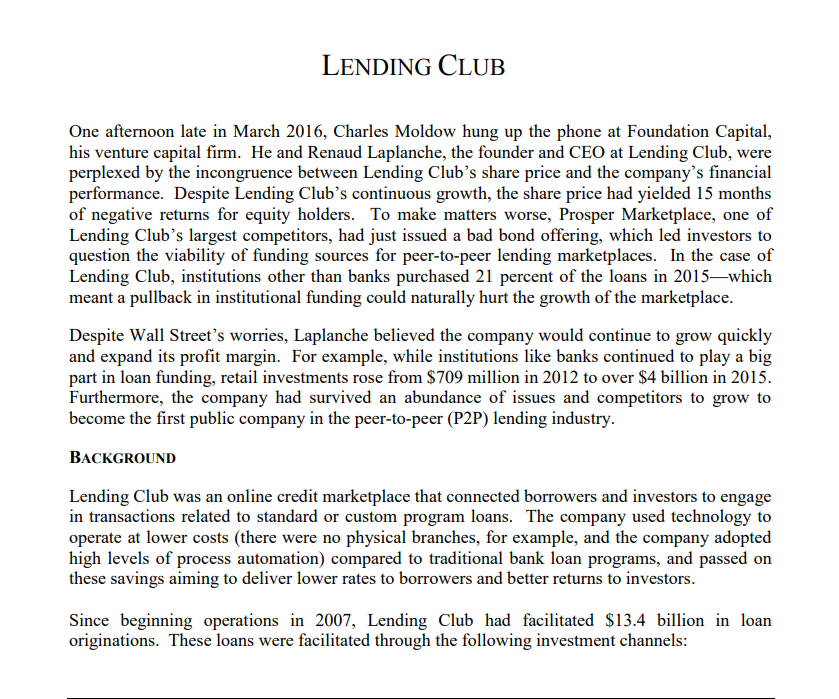
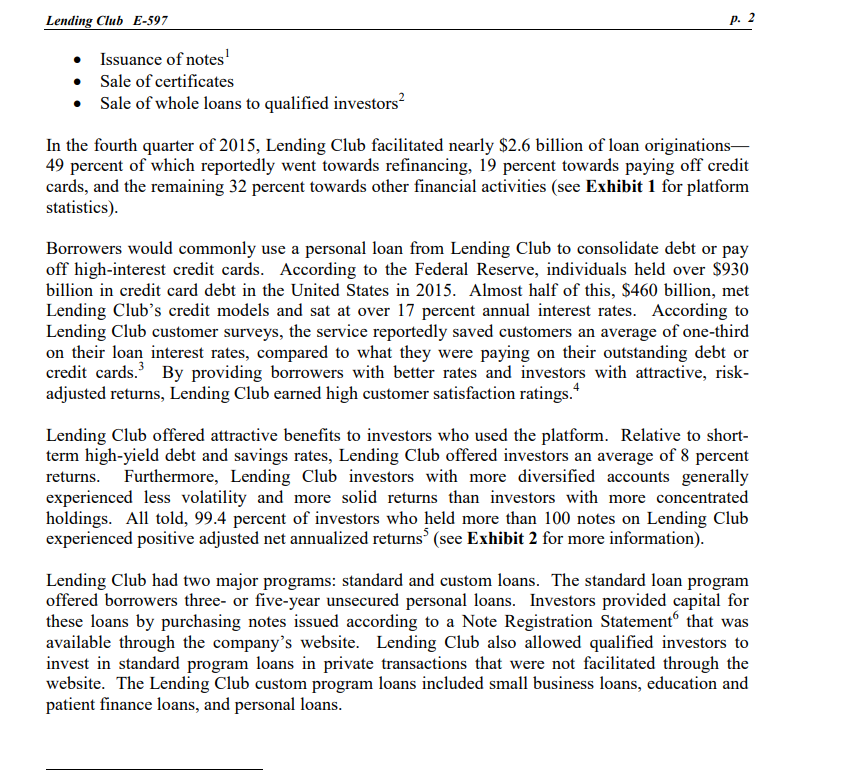
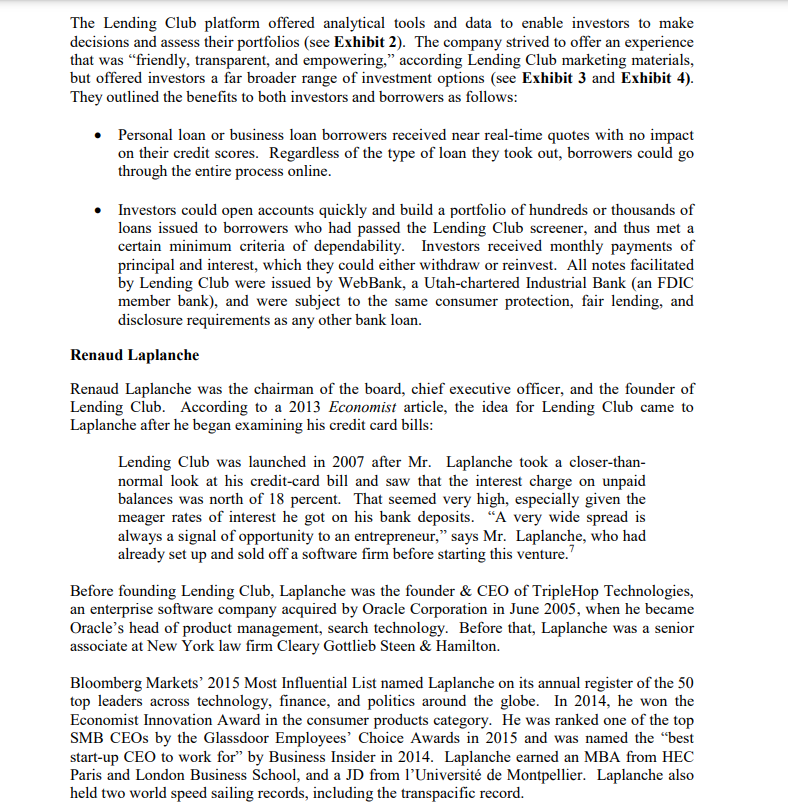
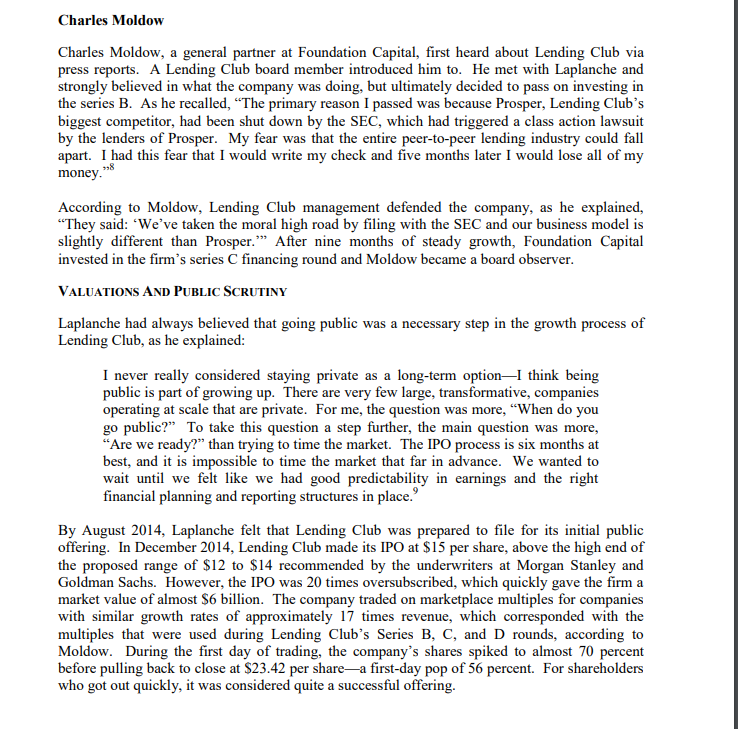
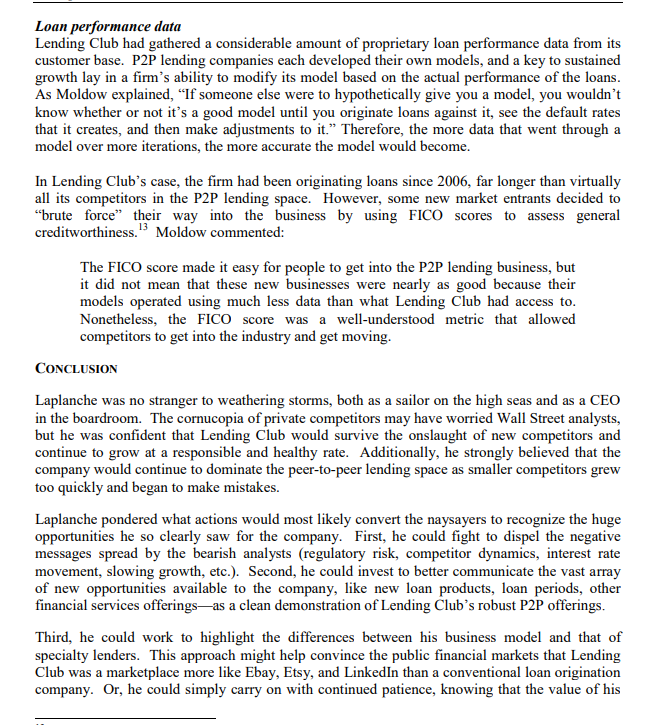
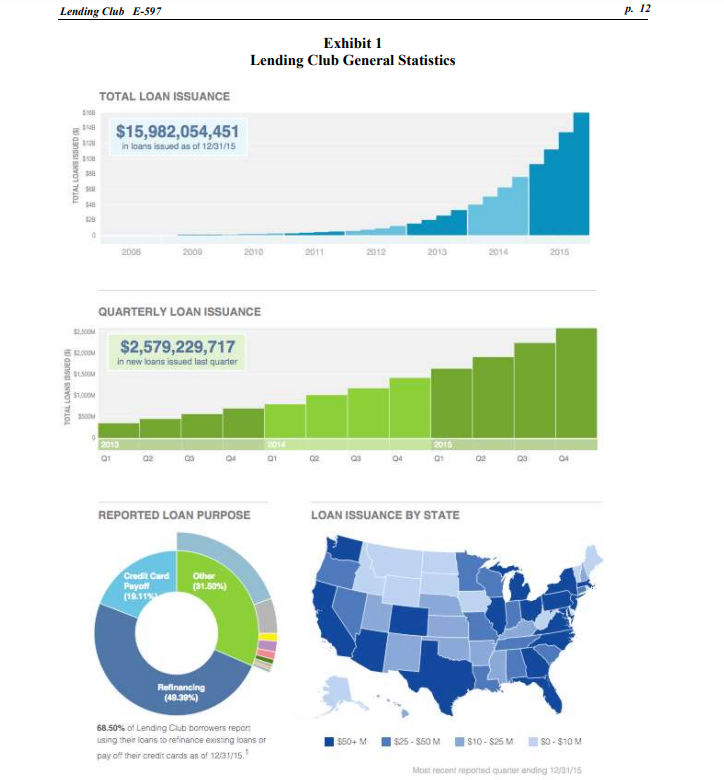
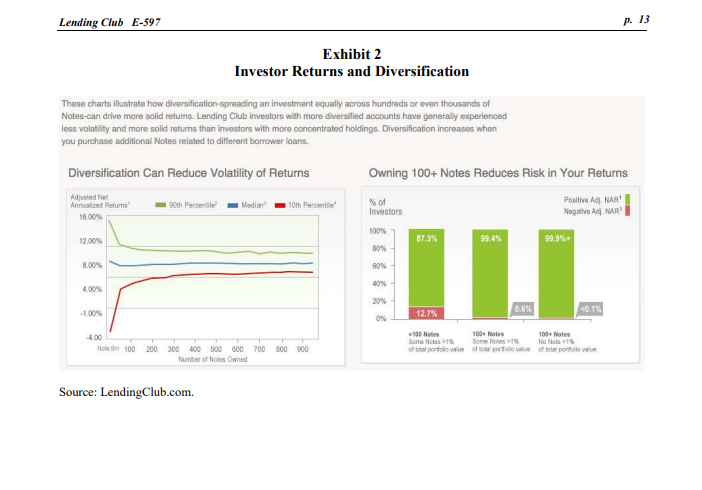
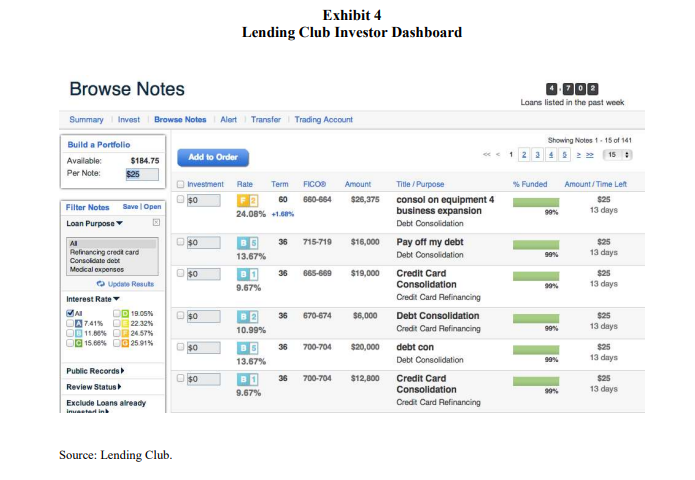
LENDING CLUB One afternoon late in March 2016, Charles Moldow hung up the phone at Foundation Capaital, his venture capital firm. He and Renaud Laplanche, the founder and CEO at Lending Club, were perplexed by the incongruence between Lending Club's share price and the company's financial performance. Despite Lending Club's continuous growth, the share price had yielded 15 months of negative returns for equity holders. To make matters worse, Prosper Marketplace, one of Lending Club's largest competitors, had just issued a bad bond offering, which led investors to question the viability of funding sources for peer-to-peer lending marketplaces. In the case of Lending Club, institutions other than banks purchased 21 percent of the loans in 2015which meant a pullback in institutional funding could naturally hurt the growth of the marketplace. Despite Wall Street's worries, Laplanche believed the company would continue to grow quickly and expand its profit margin. For example, while institutions like banks continued to play a big part in loan funding, retail investments rose from $709 million in 2012 to over $4 billion in 2015. Furthermore, the company had survived an abundance of issues and competitors to grow to become the first public company in the peer-to-peer (P2P) lending industry. BACKGROUND Lending Club was an online credit marketplace that connected borrowers and investors to engage in transactions related to standard or custom program loans. The company used technology to operate at lower costs (there were no physical branches, for example, and the company adopted high levels of process automation) compared to traditional bank loan programs, and passed on these savings aiming to deliver lower rates to borrowers and better returns to investors. Since beginning operations in 2007, Lending Club had facilitated $13.4 billion in loan originations. These loans were facilitated through the following investment channels: Issuance of notes' s Sale of certificates e Sale of whole loans to qualified investors\" In the fourth quarter of 2015, Lending Club facilitated nearly $2.6 billion of loan originations 49 percent of which reportedly went towards refinancing, 19 percent towards paying off credit cards, and the remaining 32 percent towards other financial activities (see Exhibit 1 for platform statistics). Borrowers would commonly use a personal loan from Lending Club to consolidate debt or pay off high-interest credit cards. According to the Federal Reserve, individuals held over $930 billion in credit card debt in the United States in 2015. Almost half of this, $460 billion, met Lending Club's credit models and sat at over 17 percent annual interest rates. According to Lending Club customer surveys, the service reportedly saved customers an average of one-third on their loan interest rates, compared to what they were paying on their outstanding debt or credit cards.'\" By providing borrowers with better rates and investors with attractive, risk- adjusted returns, Lending Club earned high customer satisfaction ratings.\" Lending Club offered attractive benefits to investors who used the platform. Relative to short- term high-yield debt and savings rates, Lending Club offered investors an average of & percent returns. Furthermore, Lending Club investors with more diversified accounts generally experienced less volatility and more solid returns than investors with more concentrated holdings. All told, 99.4 percent of investors who held more than 100 notes on Lending Club experienced positive adjusted net annualized returns' (see Exhibit 2 for more information). Lending Club had two major programs: standard and custom loans. The standard loan program offered borrowers three- or five-year unsecured personal loans. Investors provided capital for these loans by purchasing notes issued according to a Note Registration Statement\" that was available through the company's website. Lending Club also allowed qualified investors to invest in standard program loans in private transactions that were not facilitated through the website. The Lending Club custom program loans included small business loans, education and patient finance loans, and personal loans. The Lending Club platform offered analytical tools and data to enable investors to make decisions and assess their portfolios (see Exhibit 2). The company strived to offer an experience that was \"friendly, transparent, and empowering,\" according Lending Club marketing materials, but offered investors a far broader range of investment options (see Exhibit 3 and Exhibit 4). They outlined the benefits to both investors and borrowers as follows: * Personal loan or business loan borrowers received near real-time quotes with no impact on their credit scores. Regardless of the type of loan they took out, borrowers could go through the entire process online. s Investors could open accounts quickly and build a portfolio of hundreds or thousands of loans 1ssued to borrowers who had passed the Lending Club screener, and thus met a certain minimum criteria of dependability. Investors received monthly payments of principal and interest, which they could either withdraw or reinvest. All notes facilitated by Lending Club were 1ssued by WebBank, a Utah-chartered Industrial Bank (an FDIC member bank), and were subject to the same consumer protection, fair lending, and disclosure requirements as any other bank loan. Renaud Laplanche Renaud Laplanche was the chairman of the board, chief executive officer, and the founder of Lending Club. According to a 2013 Economist article, the idea for Lending Club came to Laplanche after he began examining his credit card balls: Lending Club was launched in 2007 after Mr. Laplanche took a closer-than- normal look at his credit-card bill and saw that the interest charge on unpaid balances was north of 18 percent. That seemed very high, especially given the meager rates of interest he got on his bank deposits. \"A very wide spread i1s always a signal of opportunity to an entrepreneur,\" says Mr. Laplanche, who had already set up and sold off a software firm before starting this venture.' Before founding Lending Club, Laplanche was the founder & CEO of TripleHop Technologies, an enterprise software company acquired by Oracle Corporation in June 2005, when he became Oracle's head of product management, search technology. Before that, Laplanche was a senior associate at New York law firm Cleary Gottheb Steen & Hamilton. Bloomberg Markets\" 2015 Most Influential List named Laplanche on its annual register of the 50 top leaders across technology, finance, and politics around the globe. In 2014, he won the Economist Innovation Award in the consumer products category. He was ranked one of the top SMB CEOs by the Glassdoor Employees' Choice Awards in 2015 and was named the \"best start-up CEO to work for\" by Business Insider in 2014. Laplanche earned an MBA from HEC Paris and London Business School, and a JD from 1'Universit de Montpellier. Laplanche also held two world speed sailing records, including the transpacific record. Charles Moldow Charles Moldow, a general partner at Foundation Capital, first heard about Lending Club via press reports. A Lending Club board member introduced him to. He met with Laplanche and strongly believed in what the company was doing, but ultimately decided to pass on investing in the series B. As he recalled, \"The primary reason I passed was because Prosper, Lending Club's biggest competitor, had been shut down by the SEC, which had triggered a class action lawsuit by the lenders of Prosper. My fear was that the entire peer-to-peer lending industry could fall apart. I had this fear that I would write my check and five months later I would lose all of my money.\" According to Moldow, Lending Club management defended the company, as he explained, \"They said: \"We've taken the moral high road by filing with the SEC and our business model is slightly different than Prosper.\" After nine months of steady growth, Foundation Capital invested in the firm's series C financing round and Moldow became a board observer. VALUATIONS AND PUBLIC SCRUTINY Laplanche had always believed that going public was a necessary step in the growth process of Lending Club, as he explained: I never really considered staying private as a long-term optionI think being public is part of growing up. There are very few large, transformative, companies operating at scale that are private. For me, the question was more, \"When do you go public?\" To take this question a step further, the main question was more, \"Are we ready?\" than trying to time the market. The IPO process is six months at best, and it is impossible to time the market that far in advance. We wanted to wait until we felt like we had good predictability in earnings and the right financial planning and reporting structures in place.\" By August 2014, Laplanche felt that Lending Club was prepared to file for its initial public offering. In December 2014, Lending Club made its IPO at $15 per share, above the high end of the proposed range of $12 to $14 recommended by the underwriters at Morgan Stanley and Goldman Sachs. However, the IPO was 20 times oversubscribed, which quickly gave the firm a market value of almost $6 billion. The company traded on marketplace multiples for companies with similar growth rates of approximately 17 times revenue, which corresponded with the multiples that were used during Lending Club's Series B, C, and D rounds, according to Moldow. During the first day of trading, the company's shares spiked to almost 70 percent before pulling back to close at $23.42 per sharea first-day pop of 56 percent. For sharcholders who got out quickly. it was considered quite a successful offering. Lomding Club E-597 ps However, the exciting stock performance did not last for long. Lending Club's stock peaked about a week after the [POat just above $29 per shareand declined steadily over the next year. By March 2016, the company was trading around $8 per share, nearly 50 percent below its %15 IPO price. Despite the lagging stock performance, Lending Club continued to deliver extraordinary financial results during that timeframe, with operating revenue growing more than 100 percent 1in 2015 {compared to 2014}, and EBITDA growing more than 200 percent. Three kinds of people Laplanche explained the complexities of operating as a public company: When you're a pnivate company, there are two kinds of people: those who support you, and those who don't care. When you are a public company, there are three kinds of people: People who are rooting for you, people who still don't care, and those who have an active and vested interested in your stock going down. So we have short-sellers and entities that are shorting the stock and trying to manufacture bad news to feed the market. We have 15 analysts that cover Lending Club: 13 have buy or hold ratings on us, and two have a sell rating. It seems that we hear from these two in the press disproportionately. These beansh analysts argued that several factors, including regulatory nsk, competitor dynamics, and intercst rate movement, would dampen Lending Club's future performance. Despite the pressure brought on by negative press, Laplanche still believed that going public was an important step for the company to make. He argued that the IPO increased brand awareness and projected to the markets that the company planned on growing over the long term: \"We basically said, \"We are poing to continue growing over the next 10 to 20 years, and we are not for sale,\" he recalled. Specialty finance company or marketplace? According to Moldow, much of Lending Club's IPO pricing was due to the company's ability to tell a compelling story around its marketplace business model, as opposed to positioning itself as a specialty finance company. As he explained: Specialty finance companies use their balance sheets to loan money to customers. Generally, these types of companies trade at one to two times revenue. There are a lot of companies out there hike this. They don't trade very interestingly because they don't grow wvery fast and., more mmportantly, their business models are predicated on the spread between what they borrow and what they lend out, which has several repercussions on their valuations. First, specialty finance companies' margins are squeezed when interest rates rise, which can create concern for public market mmvestors. Second, the companies must borrow more capital in order to grow. In order to borrow more capital, these firms must raise more equity capital, which means that they must grow via equity dilution. Agamn, this 1s something that investors try to avoid. Lomding Club E-597 P For years, Laplanche argued that Lending Club was a marketplace between borrowers and lenders, rather than a specialty finance company. He furthered his argument by showing that Lending Club did not keep cash on its balance sheet to finance or hold the loans. But it wasn't clear that public market analysts truly believed the marketplace story told by the Lending Club team. All the while, many of Lending Club's private competitors continued to raise capital in 2015 at marketplace multiples. GROWTH AND COMPETITORS Act I: Responsible Growth A central tenet of the Lending Club strategy was that the P2P lending market was not a winner- take-all market. Moldow pointed to a heavily fragmented retail bank industry: \"In 2014, there were 6,799 FDIC-insured banks in the United Statesbut if this was a winner-take-all market, there would only be a handful. Whatever network effects exist in the business aren't big enough to dictate a winner-take-all market. Winner-take-all markets required the leader to grow rapdly to establish barners to entry to ensure they were the sole winner. Since the P2P lending space was not a winner-take-all industry, Laplanche was free to think differently about Lending Club's growth profile. As a result, Laplanche was careful to grow Lending Club at a responsible rate. As the market leader with a quickly growing franchise, he considered unchecked growth to be one of the biggest risks to the companyif Lending Club expanded too fast and break any part of the underwnting or loan ongination process, the company could land in dire regulatory constraints. Additionally, if the firm took shortcuts in the credit process, it could impact investor returns and choke the critical flow of capital from investors. So instead of trying to capture as much market share as quickly as possible, Laplanche believed that one of the keys to Lending Club's success was to maintain responsible growth targets. Moldow and the rest of the company's advisors thought this was a brilliant strategy. As Moldow recalled, \"This 1s a business that 1s growing incredibly rapidly and has amazing control over their processes. They've built the orgamization in such a way where the systems and processes have scaled alongside their revenue growth, so they've not stepped on thewr own toes.\" In other words, Laplanche's growth strategy had worked. Act 11: Newcomers Enter the Market While Lending Club was growing at responsible rates, other smaller start-ups hke Upstart and CircleBack Lending opened and began competing for market share. As Moldow reasoned, \"They were probably thinking, \"We're behind, but we need to catch upso we need to grow faster than Lending Club. It may not be as responsible, but we have nothing to lose. As with most venture-backed compamies, mgh growth rates typically meant easier access to capital, which these newcomers required in order to compete with Lending Club. Act IT1: Have the Tables Turned? The success of Lending Club's P2P loan programs and the rush of competitors led to increased inflows of venture capital into the industry. Soon, competitors were flush with cash and looking to compete directly with Lending Club. Moldow realized that the firm had become a victim of its own successby demonstrating product/market fit in the P2P lending space, Lending Club had allewviated investor concerns about market viability. As a result, gaining access to investor capital was mo longer a barrier to entry into the industry. Start-up competitors continued to grow, as Moldow explamed: These early-stage companies raised a lot of money and grew rapidly. Suddenly, they had infiltrated our metronomic rhythm and growth. Lending Club could have put its foot on every newcomer's neck and said, \"We are going to dominate this industry.\" But an unfortunate ramification of not acquiring these competitors early was that they no longer became acquisition targets for Lending Club. They had raised large amounts of capital and had lots of cash on their balance sheetso there was no imperative for them to sell. Furthermore, their investors had all invested billions of dollars and expected sizeable returns. So what could have been an otherwise fantastic opportunity for Lending Club to simply acquire companies like the P2ZP auto lender, student loan lender, or purchase finance lender at a good price with a high-priced stock is now inversed. Now, the company has a low stock price because of public market fears of the competing companies, which all have plenty of cash on their balance sheets. This means that acquisition 1s a much less desirable growth strategy for the company. Hans Morris, Lending Club board member and chair of the audit committee, provided an alternative view on the perils of growing too quickly: There are four key risks for financial services: market, credit, operational, and liquidity nisk. When it comes to operational nisks, you can be almost certain that people will fry to game the system. People won't pay you back, people will try to defraud youand these people can be either inside or outside the company. Therefore, it's important to have measured growth so that you can build the appropriate infrastructure to manage your risks, which include credit risk, liquidity risks, and operational risk. There are all kinds of things that can go wrong, and they do go wrong. A company can suffer dire consequences if it grows quickly but hasn't built the tools to manage all of these risksit could potentially misunderstand the signals or the inherent nisk itself. So my view is that measured growth is extremely important if you're taking those types of risks, particularly when it comes to the \"unknown unknowns.\" They don't realize the types of risks they're taking, and Lending Cluby E-597 o 8 thercfore, when something bad happens, it's a total surprise. In reality, it should have been something that they should have cxpcn:tcd.m Morris also offered a contrasting perspective when it came to the issue of Lending Club's measured growth rate potentially opening the door for newcomers to gain market share: In general. rapidly growing competitors might be doing something that 1s fundamentally better than what everyone is doing. Therefore, a company's decision to grow at a measured rate 1s not the reason these newcomers would be able to achieve rapid growth. My view 1s that if a financial services firm is growing incredibly quickly, then they're taking risks that they do not fully understand. However, if they do understand the risk, and they have all the controls 1n place to correctly mutigate them, then perhaps the competitor 1s fundamentally betterbut your failure to grow or slow growth rate is not a sufficient explanation of why they became successful. Lending Club's Defense Lending Club had to counter market concerns that it would not be able to perform as well as it had histonically. As the sole public company in the P2P lending space, Lending Club was held to certain standards that its private competitors were able to avoid, as Moldow commented: The net result of Lending Club's steady growth rate was that the markets criticized us for two things. First, they questioned why we weren't growing as fast as our competitors. Despite our explanation that we were growing responsibly, they questioned whether there was something wrong. Second, the amount of capital that our competitors raisedand the expectations that came along with itwas so great that it suggested that those companies would mnvest capital aggressively to continuously grow top line revenue, which would mean that most capital would go primanly into customer acquisition. This meant that there was potentially a risk for customer acquisition costs to increase for the industry. Unfortunately, the markets did not believe that Lending Club would be able to sustan 1ts current customer acquisition costs. Essentially, analysts placed extra burden on Lending Club as the only public P2P lending marketplace because of the quarterly expectations that they published. When the analysts looked at all the capital that had been raised by competitors, they believed that the firm would see an increase in acquisition costs and a decrease in margins. With the public markets queshoming whether Lending Club would continue to grow at their current rate given increased competition, Lending Club began to mount its defense, as Moldow recalled: \"Right now the company continues to not report increases 1n customer acquisition costs, but the investor community keeps saying, 'It's going to hit youit 1s only a matter of when. The Lending Club team argued that they would be able to keep acquisition costs manageable for several reasons. Diverse approach to customer acquisition The team argued that Lending Club's diverse approach to customer acquisition created a competitive advantage. Lending Club acquired customers from a wide variety of channels mncluding direct mail, organic mmquines and paid search, radio and TV, display ads, and online partnershipssuch as lead-generating sites, credit card recommendation sites, and bank partnerships. The team believed that such a diversified approach to customer acquisition ensured that no single sales channel (i.e., Credit Karma'' or NerdWallet'") could hold them hostage to unreasonable demands. Additionally, Lending Club had developed a solid understanding of its core customer base over the years, and used this data to increase their conversions on direct mail campaigns, as Moldow recalled, \"Lending Club's ability to convert a person via direct mail 15 dramatically better due to increased data on the ideal customer. Plus, we begin to see benefits come from economies of scale that help to create additional competiive advantagesconversion rates are higher and ongination and servicing costs become cheaper, more cost-cffective. Efficient conversion funnel According to Laplanche and Moldow, Lending Club had additional competitive advantages that led to a more efficient conversion funnel. Laplanche credited the IPO with increasing brand awareness, which i turn helped stabilize customer acquisition costs. Moldow reasoned that brand affinity alone would help increase conversion through the funnel. He also argued that Lending Club had been managing this process for years longer than any other competitor in the space, which in turn meant that the company had more time to develop operational efficiencies. Finally, Moldow believed that this increased time mn the industry led to better data collection practices, which helped create data models that were adept at identifyving Lending Club's core set of potential customers, as he explained: The Lending Club models have become mcreasingly more evolved and sophisticated over the years, to the point where we now have prime, near-pnme, and sub-prime categones that help the company better manage customers through the funnel. The trick with the process is not to identify people who don't belong, it's to identify people that other lending companies don't think belong, but your model suggests they are actually creditworthy. This means that the company can accept more people, which led to higher conversion rates and lower acquisition costs. Loan performance data Lending Club had gathered a considerable amount of proprietary loan performance data from its customer base. P2P lending companies each developed their own models, and a key to sustained growth lay in a firm's ability to modify its model based on the actual performance of the loans. As Moldow explained, \"If someone else were to hypothetically give you a model, you wouldn't know whether or not it's a good model until you originate loans against it, see the default rates that it creates, and then make adjustments to it.\" Therefore, the more data that went through a model over more iterations, the more accurate the model would become. In Lending Club's case, the firm had been originating loans since 2006, far longer than virtually all its competitors in the P2P lending space. However, some new market entrants decided to \"brute force their way into the business by using FICO scores to assess general creditworthiness.\" Moldow commented: The FICO score made it easy for people to get into the P2P lending business, but it did not mean that these new businesses were nearly as good because their models operated using much less data than what Lending Club had access to. Monetheless, the FICO score was a well-understood metric that allowed competitors to get into the industry and get moving. CONCLUSION Laplanche was no stranger to weathering storms, both as a sailor on the high seas and as a CEO in the boardroom. The cornucopia of private competitors may have worried Wall Street analysts, but he was confident that Lending Club would survive the onslaught of new competitors and continue to grow at a responsible and healthy rate. Additionally, he strongly believed that the company would continue to dominate the peer-to-peer lending space as smaller competitors grew too quickly and began to make mistakes. Laplanche pondered what actions would most likely convert the naysayers to recognize the huge opportunities he so clearly saw for the company. First, he could fight to dispel the negative messages spread by the bearish analysts (regulatory risk, competitor dynamics, interest rate movement, slowing growth, etc.). Second, he could invest to better communicate the vast array of new opportunities available to the company, like new loan products, loan periods, other financial services offeringsas a clean demonstration of Lending Club's robust P2P offerings. Third, he could work to highlight the differences between his business model and that of specialty lenders. This approach might help convince the public financial markets that Lending Club was a marketplace more like Ebay, Etsy, and LinkedIn than a conventional loan origination company. Or, he could simply carry on with continued patience, knowing that the value of his stock in ten years would be the truest measure of what he aspired to build, rather than the public stock price today, tomorrow, or next week. Lending Club E-597 p. 12 Exhibit 1 Lending Club General Statistics TOTAL LOAN ISSUANCE $15,982,054,451 In loans issued as of 1231/15 TOTAL LOANS ISS 2008 2009 2010 2011 2012 2013 2014 2015 QUARTERLY LOAN ISSUANCE $2,579,229,717 SUED in new loans issued last quarter TOTAL LO 2013 2015 02 01 02 04 01 02 03 04 REPORTED LOAN PURPOSE LOAN ISSUANCE BY STATE Credit Card Other Payoff (31.50) Refinancing (48.30) 68.50% of Lending Club borrowers repon using their loans to refinance existing loans or $50+ M $25- $50 M $10 -$25 M. SO - $10 M pay off their credit cards as of 12/31/15. Most recent reported quarter anding 12/31/15Lending Club E-597 p. 13 Exhibit 2 Investor Returns and Diversification These charts illustrate how diversification-spreading an investment equally across hundreds or even thousands of Notes-can drive more solid retums. Lending Club investors with more diversified accounts have generally experienced less volatility and more solid returns than investors with more concentrated holdings. Diversification increases when you purchase additional Notes related to different borrower loans. Diversification Can Reduce Volatility of Returns Owning 100+ Notes Reduces Risk in Your Returns Adjusted Net Annualized Returns" 90th Percentile Median 10th Percentit" % of Positive Adj. NAR Nogative Adj. NAR" 18.00%% Investors 100% 12.03%% 87.3% 99.9%+ 8.00% 1.00% 12.7% -4.00 #139 Hobes 160= holen 1004 Notes Some Notes > 714 Nots Bin 100 200 300 600 500 600 700 800 800 of total portbig with of total parigiin wus Number of Notes Owned Source: LendingClub.com.Exhibit 3 Investor Mix in Standard Programs Investor Mix in Standard Program Loans Individual Investors who invest through self-managed accounts, managed accounts or private funds have invested over $4 billion in 2015 100% Institutional 7.000 8,417 5 1-managed, 6.000 individuals - Managed accounts and dedicated 5.008 funds, Individuals 4000 1.504 509% 3.000 30%% 2.000 20%% 1,000 2012 2013 2014 2015 2012 2013 2014 2015 LendingClub 11 Source: Lending Club.Exhibit 4 Lending Club Investor Dashboard Browse Notes 4. 7 0 2 Loans listed in the past week Summary | Invest | Browse Notes | Alert ] Transfor | Trading Account Showing Notes 1 - 15 of 141 Build a Portfolio Add to Order 12 2 4 8 2 20 16 : Available: $184.75 Per Note: $25 Investment Rate Term FICOO Amount Title / Purpose *% Funded Amount / Time Len 0 $0 F 2 660-664 $26,375 consol on equipment 4 125 Filter Notes Save | Opun 24.08% +1 40% business expansion 13 days Loan Purpose Debt Consolidation Al B 5 35 715-719 $16,000 Pay off my debt $25 Afinancing credit card 13 days 13.67% Debt Consolidation Consolidain debt Modical cuponsos 0 50 B 1 685-869 $19.000 Credit Card $25 Update Results 13 days 9.67% Consolidation Interest Rate Credit Card Refinancing D 19 05% B 2 35 670-674 $6,000 Debt Consolidation 525 CA 741% 22 32% 13 days QB 11.60% OF 24 57% 10.99% Credit Card Refinancing 39% 08 15.68% 06 2591% 0 5 700-704 $20,000 debt con $25 13 days 13.67% Debt Consolidation Public Records B 1 36 700-704 $12,800 Credit Card $25 Review Status 13 days 9.67% Consolidation Exclude Loans already Credit Card Refinancing Source: Lending Club
Step by Step Solution
There are 3 Steps involved in it
1 Expert Approved Answer
Step: 1 Unlock
Question Has Been Solved by an Expert!
Get step-by-step solutions from verified subject matter experts
Step: 2 Unlock
Step: 3 Unlock
Students Have Also Explored These Related Finance Questions!