







Question: Then, this tree can be specified in a file as follows. Note that the first node ( the root ) is numbered 0 , and
Then, this tree can be specified in a file as follows. Note that the first node the root is
numbered and no other nodes point to itA decision tree is a model that is frequently used to
support decisionmaking. The model has a tree
structure, with question nodes that branch to other
nodes depending on the answer. Eventually, one arrives
at a decision. A very simple tree is shown in slide in
the presentation on pointers, reproduced here for
convenience:
An example application of a decision tree would be a set of questions to determine if it is
safe for a technician to enter a potentially hazardous room. A robot might use a decision
tree to decide whether a product component is defective.
Decision trees are also used to classify objects based on their features For example, if it
has wings and two feet, its a bird; if it has wings and six feet, its an insect A common
machine learning technique is to develop algorithms that automatically build classifier
trees based on training data. For more information on this technique, see here.
In this project, you will develop a program that reads the specification of a decision tree
from a file, and then walks the user through the tree until a decision is reached. The tree
will be implemented using structs and pointers. The kind of tree you will work with is
called a binary tree: each question can have only two possible answers: yes or no
Specification of a Decision Tree
Assume that a struct Node is defined as in Lab Then, the tree can be defined as a
vector of pointers to nodes that is the vector elements have type Node
How to describe a tree in textual form? One possible way is to use three lines to specify one
node. The first line consists of the nodes textual description; the second and third lines
integers specify the node to jump to if the answer is yes or no respectively. If both
lines are then this is a leaf node a decision
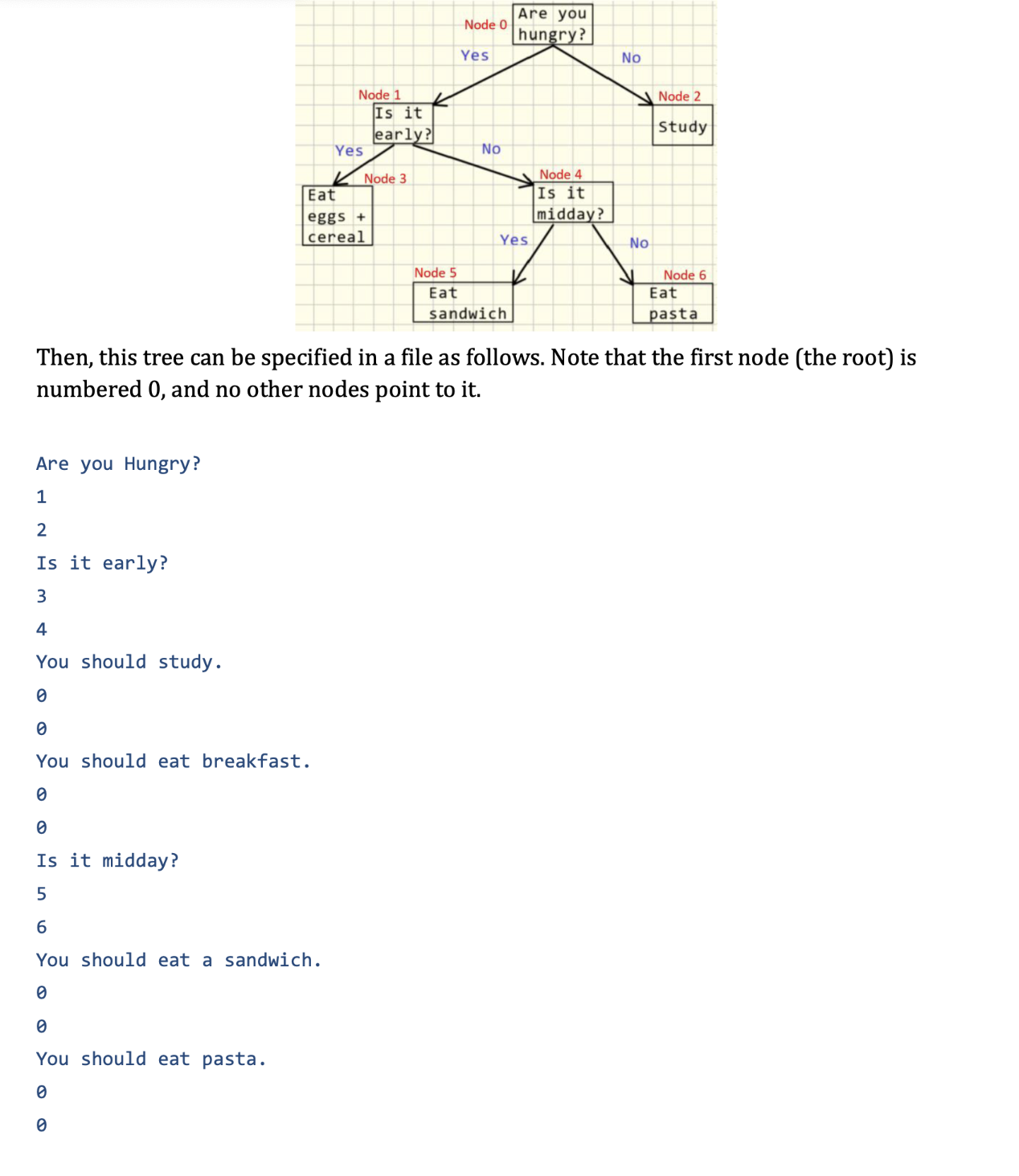
Assume the nodes are labeled as in the figure below:
Then, this tree can be specified in a file as follows. Note that the first node the root is
numbered and no other nodes point to it
Are you Hungry?
Is it early?
You should study.
You should eat breakfast.
Is it midday?
You should eat a sandwich.
You should eat pasta.
Program Requirements
Your programs functionality must meet the following requirements.
It must ask the user for a filename.
It must open and read a file with the provided name, with txt appended to it For
example, if the user provides the file name tree the program must open and read
the file treetxt
The file must contain a textual description of a binary decision tree as in the
example above.
This file must specify a tree of your own design. It is suggested to design a tree on a
topic you like, or a hobby, or something you are interested in and are knowledgeable
about.
The tree must have at least five question nodes; there is no upper limit
After reading the file, the program must walk the user through the tree until a
decision is reached.
The program must use at least one function, which should read the provided file and
return a tree. This function must be present in a separate file. The prototype of this
function should be:
vector readtreeifstream &;
The function argument is an input file stream; the function assumes that the file was
already opened successfully, so it can start reading from the stream directly. Here,
Node is a struct defined as in the slides on pointers and in Lab #
A header file must be provided.
Aside from these requirements, you get to decide how your program presents the questions
and the decision, and what to do after that.
Note that you may assume that the file contains no errors there is no need to handle
invalid text files
Other Program Requirements:
Only the following C keywords are accepted in this project:
o All type declarations int float, etc.
o All arithmetic operations etc.
o cin, cout and the output configuration from iomanip setw etc.
o Branching with ifelse and switch.
o The loops covered in class.
o Strings as covered in class, including the functions atoi and stoi to convert
characters and strings to integers.
o Vectors as covered in class.
o Functions as covered in class.
o IO streams as covered in class.
o Structs and pointers as covered in class.
If you need a particular keyword not in this list, ask your instructor first.
Step by Step Solution
There are 3 Steps involved in it
1 Expert Approved Answer
Step: 1 Unlock

Question Has Been Solved by an Expert!
Get step-by-step solutions from verified subject matter experts
Step: 2 Unlock
Step: 3 Unlock
 Study Help