



Question: THEORETICAL PROBABILITIES USING A MATRIX You can determine if the game is fair without conducting an experiment. 1. Complete the matrix at the right. Player
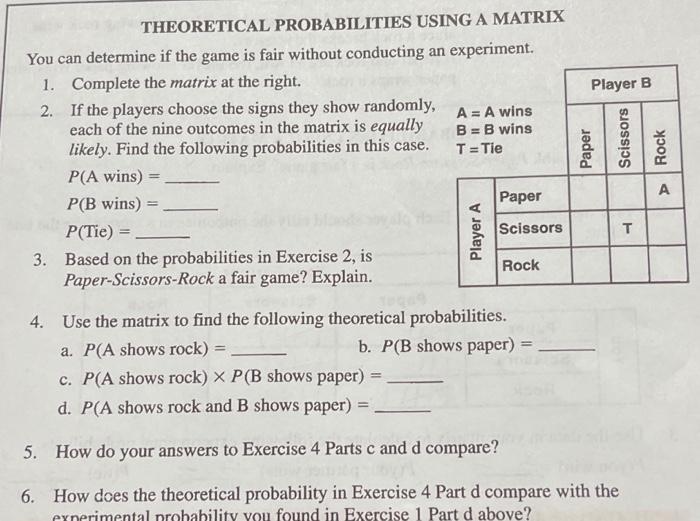
THEORETICAL PROBABILITIES USING A MATRIX You can determine if the game is fair without conducting an experiment. 1. Complete the matrix at the right. Player B 2. If the players choose the signs they show randomly, A = A wins each of the nine outcomes in the matrix is equally B = B wins likely. Find the following probabilities in this case. Scissors T = Tie Rock Paper P(A wins) = P(B wins) = Paper A P(Tie) = Player A Scissors T 3. Based on the probabilities in Exercise 2, is Paper-Scissors-Rock a fair game? Explain. Rock 4. Use the matrix to find the following theoretical probabilities. a. P(A shows rock) =_ b. P(B shows paper) = c. P(A shows rock) X P(B shows paper) = d. P(A shows rock and B shows paper) = 5. How do your answers to Exercise 4 Parts c and d compare? 6. How does the theoretical probability in Exercise 4 Part d compare with the primental probability you found in Exercise 1 Part d above
Step by Step Solution
There are 3 Steps involved in it

Get step-by-step solutions from verified subject matter experts