







Question: Theoretical section: 10 questions, with only one answer. Each one is worth one point. Wrong answers subtract ( 1 / 5 ) 1. Productivity increases
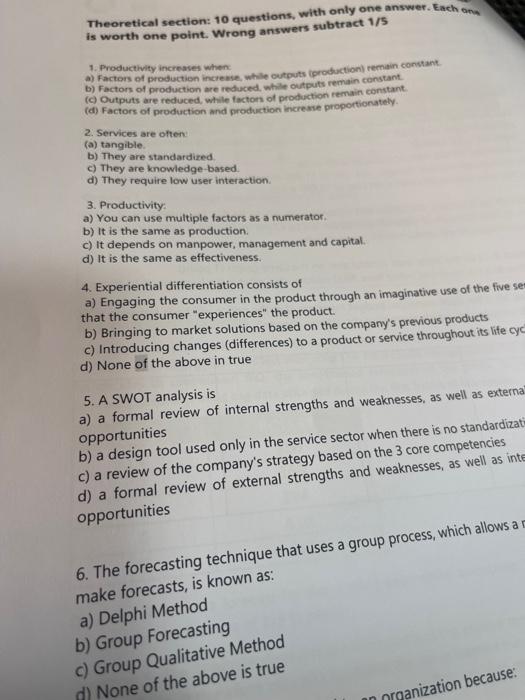
Theoretical section: 10 questions, with only one answer. Each onc is worth one point. Wrong answers subtract 1/5 1. Productivity increvases when: a) Factors of production increase, while outputs (production) remain constant: b) Factors of production are reduced. while outputs remain constant. (c) Outputs are reduced, while factors of production remain constant (d) Factors of production and production increase proportionately. 2. Services are often: (a) tangible. b) They are standardized c) They are knowledge -based. d) They require low user interaction. 3. Productivity: a) You can use multiple factors as a numerator. b) It is the same as production. c) It depends on manpower, management and capital. d) It is the same as effectiveness. 4. Experiential differentiation consists of a) Engaging the consumer in the product through an imaginative use of the five se that the consumer "experiences" the product. b) Bringing to market solutions based on the company's previous products c) Introducing changes (differences) to a product or service throughout its life cyc d) None of the above in true 5. A SWOT analysis is a) a formal review of internal strengths and weaknesses, as well as externa opportunities b) a design tool used only in the service sector when there is no standardizat c) a review of the company's strategy based on the 3 core competencies d) a formal review of external strengths and weaknesses, as well as inte opportunities 6. The forecasting technique that uses a group process, which allows a make forecasts, is known as: a) Delphi Method b) Group Forecasting c) Group Qualitative Method d) None of the above is true
Step by Step Solution
There are 3 Steps involved in it

Get step-by-step solutions from verified subject matter experts
 Study Help