







Question: Theory and computing Sigma = {a, b}, L = {w: c-1xc_2, x sum sigma^+, c_1, c_2 sum, c_1 not equal to c_2}. Note that c_1
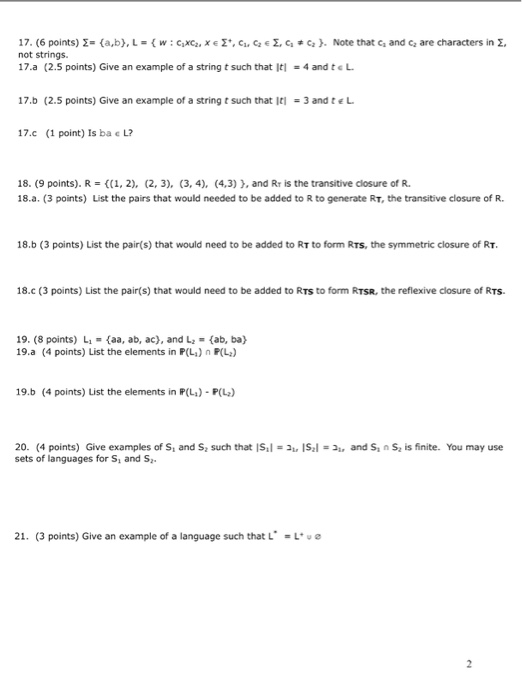
Sigma = {a, b}, L = {w: c-1xc_2, x sum sigma^+, c_1, c_2 sum, c_1 not equal to c_2}. Note that c_1 and c_2 are characters in not strings. Give an example of a string t such that |t| = 4 and t sum L. Give an example of a string t such that |t| = 3 and t sum L. Is ba L? R = {(1, 2), (2, 3), (3, 4), (4, 3)}, and R_T is the transitive closure of R. List the pairs that would needed to be added to R^T to generate R_TS, the transitive closure of R^T. List the pair(s) that would need to be added to R_T to form R_TS, the symmetric closure of R^T. List the pair(s) that would need to be added to R^TS to form R^TSR, the reflexive closure of R_TS. L_1 = {aa, ab, ac}, and L_2 = {ab, ba} List the elements in P(L_1) n P(L_2) List the elements in P(L_1) - P(L_2) Give examples of S_1 and S_2 such that |S_1| = 2_1, |S_2| = 2_, and S_1 intersection S_2 is finite. You may use sets of languages for S_1 and S_2. Give an example of a language such that L* = L* union phi
Step by Step Solution
There are 3 Steps involved in it

Get step-by-step solutions from verified subject matter experts
 Study Help