







Question: Theory: Let B , C , D be any sets, R , S be any relation. a ) Prove: If B CsubeD and C D
Theory:
Let be any sets, be any relation.
a Prove: If CsubeD and then
b Prove: If then BsubeC.
c Disprove: If on is transitive and on is transitive, then on is transitive.
Note: All proofs must be done using the sets definitions given in the notes.
A Venn Diagram is not a proof and will not earn you part marks.Application:
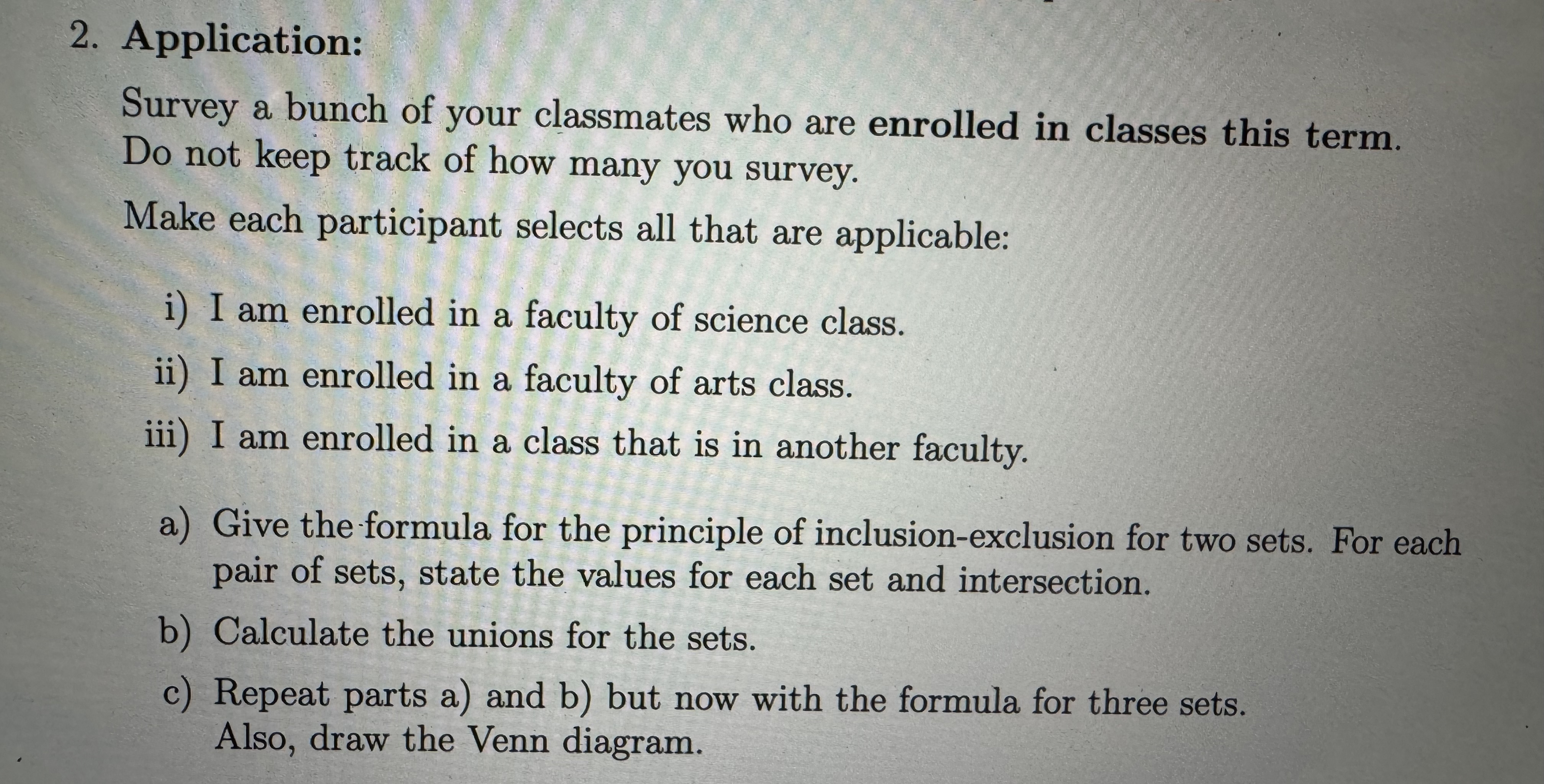
Survey a bunch of your classmates who are enrolled in classes this term. Do not keep track of how many you survey.
Make each participant selects all that are applicable:
i I am enrolled in a faculty of science class.
ii I am enrolled in a faculty of arts class.
iii I am enrolled in a class that is in another faculty.
a Give the formula for the principle of inclusionexclusion for two sets. For each pair of sets, state the values for each set and intersection.
b Calculate the unions for the sets.
c Repeat parts a and b but now with the formula for three sets. Also, draw the Venn diagram.
Step by Step Solution
There are 3 Steps involved in it
1 Expert Approved Answer
Step: 1 Unlock

Question Has Been Solved by an Expert!
Get step-by-step solutions from verified subject matter experts
Step: 2 Unlock
Step: 3 Unlock
 Study Help