







Question: There are FOUR (4) questions in this section. Answer ALL questions in the answer booklet. . How Working Conditions and Attitudes Have Changed Due to
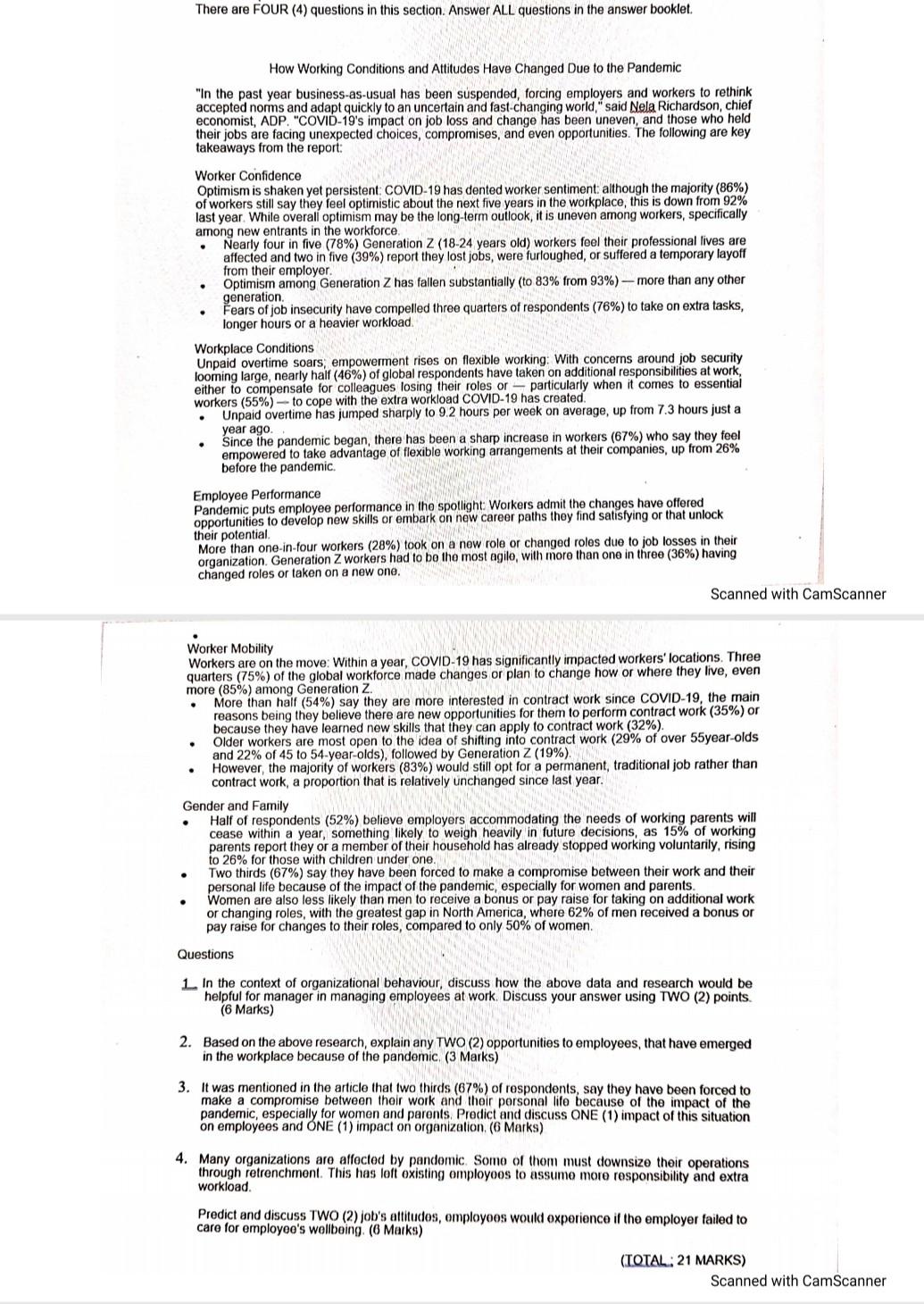
There are FOUR (4) questions in this section. Answer ALL questions in the answer booklet. . How Working Conditions and Attitudes Have Changed Due to the Pandemic "In the past year business-as-usual has been suspended, forcing employers and workers to rethink accepted norms and adapt quickly to an uncertain and fast-changing world," said Nela Richardson chief economist, ADP. "COVID-19's impact on job loss and change has been uneven, and those who held their jobs are facing unexpected choices, compromises, and even opportunities. The following are key takeaways from the report: Worker Confidence Optimism is shaken yet persistent: COVID-19 has dented worker sentiment: although the majority (86%) of workers still say they feel optimistic about the next five years in the workplace, this is down from 92% last year. While overall optimism may be the long-term outlook, it is uneven among workers, specifically among new entrants in the workforce. Nearly four in five (78%) Generation 2 (18-24 years old) workers feel their professional lives are affected and two in five (39%) report they lost jobs, were furloughed, or suffered a temporary layoff from their employer Optimism among Generation Z has fallen substantially (to 83% from 93%) - more than any other generation Fears of job insecurity have compelled three quarters of respondents (76%) to take on extra tasks, longer hours or a heavier workload Workplace Conditions Unpaid overtime soars, empowerment rises on flexible working: With concerns around job security looming large, nearly half (46%) of global respondents have taken on additional responsibilities at work, either to compensate for colleagues losing their roles or particularly when it comes to essential workers (55%) - to cope with the extra workload COVID-19 has created Unpaid overtime has jumped sharply to 9.2 hours per week on average, up from 7.3 hours just a year ago Since the pandemic began, there has been a sharp increase in workers (67%) who say they feel empowered to take advantage of flexible working arrangements at their companies, up from 26% before the pandemic. Employee Performance Pandemic puts employee performance in the spotlight Workers admit the changes have offered opportunities to develop new skills or embark on new career paths they find satisfying or that unlock their potential More than one-in-four workers (28%) took on a new role or changed roles due to job losses in their organization Generation Z workers had to be the most agile, with more than one in three (36%) having changed roles or taken on a new one. Scanned with CamScanner Worker Mobility Workers are on the move: Within a year, COVID-19 has significantly impacted workers' locations. Three quarters (75%) of the global workforce made changes or plan to change how or where they live, even more (85%) among Generation Z. More than half (54%) say they are more interested in contract work since COVID-19, the main reasons being they believe there are new opportunities for them to perform contract work (35%) or because they have learned new skills that they can apply to contract work (32%). Older workers are most open to the idea of shifting into contract work (29% of over 55year-olds and 22% of 45 to 54-year-olds), followed by Generation Z (19%). However, the majority of workers (83%) would still opt for a permanent, traditional job rather than contract work, a proportion that is relatively unchanged since last year. Gender and Family Half of respondents (52%) believe employers accommodating the needs of working parents will cease within a year, something likely to weigh heavily in future decisions, as 15% of working parents report they or a member of their household has already stopped working voluntarily, rising to 26% for those with children under one. Two thirds (67%) say they have been forced to make a compromise between their work and their personal life because of the impact of the pandemic, especially for women and parents. Women are also less likely than men to receive a bonus or pay raise for taking on additional work or changing roles, with the greatest gap in North America, where 62% of men received a bonus or pay raise for changes to their roles, compared to only 50% of women. . Questions 1 In the context of organizational behaviour, discuss how the above data and research would be helpful for manager in managing employees at work. Discuss your answer using TWO (2) points. (6 Marks) 2. Based on the above research, explain any TWO (2) opportunities to employees, that have emerged in the workplace because of the pandemic (3 Marks) 3. It was mentioned in the article that two thirds (67%) of respondents, say they have been forced to make a compromise between their work and their personal life because of the impact of the pandemic, especially for women and parents Predict and discuss ONE (1) impact of this situation on employees and ONE (1) impact on organization. (6 Marks) 4. Many organizations are affected by pandemic Some of thom must downsize their operations through retrenchment. This has loft oxisting employoos to assume more responsibility and extra workload. Predict and discuss TWO (2) job's attitudos, employoos would oxperience if the employer failed to care for employee's wellbeing. ( Marks) (TOTAL: 21 MARKS) Scanned with CamScanner
Step by Step Solution
There are 3 Steps involved in it
1 Expert Approved Answer
Step: 1 Unlock

Question Has Been Solved by an Expert!
Get step-by-step solutions from verified subject matter experts
Step: 2 Unlock
Step: 3 Unlock
 Study Help