







Question: There are several block error correction codes that make a decision on the basis of minimum distance. That is , given a code consisting of
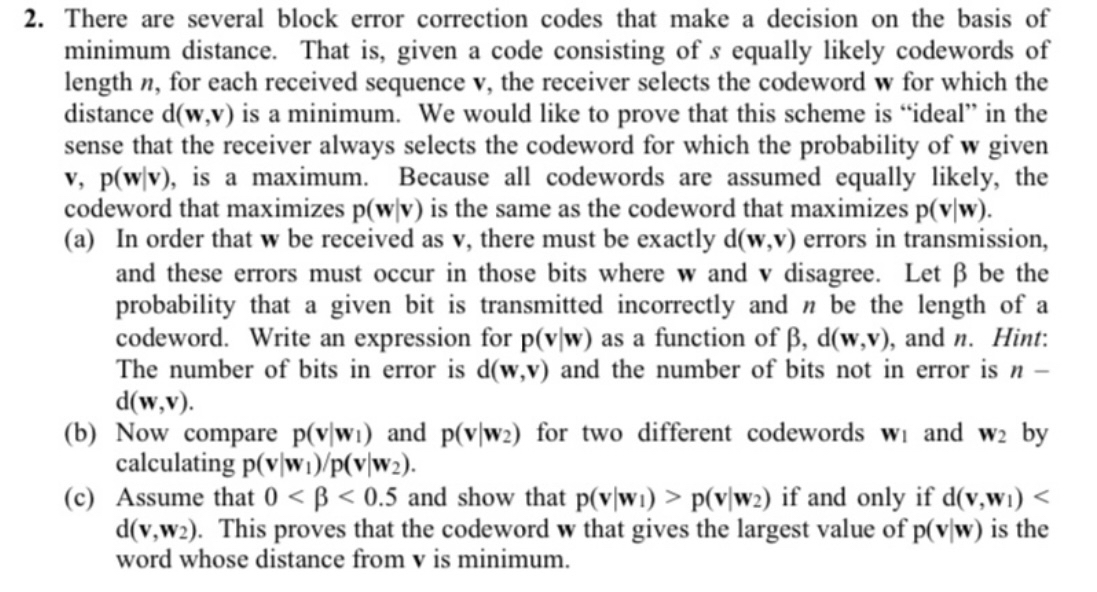
There are several block error correction codes that make a decision on the basis of minimum distance. That is given a code consisting of equally likely codewords of length for each received sequence the receiver selects the codeword for which the distance is a minimum. We would like to prove that this scheme is "ideal" in the sense that the receiver always selects the codeword for which the probability of given is a maximum. Because all codewords are assumed equally likely, the codeword that maximizes is the same as the codeword that maximizes
a In order that be received as there must be exactly errors in transmission, and these errors must occur in those bits where and disagree. Let be the probability that a given bit is transmitted incorrectly and be the length of a codeword. Write an expression for as a function of and Hint: The number of bits in error is and the number of bits not in error is
b Now compare and for two different codewords and by calculating
c Assume that and show that if and only if This proves that the codeword that gives the largest value of is the word whose distance from is minimum.
Step by Step Solution
There are 3 Steps involved in it
1 Expert Approved Answer
Step: 1 Unlock

Question Has Been Solved by an Expert!
Get step-by-step solutions from verified subject matter experts
Step: 2 Unlock
Step: 3 Unlock
 Study Help