







Question: There are three Container Models 20 container 40 container HIGH CUBE 40 container, we'll start with the first, the 20container, which is appropriate for low-volume
There are three Container Models 20 "container 40 "container HIGH CUBE 40 container, we'll start with the first, the 20"container, which is appropriate for low-volume item transportation. The load capacity that we can travel varies depending on the type of solar panel that we transport (60 cells / 72 cells). For panels with 60 cells, we have a load capacity of roughly 400 panels, which equates to roughly 12-13 pallets depending on the size of the solar panels being transported. For panels with 72 cells, we can ship around 290 panels, or around 9-10 pallets of solar panels. The second type, 40 "container, would be recommended for "groupage" orders, i.e., if we are unable to complete the total capacity from only one type, we could group with other orders. We can transport 896 panels spread among 28-29 pallets for 60cels modules. The 72 cell panels that will fit in our container are made up of 716 pieces divided into 24-25 pallets. Finally, the HIGH CUBE 40 container "is the container mastodon, because several of them reach up to 45." It has the same qualities as 20" and 40" containers, with the exception that they are higher, allowing us to pack a larger order inside the container depending on the sort of products we transport and its weight. Finally, the HIGH CUBE 40 container "is the container mastodon, because several of them reach up to 45." It has the same qualities as 20" and 40" containers, with the exception that they are higher, allowing us to pack a larger order inside the container depending on the sort of products we transport and its weight. Prior to transportation, solar panels are usually placed in a box or crate. They can be stacked horizontally or vertically, depending on the panel's dimensions and how they're positioned in the box. Cushioned separators should be used between each unit in the box. Before putting the units in the box, you might want to use corner cushions on each one. Separators are particularly crucial since poor packaging might result in product harm. Solar panels stacked horizontally without the proper separators or cushion can cause microcracks and other issues. The box or crate should then be secured to a shipment pallet. Shipping pallets are basically platforms that are used to move and store freight. Pallets are available in a variety of sizes, the most common of which is 40 inches by 48 inches. Depending on the size of the panels, you might be able to fit 30 on a pallet. Pallets can weigh up to 4,000 pounds and be stacked up to6-feet tall. Each First Solar packing package contains 50 modules as well as internal support material. A fully loaded package for a 50-module pack weights up to 665 kg (1466) for planning reasons. Variations in packaging and wrapping may result in somewhat lower actual weights. The box comes with a built-in pallet for forklift transport. All boxes should be dry and filled full of modules and support material to retain the intended strength. The modules and interior support material are critical to the packaging's strength. When full, intact, and dry, the boxes can be vertically stacked indoors for lengthy periods of time up to four boxes high. If any of the modules or support materials are taken from the box, or if the box becomes damaged or damp, the boxes should not be stacked in any way. Details on box packaging a. Modules will be packaged in 50-pack module cartons. c. A single Model Number will be assigned to all modules within a box. c. First Solar will make commercially reasonable efforts to send only full containers or truck loads. d. Typical container volumes (for planning purposes only; real sizes may differ according to local load limits or shipment locations) Dimensions of the General Box: Length: 1372 mm (54 in) Width: 1118 mm (44 in) 876 mm in height (34.5 in) Weight: No more than 665 kg (1466 lbs.)
Calculate the weight break in pricing for the different
modes of transport including the factors that affect
the shipping rates for each mode.
Supplier - Jinko Solar, Shanghai China
Delivery Destination - Brampton canada
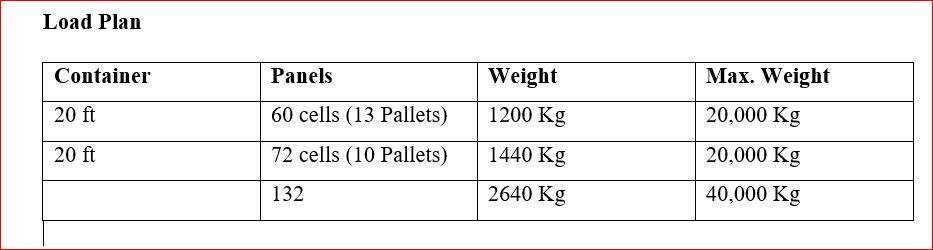
Load Plan Container Panels Weight Max. Weight 20 ft 60 cells (13 Pallets) 1200 Kg 20,000 Kg 20 ft 72 cells (10 Pallets) 1440 Kg 20,000 Kg 132 2640 Kg 40,000 Kg Load Plan Container Panels Weight Max. Weight 20 ft 60 cells (13 Pallets) 1200 Kg 20,000 Kg 20 ft 72 cells (10 Pallets) 1440 Kg 20,000 Kg 132 2640 Kg 40,000 KgStep by Step Solution
There are 3 Steps involved in it

Get step-by-step solutions from verified subject matter experts
 Study Help