







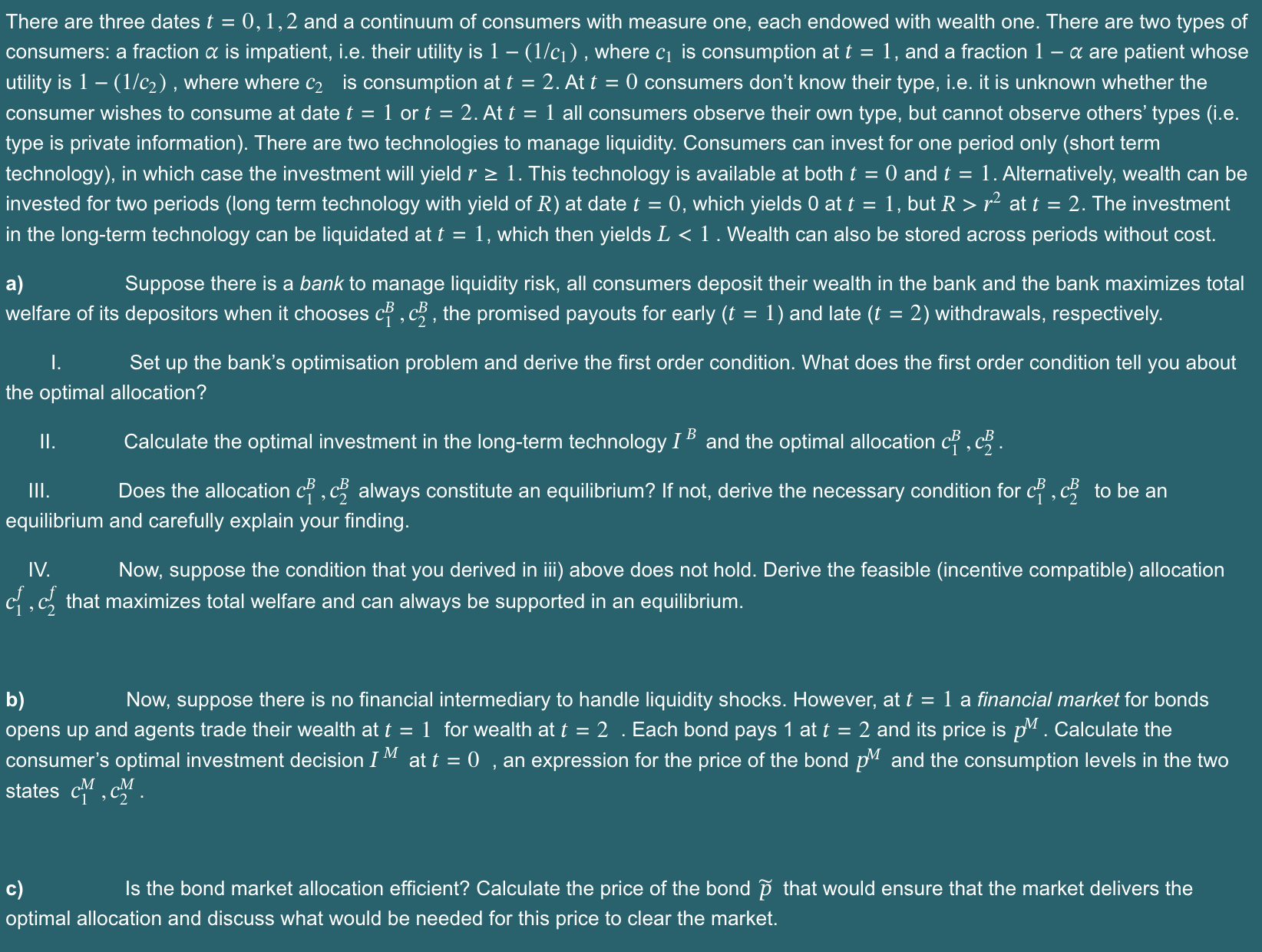
Question: There are three dates t = 0 , 1 , 2 a continuum of consumers with measure one, each endowed with wealth one. There are
There are three dates t a continuum of consumers with measure one, each endowed with wealth one. There are two types of these consumers, a fraction a is impatient, ie derive utility their utility is where is consumption at t and a fraction a are patient whose utility is where is consumption at t At tconsumers dont know their type, ie it is unknown whether the consumer wishes to consume at date t or t The investment in the longterm technology can be liquidated at t which then yields L Wealth can also be stored across pThere are three dates and a continuum of consumers with measure one, each endowed with wealth one. There are two types of
consumers: a fraction is impatient, ie their utility is where is consumption at and a fraction are patient whose
utility is where where is consumption at At consumers don't know their type, ie it is unknown whether the
consumer wishes to consume at date or At all consumers observe their own type, but cannot observe others' types ie
type is private information There are two technologies to manage liquidity. Consumers can invest for one period only short term
technology in which case the investment will yield This technology is available at both and Alternatively, wealth can be
invested for two periods long term technology with yield of at date which yields at but at The investment
in the longterm technology can be liquidated at which then yields Wealth can also be stored across periods without cost.
a Suppose there is a bank to manage liquidity risk, all consumers deposit their wealth in the bank and the bank maximizes total
welfare of its depositors when it chooses the promised payouts for early and late withdrawals, respectively.
I. Set up the bank's optimisation problem and derive the first order condition. What does the first order condition tell you about
the optimal allocation?
II Calculate the optimal investment in the longterm technology and the optimal allocation
III. Does the allocation always constitute an equilibrium? If not, derive the necessary condition for to be an
equilibrium and carefully explain your finding.
IV Now, suppose the condition that you derived in iii above does not hold. Derive the feasible incentive compatible allocation
that maximizes total welfare and can always be supported in an equilibrium.
b Now, suppose there is no financial intermediary to handle liquidity shocks. However, at a financial market for bonds
opens up and agents trade their wealth at for wealth at Each bond pays at and its price is Calculate the
consumer's optimal investment decision at an expression for the price of the bond and the consumption levels in the two
states
c Is the bond market allocation efficient? Calculate the price of the bond widetilde that would ensure that the market delivers the
optimal allocation and discuss what would be needed for this price to clear the market.eriods without cost. ii Calculate the optimal investment in the longterm technology and the optimal allocation
Step by Step Solution
There are 3 Steps involved in it
1 Expert Approved Answer
Step: 1 Unlock

Question Has Been Solved by an Expert!
Get step-by-step solutions from verified subject matter experts
Step: 2 Unlock
Step: 3 Unlock
 Study Help