





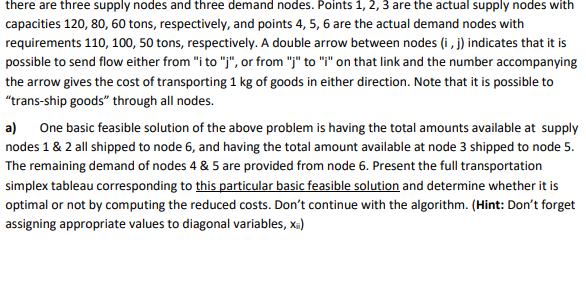
Question: there are three supply nodes and three demand nodes. Points 1, 2, 3 are the actual supply nodes with capacities 120, 80, 60 tons, respectively,
there are three supply nodes and three demandthere are three supply nodes and three demand

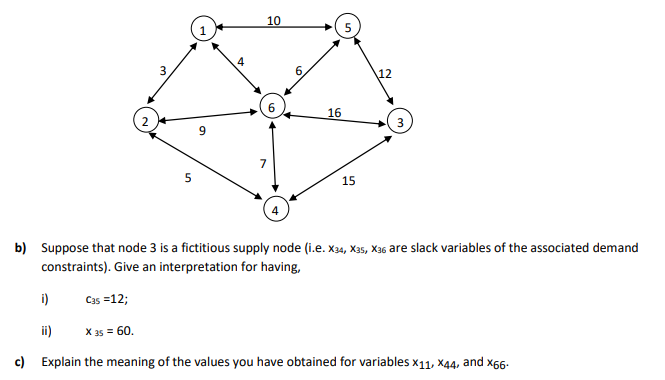
there are three supply nodes and three demand nodes. Points 1, 2, 3 are the actual supply nodes with capacities 120, 80, 60 tons, respectively, and points 4, 5, 6 are the actual demand nodes with requirements 110, 100, 50 tons, respectively. A double arrow between nodes (i, j) indicates that it is possible to send flow either from "i to "j", or from "j" to "1" on that link and the number accompanying the arrow gives the cost of transporting 1 kg of goods in either direction. Note that it is possible to "trans-ship goods" through all nodes. a) One basic feasible solution of the above problem is having the total amounts available at supply nodes 1 & 2 all shipped to node 6, and having the total amount available at node 3 shipped to node 5. The remaining demand of nodes 4 & 5 are provided from node 6. Present the full transportation simplex tableau corresponding to this particular basic feasible solution and determine whether it is optimal or not by computing the reduced costs. Don't continue with the algorithm. (Hint: Don't forget assigning appropriate values to diagonal variables, x) 10 1 4 3 6 12 16 2 3 9 9 7 15 4 b) Suppose that node 3 is a fictitious supply node (i.e. X34, X35, Xa6 are slack variables of the associated demand constraints). Give an interpretation for having, i) Cas =12; ii) X 35 = 60 c) Explain the meaning of the values you have obtained for variables X11, 444, and X66

Step by Step Solution

There are 3 Steps involved in it

1 Expert Approved Answer
Step: 1 Unlock blur-text-image

Question Has Been Solved by an Expert!

Get step-by-step solutions from verified subject matter experts

Step: 2 Unlock
Step: 3 Unlock

Students Have Also Explored These Related General Management Questions!