







Question: There are two sections as explained below. Provide answers to the following questions specified in the corresponding section. Section 1 : Inference Logic Exercise: Applying
There are two sections as explained below. Provide answers to the following questions specified in the corresponding section.
Section : Inference Logic Exercise: Applying Inference Rules marks
For each question, you are provided with a set of premises and a conclusion. Your task is to apply the appropriate inference rules to prove the conclusion based on the given premises. Clearly state the inference rules used in each step of your proof. Ensure that your proof follows a logical sequence and that each step is justified by the application of a valid inference rule.
Q Premises:
Conclusion: Q
Q Premises:
Conclusion: P
Q Premises: notP
Conclusion: Q
Q Premises: notR
Conclusion: notP
Q Premises: notR
Conclusion: notQ
Q Premises: notR,
Conclusion: S
Q Premises: not
Conclusion: notP
Q Premises: notR
Conclusion:
Q Premises:
Conclusion:
Q Premises: notR
Conclusion: notPvvnotQ
Note: Submit your solutions with clear explanations for each step, indicating the inference rules applied. Ensure clarity, coherence, and correctness in your proofs. Use proper notation and formatting to present your proofs.
Description:
Classic planning in artificial intelligence involves generating a sequence of actions to achieve a desired goal state from an initial state, adhering to specified constraints and preconditions. In this assignment, you will be presented with a classic planning problem scenario, and you will use inference rules to deduce the sequence of actions required to accomplish the task.
Scenario:
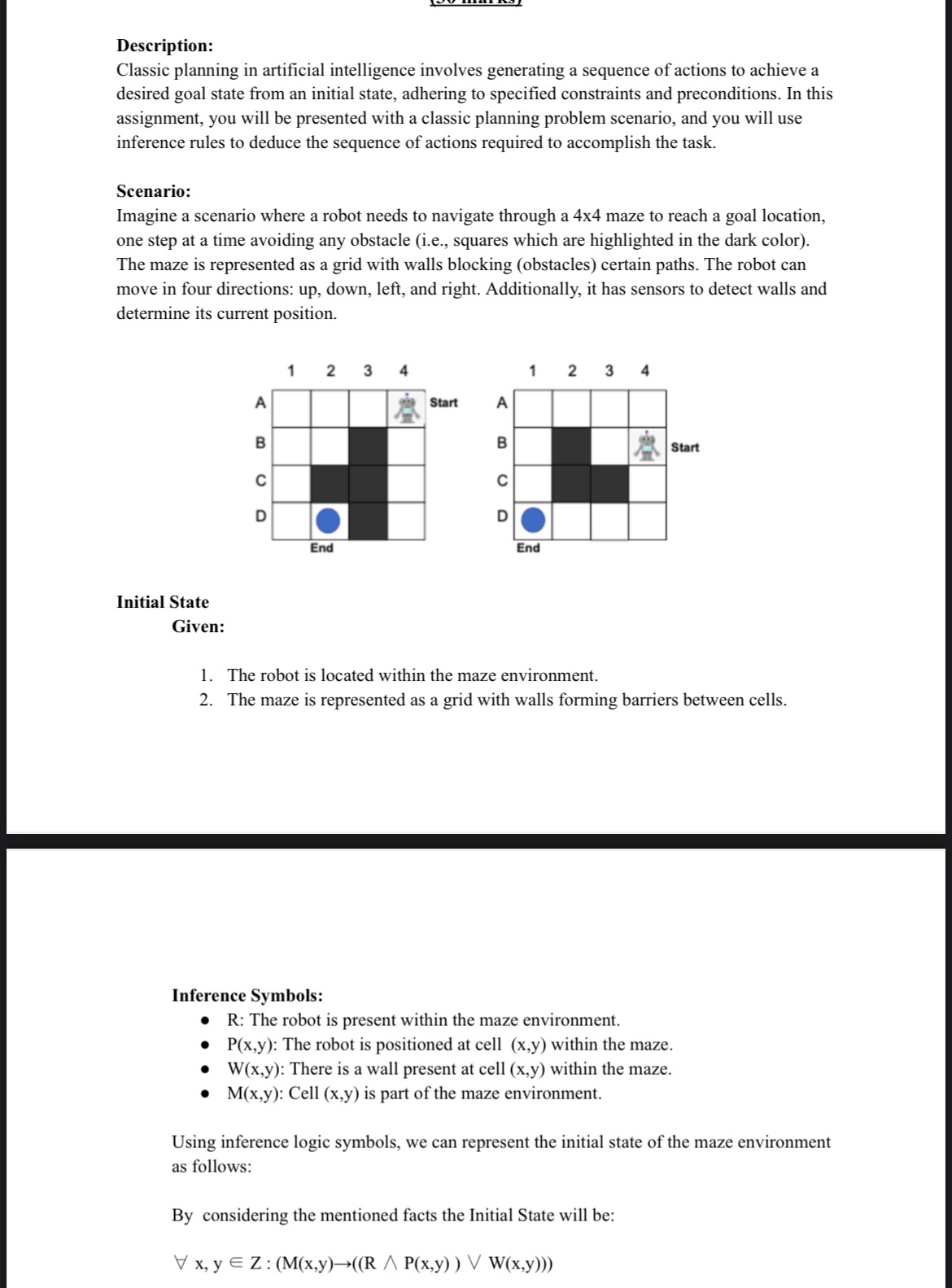
Imagine a scenario where a robot needs to navigate through a x maze to reach a goal location, one step at a time avoiding any obstacle ie squares which are highlighted in the dark color The maze is represented as a grid with walls blocking obstacles certain paths. The robot can move in four directions: up down, left, and right. Additionally, it has sensors to detect walls and determine its current position.
Initial State
Given:
The robot is located within the maze environment.
The maze is represented as a grid with walls forming barriers between cells.
Inference Symbols:
R : The robot is present within the maze environment.
: The robot is positioned at cell within the maze.
Wxy: There is a wall present at cell within the maze.
: Cell is part of the maze environment.
Using inference logic symbols, we can represent the initial state of the maze environment as follows:
By considering the mentioned facts the Initial State will be:
AAx,yinZ:
Step by Step Solution
There are 3 Steps involved in it
1 Expert Approved Answer
Step: 1 Unlock

Question Has Been Solved by an Expert!
Get step-by-step solutions from verified subject matter experts
Step: 2 Unlock
Step: 3 Unlock
 Study Help